Author: Admin

  • The State of the Male Workforce in Mongolia

    The State of the Male Workforce in Mongolia

    I remember there were a podcast called “Where are the Mongolian men?” hosted by three men. Three hosts worked in a corporate sector. They have claimed that everywhere they go, in the office, restaurants, networking events, different clubs and training, there were always women outnumbering the men. Hence, they have started a podcast to discuss this issue. 

    According to the study the state is one of the major employers in Mongolia, especially in the rural provinces. One out of five people in Mongolia are employed by the state. Head of the government agencies are dominated by men. 
    There are around 120 state owned enterprises, if the subsidiary and local government owned enterprises will be added this number will rocket to 450. Men are dominantly working in these state-owned enterprises. It is not a secret that recruiting process of ministries, government agencies and state-owned enterprises are very different than the private enterprises. Private enterprises have largely merit based recruiting system. Candidates have to pass the interview and exam to get into the big company, whereas in the state-owned enterprise connection is more important than the candidates’ education and skills. This connection-based system allows a number of incompetent workforces to easily get a job.
    Majority of Mongolian men are heavily interested in politics. Therefore, most of them see state enterprises as a ladder to the political leadership role. It is public knowledge that the heads of the state-owned enterprises are appointed by a political party. 
    The rest, who are not aspiring to the political leadership role, stays in the organization even if they dislike the job. The main reason is they are aware that, if they lose this job, they will face hard time to get another one as they have poor skills and qualifications. 

    For both government agencies and corporate sector, in the office environment men are either at the top or the bottom. Middle positions are dominated by women. That’s why women seem to be everywhere in the corporate world. 
    Educated and skilled Mongolian men are predominantly working in construction, mining and energy sectors in the home country. Rest is the business owners. If we look into the number of medical professionals of Mongolia, men comprise only around 20%, which is a huge gap. 

    Men, who have no connection to government agencies and state-owned enterprises among others, choose to go abroad and work there. Working abroad allows men to earn a decent salary to build their life. Today approximately 55,000 Mongolians are residing in South Korea, from which 37,000 are contracted workers. It is the number one destination for Mongolians. Consequently, South Korea is the largest country with bilateral social security agreement with Mongolia, where Mongolians are granted an option to be covered by Mongolian social insurance. It is not clear when will the outflow to South Korea cease, as the system sending the contractor workers is well established that even the legal regulations are in favor of it. 

    Another group of men are the men who are continuing the Mongolian heritage, undertaking a herding work. They regarded as a workforce in the agricultural sector. Herding is a hard work. Consequently, most herder families keep the boys to help with herding, while sending the girls to go to the university. It created a so-called reverse gender gap in education. 

    This is the overall picture of male workforce of Mongolia. They are either directors or a contract worker, they are a business owner or a herder. There are small number of doctors, software engineers and other specialists. Thus, there is need to support the male professionals and increase the number of highly skilled workforce.

    Tips to support existing male professionals:

    – Involve in professional training to upgrade their qualifications
    – Involve in other self-development training 
    – Provide clear career path
    – Provide incentives aside the salary, such as transportation and communication allowances
    – Provide attractive packages such as a health insurance.

    References:

    1. Agreement between Mongolia and the Republic of Korea on Social Security, the Ministry of Family, Labour and Social Protection, 2006
    2. Employment of Mongolians in South Korea and Changes of Foreign Labor Policy of South Korea,2024
    3. Gender bias in medicine: which countries have the most female doctors, the World Health Organization, 2023
    4. Mongolia’s Workforce in the Public Sector is 18.4%, Inside Mongolia, 2026
    5. Reports of State-owned enterprises, Agency for State Property Policy and Coordination,2023. 

  • Most of Mongolia’s Best Candidates Are Invisible. Lambda Is Changing That.

    Most of Mongolia’s Best Candidates Are Invisible. Lambda Is Changing That.

    Anywhere from 70% to 80% of professional roles are never advertised before they are filled. This figure could actually be higher in Mongolia. It is no secret. It is a common practice. And if you are a hiring manager, then it may be slowly draining away potential applicants you may never come across.

    The best professionals in Mongolia are usually off the radar. Not because of any skill deficiencies, but rather because they do not belong to the correct chat groups or networking events in the city of Ulaanbaatar. They are out there somewhere, and yet the market never sees them.

    The comfort of the small circle, and why it is not enough

    In a simple term, Mongolia’s professional network is compact. When a leadership or specialist role opens, it’s usually the same scenario for many places. They call a few people they trust and ask who they know. Those people are often already employed, known, or being chased by someone else. The pool looks busy but it is certainly shallow.

    It makes total sense that this approach is prevalent and it’s not because of laziness. It came from logic. In a market where salaries are opaque and credentials can be inflated, a referral feels safe. The person vouching has a reputation in the game. That is the real value.

    Unfortunately, the same small group of candidates gets approached again and again. Their salary expectations inflate and the thousands of capable people who are not in that circle stay invisible, including people in Darkhan or Erdenet city, Mongolians quietly returning from years abroad, and professionals who simply never learned how or never had the time to network in the right rooms.

    The market is bigger than it feels

    But the facts paint a completely different picture. For example, Mongolia boasts 2.8 million Internet users. And that is only the number of people registered on LinkedIn. This number exceeds half a million profiles belonging to residents of the country. That figure does not even take into consideration the individuals whose information needs updating, as well as those people who have never used social networking sites like LinkedIn at all.

    The old way worked when the economy was simpler and everyone knew everyone. But Mongolia’s private sector is changing. Fintech, logistics, professional services, and technology are growing. They need skills that did not exist in the local market a decade ago. You cannot fill a niche compliance role or a data leadership position by asking your old classmate if he knows someone. You need to see a bigger picture.

    What Lambda.Global is doing about it

    Lambda.Global was not built to be a job board. A job board lists vacancies. It does not solve the problem of who gets seen. Lambda works the other way around. It all begins with the talent pool, but with the help of data, it connects the right individuals to the right opportunities, no matter whether these two never would have met under normal circumstances. This results in three things being done differently.

    Lambda.Global keeps a running map of professionals across sectors, locations, and experience levels, including Mongolians abroad who are open to working here but have no obvious way to wave their hand and say “I exist”. That alone changes a hiring conversation before it even begins.

    Then there’s the money question. In a market where salary talks often collapse because nobody knows what’s real, Lambda pulls compensation data from actual placements, not from surveys that have been sitting in a drawer for two years. Therefore, both sides can show up with numbers they can defend, not numbers they pulled from nowhere. A lot of good matches die simply because someone guessed wrong. Lambda makes guessing less necessary.

    And when it’s time to find the person, the platform uses AI not to judge who is best, but to pull forward candidates who actually fit. It means the search stops being about who you already know and starts being about who you should be talking to. Lambda’s own placement data backs this up. Roles that are posted with clear pay ranges and an open search scope fill about twice as fast as the ones that still run on the old model.

    Another part worth paying attention to is who finally gets considered. People who would never have landed on a referral shortlist start showing up in final interviews. That’s not a minor improvement. It’s a different hiring market entirely.

    Let’s take an example where a Mongolian manufacturing firm needed a lead role. The role had been empty for several months. The CEO had exhausted every contact he had, but someone on his team suggested Lambda. Within a few weeks, the platform surfaced a candidate the CEO had never heard of. The candidate was not in any chat group and he was not on anyone’s referral list. He took the job. This is not technology saving the day. It is seeing what was already there. The talent did not appear because Lambda created it. It appeared because Lambda made it visible.

    Moreover, Lambda.Global is not trying to kill referrals. Referrals will always matter and they should. What Lambda is doing is putting data and transparency alongside personal relationships, so the referral is not the only door. So a company can still trust its network while also growing it.

    Lambda.Global gives companies a map of the talent that is actually out there, not just the talent that happens to be in the same group. Mongolia’s hiring problem is not a shortage of capable people. It is a habit of looking in the same small places and pretending that is the whole market. Breaking that habit does not require a revolution. It requires a decision that can be made tomorrow morning.

    References

    • Internet penetration: Mongolia has approx. 2.8 million internet users (DataReportal, Digital 2025 Mongolia).
    • LinkedIn profiles in Mongolia: over 550,000 active professionals
    • Lambda.Global internal placement data (2025–2026)
    • World Bank, Skills demand in Mongolia: Main Findings of the Skills Module of the Barometer Survey (2022)
  • The C-Suite Squeeze in Mongolia

    The C-Suite Squeeze in Mongolia

    Why Mongolia’s Executive Talent Market Is Tighter Than Any Salary Number Suggests

    When a senior executive role opens at a mid-sized Mongolian company today, the hiring team faces a challenge that did not exist a decade ago. It is not that qualified candidates are impossible to find. It is that the definition of ‘qualified’ has fundamentally shifted, and many organizations are still evaluating candidates against criteria that no longer match the roles they are trying to fill.

    Mongolia’s C-suite talent market in 2025 is tighter, more competitive, and more technically demanding than at any point in the country’s post-transition economic history. Understanding why and what companies can do about it matters far beyond any single hiring decision.


    The Numbers Behind the Squeeze

    Start with compensation, because it tells the story quickly. Average monthly salaries for senior management in Mongolia now sit around 4.37 million MNT, roughly $1,250 at current exchange rates. But that number is almost misleading in isolation. In Mongolia’s banking sector, C-suite executives at major institutions like Khan Bank, Golomt, and TDB command between 15 and 30 million MNT per month, plus performance bonuses, housing allowances, and, in some cases, international schooling coverage for families. In mining, still the economy’s dominant force, C-suite total annual compensation at operations tied to Oyu Tolgoi and major coal projects can exceed 400 to 600 million MNT, inclusive of bonuses.

    The finance sector tells a more specific story. A seasoned CFO who can operate across both Mongolian regulatory requirements and international accounting standards, IFRS, Basel III, AML/KYC frameworks, can command 90 to 150 million MNT annually. The problem is not that companies refuse to pay that figure. The problem is that there are not enough people who can credibly do the job at that level.

    The pool of executives with deep boardroom experience in Mongolia remains small. Every qualified placement carries significant weight.

    Executive base salaries across sectors grew 8 to 12 percent on average between 2024 and 2025. That growth rate, while positive, still trails comparable emerging markets in Southeast Asia. Vietnam and Indonesia, often cited as peer comparators, are seeing faster compensation escalation partly because they have larger domestic talent pools that create genuine competitive pressure. Mongolia’s market is moving, but it is moving slowly relative to the demand it now faces.


    What Companies Are Actually Looking For And Not Finding

    The shift in what defines a strong executive hire is worth examining directly, because it explains why the shortage feels so acute even when the labor market technically contains experienced professionals.

    Ten years ago, the profile of a successful Mongolian executive was largely defined by two things: deep sector knowledge and strong domestic relationships. A bank branch manager with 20 years of experience and a reliable network was a credible candidate for a regional director role. That model worked in a relatively closed, relationship-driven economy.

    Today, that profile is necessary but not sufficient. The modern Mongolian executive candidate needs to layer international competency on top of local fluency. Banks are integrating with global compliance systems. Mining operations are reporting ESG metrics to international lenders. Fintech companies — LendMN, AND Global, HiPay, and Ard App are building products that compete regionally. Every one of these contexts requires a leader who can read a room in Ulaanbaatar and a term sheet in Singapore.

    The skills in shortest supply right now are specific: financial executives with genuine IFRS and investor relations experience, technology leaders who understand both product development and regulatory risk, operations executives who can manage large Mongolian workforces while satisfying the governance requirements of international joint venture partners. These are not entry-level gaps. They are senior-level gaps, the hardest and most expensive kind to fill.


    The Returnee Opportunity – Real, But Overestimated

    The most discussed solution to this gap is the returnee pipeline: Mongolians who studied and worked abroad in South Korea, Australia, Singapore, or the United States, and are now returning to Ulaanbaatar with global-standard experience and negotiation confidence.

    This pipeline is real. It is growing. And it is genuinely changing the composition of senior leadership in certain sectors, particularly fintech and financial services. Companies actively recruiting from this pool are offering expatriate-style packages to compete with housing stipends, travel budgets, and international schooling for childrenprecisely because returnees have an honest alternative in the markets they are being asked to leave.

    But the returnee pipeline is also overestimated as a near-term solution. The total pool is limited. Many returnees are mid-career, not yet ready for C-suite mandates. Others are selectively returning, taking roles at organizations they personally respect, not necessarily at companies most desperate to fill leadership gaps. And a meaningful portion hesitate to return at all, citing concerns about market stability, governance culture, and limited professional development infrastructure once they arrive.

    79% of Mongolian executives rate professional development and global exposure as top motivators — often ranking above salary increases.

    That statistic, from Higher Careers’ 2025 research, is worth sitting with. The companies winning the executive talent competition in Mongolia right now are not always the ones paying the most. They are the ones offering a career trajectory that a serious professional actually wants: international exposure, governance autonomy, and the sense that their work will have measurable institutional impact.


    A Structural Problem Requiring a Structural Response

    The organizations that treat Mongolia’s executive talent shortage as a recruiting problem will keep losing. Post a role, receive thin applications, extend an offer, get declined, repeat. That cycle is expensive, time-consuming, and demoralizing for everyone involved.

    The organizations making progress are treating it as a pipeline problem, which requires a different set of actions. Internal succession planning that identifies and deliberately develops mid-career managers three to five years before they need to fill senior roles. Structured mentorship that pairs domestic professionals with returning or expatriate executives. Compensation architecture that goes beyond base salary to include long-term incentives,phantom shares, retention bonuses, and performance-linked equity that signal genuine organizational confidence in a leader’s tenure.

    Externally, specialized executive search is no longer a luxury reserved for multinationals. In a market this small and this competitive, the difference between a structured headhunting process and a word-of-mouth hire is often the difference between finding the person who can do the job and settling for the available person. Lambda.Global’s approach to executive search in the Mongolian market is built precisely on this premise: the best candidates for most senior roles in Mongolia are not actively looking. They need to be found, evaluated properly, and offered a compelling reason to move.


    The Opportunity Side of This Story

    It would be incomplete to describe Mongolia’s executive hiring market purely as a crisis. There is a genuine opportunity embedded in the scarcity. For Mongolian professionals who have invested in building international-standard competence through education, through cross-sector experience, through deliberate skill development, the demand has never been higher. Senior finance, technology, and operations roles are commanding compensation that competes with regional markets. Organizations are offering development programs and governance roles that did not exist five years ago.

    The next generation of Mongolian C-suite leaders will be defined by something their predecessors were rarely asked to demonstrate: the ability to operate simultaneously in Mongolian and global professional registers, to hold both relationship networks and technical rigor, to lead organizations that are growing in complexity faster than the leadership pipeline that is supposed to serve them.

    That is a hard set of capabilities to build. It is also why the executives who possess them, and the companies that know how to find them, will disproportionately shape what Mongolia’s economy looks like in a decade.

  • They Came Back to Mongolia for the Salary. They Stayed for Something Else.

    They Came Back to Mongolia for the Salary. They Stayed for Something Else.

    Bilguun left for Singapore in 2014. He was 24 when he left and he had a finance degree from a university in Ulaanbaatar city that nobody outside Mongolia had heard of. For seven years he climbed in a foreign land. He began working with a local bank, followed by a startup, and ended up doing business across three countries. By 2023, he was earning what those back home that he grew up with would only earn in ten years.

    In a surprising turn of events, he moved back to Mongolia last November. Not for family, not because he got pushed out. He moved back because a Mongolian company offered him something that surprised even him. Not a fancy title, not a company car, not a salary that matched Singapore dollar for dollar. None of that was on the table when he got the offer. What they offered was a real authority where he could rebuild a broken finance function however he saw fit. The CEO told him “You’ll have my ear and my backing. The rest is yours.” He took the job before they even finished negotiating the bonus salary.

    I am telling this story because it says something about Mongolia’s job market that most compensation surveys miss. We still have a gap between what executives earn in Mongolia and what their equivalent roles pay in Singapore, Australia, or Korea. Let’s say a senior finance director in UB will bring home 25 to 45 million tugriks a month. Their counterpart in a foreign country makes two or three times that, sometimes more. Money is always part of the conversation. But it’s rarely the whole conversation.

    The Ministry of Labour’s own mid-term labour forecast from 2024 showed something interesting. Within highly skilled Mongolians abroad, the top reason for considering a return to Mongolia was not a competitive salary, but a meaningful work with decision-making power. According to the info, salary came third on the list after career progression. When I first read that, it felt counterintuitive to me. But then I thought about Bilguun and it started making sense.

    What changes when someone reaches the senior level

    Early-career employees need money. They have student loans, young families, rent, etc. But by the time someone is being recruited for a director-level role or above, the arithmetic changes. What keeps them up at night is not the difference between a 20 million and a 25 million tugrik package. It’s the fear of being positioned in a role where they have the title but not the tools. They may spend six months fighting approvals, waiting for decisions that never come, and end up watching their credibility fade because nobody empowered them to actually lead.

    In a small professional market like this city, that reputation damage is permanent. Word gets around. A story about a senior hire who gets hired with fanfare and leaves quietly six months later because they couldn’t get anything done will keep following them. So experienced professionals ask harder questions in interviews. They are required to know who controls budget, who hires their team, whether the board actually wants change or just wants to announce it for the day. Companies that cannot answer those questions clearly lose the candidate.

    What the data quietly shows

    According to a skills survey carried out by the World Bank in 2022, Mongolian employers consider soft skills such as reliability and communication to be more crucial than technical skills. However, the same applies when senior professionals are picking their employers, based on factors like vision and leadership.

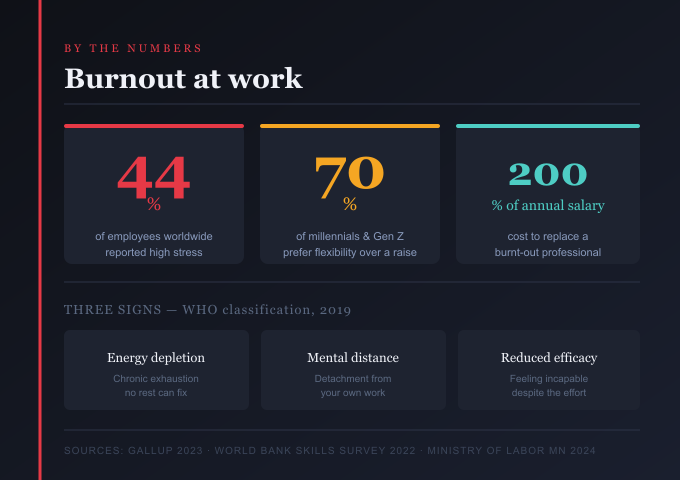
    And then there’s the flexibility piece. More than 70 percent of Gen Z and Millennial professionals globally say they value flexibility over a small salary bump. In Mongolia, that number is harder to pin down with precision, but anyone who spends time talking to candidates in the 30-45 age bracket will hear a version of it. They don’t want to be chained to a desk in Central Tower for appearance’s sake. They want to work where the work happens and be judged by output, not attendance. That mindset shift is already here. The companies ignoring it are quietly losing access to the very people they say they need most.

    Where Lambda.Global fits into this

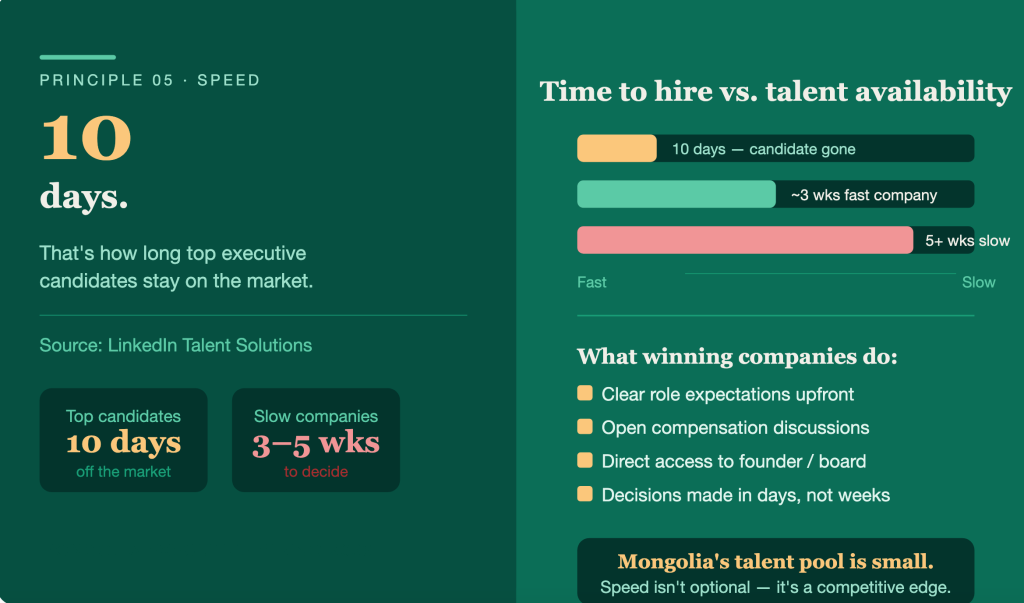
    At Lambda.Global, we see this play out in near real time. The platform surfaces not just who is looking, but what they’re actually looking for. Roles that clearly articulate decision-making authority and offer genuine flexibility fill noticeably faster than roles that offer a slightly higher salary but give vague answers about their “scope”. It’s a huge difference between a role sitting open for three months versus being filled in three weeks.

    The other thing the data makes plain is how much talent is simply invisible to traditional network-based hiring. A Mongolian professional who has spent eight years in Seoul or Sydney doesn’t show up at the usual Ulaanbaatar city networking drinks. They’re not in the group chats that produce the same shortlists. Lambda.Global helps companies get past their own limited Rolodex and actually see the wider pool that surrounds them. Not as a database of CVs, but as a map of who is reachable and what it would take to bring them home.

    A different kind of negotiation

    If you’re a company trying to hire senior talent right now, some changes are needed to be made. Not because the old one is wrong. But because candidates have already changed. Before putting a number on the table, the company should know what a person can actually do in the role. Not what they’ve done in the past. But what they’ll be allowed to do with you. If that cannot be described that with confidence, the negotiation hasn’t even started yet.

    And if you’re a professional sitting abroad or sitting at home thinking about a move, please start asking those questions early. The companies worth your time will have answers. The rest will fumble and change the subject. That alone tells you everything.

    Mongolia’s talent market in 2026 isn’t suffering from a lack of capable people. It’s suffering from a mismatch between what is being offered and what senior professionals actually want. The gap is not about money first. It’s about trust, autonomy, and respect. The organizations that understand this are not only hiring faster. They’re building teams that stay.

    A big salary might open the door. But clarity about the job is what gets someone to walk through it.

    References

    1. Ministry of Labour and Social Protection / Research Institute of Labour and Social Protection, Labor Market of Mongolia: Mid-Term Demand and Supply Forecasting Study Report (2024) – diaspora return motivations.
    2. World Bank, Skills demand in Mongolia: Main Findings of the Skills Module of the Barometer Survey (2022) – employer rankings of soft vs. technical skills.
    3. Lambda.Global internal hiring platform insights (2025–2026) – observed time-to-fill patterns for roles with vs. without clearly defined authority and flexibility.
    4. General background, Youth Employment Forum highlights, Unread / ADB / Ministry of Labour and Social Protection (2025) – generational preference for flexibility.
  • AI Won’t Take Your Jobs of Mongolia. Someone Who Uses AI Will

    AI Won’t Take Your Jobs of Mongolia. Someone Who Uses AI Will

    Picture a hiring manager at a mid-sized Mongolian company. She has just posted a vacancy. Within 48 hours, 200 CVs land in her inbox. Except they didn’t come from 200 candidates. Most of them came from maybe 40 people who used AI to tailor each application to the specific job description, making everyone look like a perfect fit.

    This is where AI and hiring intersect in 2026, not in some distant future of robots doing interviews, but in small, practical, daily decisions that are quietly reshaping who gets seen, who gets hired, and who gets left behind. Mongolia is not immune. If anything, the country’s small talent market makes the stakes higher.


    What’s Actually Happening Right Now

    Three shifts are happening simultaneously, and they are moving faster than most HR teams in Ulaanbaatar realize.

    First: Candidates are using AI aggressively. ChatGPT, Claude, and a growing list of specialized tools can rewrite a CV in minutes, draft cover letters that mirror a company’s own language back at them, and coach applicants through interview prep with unsettling accuracy. Globally, the use of AI tools in job applications jumped 68% between 2023 and 2024. The same tools are available to anyone in Mongolia with a smartphone and a Wi-Fi connection. They are being used just unevenly.

    Second: Employers are adopting AI screening tools, but slowly and patchily. Globally, 87% of companies now use some form of AI in hiring. In Mongolia, adoption is real but uneven. Larger multinationals and mining operations with international HR standards are further ahead; local SMEs and state-adjacent organizations are largely still screening manually. The result is a divided hiring landscape where some candidates are filtered by algorithms before a human ever sees their name, while others are still relying on printed CVs sitting in stacks on someone’s desk.

    Third: This is the one most people miss. AI is changing what skills are actually worth hiring for. The shelf life of a technical skill in 2026 is shorter than it has ever been. Data entry, basic financial modeling, and standard report writing are not disappearing overnight, but they are depreciating. The skills becoming more valuable are the ones AI cannot easily replicate including judgment under pressure, the ability to turn data into decisions real organizations will actually act on, and in Mongolia’s relationship driven business culture the kind of trust built through shared experience and proven integrity.


    If You’re the One Hiring

    The immediate practical problem is signal collapse. When AI tools can make any candidate look compelling on paper, the CV becomes a less reliable filter than it already was. This is uncomfortable news for hiring teams that have always leaned on CV screening as the first gate, and in Mongolia, where formal hiring processes are still maturing across many organizations, the first gate is often the only gate.

    The response isn’t to dismiss CVs, it’s to move the real evaluation earlier and make it harder to fake. Structured first-round calls with specific scenario questions. Short practical assignments that reveal how someone actually thinks, not how well they can prompt an AI to describe their thinking. Reference conversations that go beyond “was this person employed here” and into what they were genuinely like under pressure.

    None of this is revolutionary. But in a market like Mongolia’s, where hiring timelines are often rushed, personal relationships substitute for process, and many companies simply do not have the internal HR infrastructure to run rigorous evaluations, the gap between companies that do this well and those that don’t is widening fast.


    If You’re the One Looking for a Job

    Here is the honest version of the AI and jobs conversation that most career advisors avoid: the threat is not that AI replaces your role. The threat is that someone in your field who uses AI competently outcompetes you for it.

    A financial analyst who uses AI to run scenario models in two hours instead of two days does not just do their job faster. They become a different kind of candidate, one who can take on a broader scope, engage at a more strategic level, and make a more compelling case for a senior role earlier in their career. That gap is already visible in how Mongolian fintech companies like LendMN and AND Global are evaluating talent: they are not just asking what you know, they are watching what you can produce with the tools available to you.

    The Mongolian professionals who will be most exposed over the next five years are not those in technical roles who sound vulnerable, such as coders, analysts, and junior accountants. It is the people in mid-level roles whose value proposition has always been “I know how things work here” without continuing to build new capabilities on top of that local knowledge. Institutional memory is valuable. Institutional memory plus the ability to work faster and smarter than a year ago is irreplaceable.


    The Part That’s Specific to Mongolia

    Mongolia’s professional culture has always placed enormous weight on relationships, on who you know, on shared institutional history, on the trust that comes from years of working alongside someone. That is not going away, and AI cannot replicate it. In fact, as AI homogenizes the surface layer of hiring, making CVs look more similar, making first interviews more polished, the differentiation shifts further toward the things that cannot be faked, such as reputation, judgment, and the specific credibility that comes from having done hard things in a small community where everyone notices.

    This is both a comfort and a warning. A comfort, because the core of what makes Mongolian professionals valuable in their own market contextual intelligence, relationship capital, and cultural fluency, is not being automated. A warning, because that advantage only holds if it sits on top of genuine skill development, not instead of it.

    At Lambda.Global, the patterns we see in executive and mid-senior hiring confirm this. The candidates who generate the most interest right now are not the most credentialed or the most connected; they are the ones who combine local credibility with demonstrable adaptability. Employers want proof that someone can learn, not just a resume that proves they once did.


    The conclusion

    AI is not the disruption. The disruption is the uneven adoption of AI across companies, across candidates, across industries. In any market where some players adapt, and others don’t, the gap compounds quickly.

    Mongolia’s hiring market is small enough that those gaps will become visible faster than most people expect. Which side of the gap any given professional or organization ends up on is, for now, still a choice.

  • Mongolia Salary Benchmarks 2026: What Executives Are Really Earning

    Mongolia Salary Benchmarks 2026: What Executives Are Really Earning

    Mongolia has always been a country shaped by movement- of people, opportunities, and economic cycles. For decades, many of our brightest professionals have looked outward, seeking higher salaries and more stable career paths abroad. But as of 2026, something is quietly shifting.
    Executive salaries in Mongolia are rising, not dramatically across the board, but strategically in the sectors that matter most. More importantly, companies are changing how they pay. Compensation is becoming more performance-based, more globally aligned, and more competitive for a specific type of professional: leaders.

    Platforms like lambda.global, which track real hiring data and connect Mongolian talent to high-level roles, offer a clearer picture of what executives are actually earning in 2026. And the data reveals something important:

    Mongolia is no longer struggling to pay executives; it is becoming selective about who deserves to be paid more.
    Between 2024 and 2026, executive compensation has increased by an estimated 10–20%, but this growth is concentrated in high-performing industries. Mining, banking, and telecommunications continue to dominate, while other sectors remain relatively flat. This uneven growth reflects Mongolia’s broader economic structure. Industries tied to exports, foreign investment, and infrastructure development generate the highest revenues and therefore have the strongest ability to offer competitive executive packages. The result is a two-speed market:

    • A high-paying executive tier driven by capital-heavy industries
    • A moderate-growth tier where salaries are rising slowly or stagnating

    Understanding this divide is essential for anyone aiming to enter leadership roles. What are executives earning in 2026?

    Executive salaries in Mongolia are now more standardized than before, though still highly dependent on sector and company type.

    • CEO (large company): 30M – 70M MNT/month
    • CFO / COO: 22M – 45M MNT/month
    • Director (department level): 12M – 28M MNT/month
    • Senior Manager: 7M – 18M MNT/month

    In top-tier mining or multinational firms, total monthly compensation for CEOs can exceed 90M MNT when bonuses are included. However, base salary alone does not capture the full picture. Bonuses, incentives, and benefits are increasingly becoming the defining components of executive pay.

    Lambda.global Insights: What Companies Are Actually Offering

    Real-time hiring data highlights a critical shift in what Mongolian companies are actually buying. They are no longer paying for experience or “time served” alone. Instead, the premium is placed on the ability to scale organizations, build robust systems, and lead cultural or digital transformations.

    Roles such as Head of Operations and Finance Director are now viewed through the lens of measurable impact. Companies are valuing decision-making power and the capacity for strategic change over simple seniority. Leadership is no longer defined by how long you have worked, but by what you can tangibly change within the organization.:

    Sector Breakdown: Where Executives Earn the Most

    • Mining: This remains the heavyweight champion of compensation. Executive packages here often range from 45 million to over 90 million MNT per month. These roles are frequently linked to the USD and global commodity cycles, with major projects such as those associated with Rio Tinto and Oyu Tolgoi continuing to push the ceiling higher.
    • Banking & Finance: Institutions like Khan Bank and Golomt Bank maintain competitive, stable structures. Salaries range from 22 million to 50 million MNT, with a heavy emphasis on performance-linked bonuses.
    • Tech & Telecom: This is the most rapidly evolving space. Companies like Unitel Group are moving toward modern compensation models, including long-term incentives and equity structures, with salaries ranging from 15 million to 35 million MNT.
    • Retail & FMCG: Representing the moderate-growth segment, executive pay here typically falls between 12 million and 28 million MNT. There is a much heavier reliance on performance bonuses rather than high base pay in this sector

    What stands out is not only the numbers, but also the expectations. These roles consistently require the ability to scale teams and systems. In other words, companies are paying for experience, decision-making power, and transformational ability.

    The Returnee Premium Is Real

    A striking trend in 2026 is the continued rise of the “returnee advantage”. Mongolians with international experience consistently receive offers 20% to 50% higher than those of their locally experienced peers. These professionals tend to move faster into executive roles because they bring a global mindset, adaptability, and leadership styles shaped by international environments, qualities that local employers now prioritize over seniority.

    However, this executive surge highlights a staggering internal disparity. While top-tier leaders may bring home 70 million MNT monthly, the national average salary remains around 2.2 million MNT. A difference of 20 to 30 times is no longer unusual. While this reflects the high value placed on strategic leadership, it also raises urgent questions regarding economic balance and the distribution of opportunity within the country.

    2026 is making clear that our country is beginning to reward leadership as a scarce and valuable skill. Lambda.global’s hiring data shows that the highest salaries are no longer tied only to technical expertise or years of experience. Instead, they are tied to strategic thinking, decision-making ability and most importantly capacity to lead growth and change. This marks a fundamental shift in how careers are built.

    Final Takeaway

    Mongolia’s 2026 salary trends show one clear shift: executive pay is rising, but selectively.

    • Higher salaries are concentrated in key industries
    • Performance matters more than position
    • International experience brings a clear advantage
    • Leadership is defined by impact, not tenure

    Mongolia is not just raising salaries; it is redefining the worth of leadership.
    Resources:

    • For Tax Impacts: PwC Worldwide Tax Summaries (2026)
    • For Salary Specifics: Paylab Mongolia (2026 updates) and lambda.global for real-time executive hiring data.
    • For Macroeconomic Context: BTI Project 2026 Mongolia Country Report; Human Development Index (HDI) vs. GDP growth.
  • What Is the Executive Talent Gap? And Why Is It a Growing Issue in Mongolian Companies

    What Is the Executive Talent Gap? And Why Is It a Growing Issue in Mongolian Companies

    Let’s say a top-tier mining contractor in Mongolia spent close to five months trying to hire a Head of Operations. The role was critical. The salary was already above what most local companies would offer.

    Candidates came and went. Some were not quite ready. Some were already tied into better roles. A few lost interest halfway through the process. In the end, the company hired someone based in Australia. The final package landed at nearly double the original budget once relocation and allowances were factored in.

    No one involved would call this unusual by today’s standard. This is what executive hiring is starting to look like. And it moves slowly. In a market where even mid-level roles can take a month or two to fill, senior positions easily stretch to five or six months—sometimes longer. The search itself becomes more expensive than the salary increase companies were trying to avoid in the first place.

    Mongolia is not short on people. It is short on people who have already seen enough to lead without hesitation. Everything might look fine if you only check the headline numbers. The national average monthly salary reached roughly 2.48 million tugriks last year. Executive base pay climbed another 8–12 percent over the same period. On paper, the market is getting stronger.

    The reality is more awkward. The same handful of candidates keep circling through the same senior roles at different companies. The pool hasn’t grown. The price has. And at some point, salary stops being the main question.

    Early in a career, people chase the number. That’s normal. At the executive level, the questions change. People start asking what they’re walking into. Who actually makes decisions. Whether the team is stable. Whether the business knows where it’s going. Those answers matter more than an extra one or two million tugriks. And when the answers are unclear, the offer begins to fall apart.

    So, companies push harder on the one lever they can control: pay. It feels like action. It rarely fixes the real issue.

    The unevenness of economic growth can be seen from many sources. Mongolia’s economy expanded by 6.9 percent in 2025 according to the World Bank. It was driven largely by mining and agriculture industries. Thanks to that growth, wages were pushed upward, especially in resource-linked industries. But higher wages are not the same as deeper capability.

    Look at the spread. By late 2025, the average monthly salary in mining was about 5.38 million tugriks. In comparison, the information and technology sector had the average hovering around 3.6 million. At the top end, senior mining professionals can earn between 100 million and 250 million tugriks annually—numbers that simply don’t exist in most other industries. Mining companies aren’t being reckless; they have the margins. The problem is that this premium distorts expectations across the entire market. Banks, fintechs, professional service firms—they all end up competing against a benchmark they often cannot match, while trying to attract the same caliber of leader.

    The result is a market that looks competitive but feels unstable. Compensation rises faster than the organizational maturity needed to make these roles stick.

    The diaspora is not the problem. It is the signal.

    There is no shortage of Mongolian professionals working abroad. Engineers in Korea, finance professionals in Singapore, consultants in Australia. Estimates put the Mongolian diaspora at well over 200,000 people worldwide—around 6 percent of the country’s entire population. According to a recent survey of Mongolians living across 15 countries, more than 70 percent of them hold a bachelor’s, master’s, or doctoral degree. Yet eight out of ten said they had no intention of returning to their homeland.

    That is often misunderstood as a salary problem. It rarely is. People do return—but only for roles that feel worth returning to. That means clear mandates, real authority, and organizations that operate with a certain seriousness. When those conditions are absent, the global market stays more attractive, even if the pay gap narrows. The shortage of diaspora talent in senior roles isn’t the root cause. It’s a reflection.

    At the executive level, hiring in Mongolia still leans heavily on familiarity. The professional network in Ulaanbaatar is small. Most searches begin with a shortlist that already looks nearly identical across firms. For a while, that works. Then it starts to show its limits. The same people are approached over and over. They become harder to reach, more selective, and predictably more expensive. Hiring timelines stretch. Expectations on both sides drift apart. Offers get pushed higher not because the role demands it, but just to keep the conversation alive.

    It feels like a tight market. In many ways, it is artificially tight—because the search stays too narrow for too long.

    That’s where Lambda.Global starts to matter. Not as a shortcut, but as a way to make the market more visible. Real compensation benchmarks that show what similar roles actually pay—not just the inflated figure a desperate company slapped on at the last minute. Access to professionals who don’t surface in the usual Ulaanbaatar network, including Mongolians abroad who might be open to the right conversation. It doesn’t magically fix hiring. It removes a layer of guesswork that companies have operated with for years.

    The cost of waiting until it’s urgent

    Most companies only think seriously about leadership when something breaks. A key person leaves. A role opens. Suddenly it’s urgent. By then, choices are limited and expensive. The companies that navigate this better do something less dramatic. They spot people early, give them room to grow, and treat leadership development as part of running the business—not a panic button for when a gap appears. It’s quiet work. It doesn’t look impressive from the outside. But when a role opens, they aren’t scrambling.

    The gap will not close on its own

    Mongolia’s economy is still moving towards a positive direction. The World Bank projects 5.0 percent growth for Mongolian economy in 2026. Therefore, demand for experienced leadership will only increase in the future. Supply will take much longer. That gap isn’t going to fix itself.

    Sooner or later, companies will need to stop treating hiring as a response or leverage, and start treating it as recruiting a talent you build over time. That means clearer development paths, leaders who take people seriously, and better data. Compensation visibility, a wider view of the talent pool, and genuine access to diaspora professionals aren’t “nice to have” anymore. They’re part of how modern hiring gets done.

    Right now, most organizations are still reacting. The few that stop reacting first will be in a very different position five years from now.

    Conclusion

    Mongolia isn’t losing because it lacks talent. It’s losing because it hasn’t fully connected that talent to the right opportunities. Rising salaries have made the gap more visible. They haven’t closed it. The companies that will shape the next phase of Mongolia’s economy aren’t the ones offering the highest pay. They’re the ones building leaders before they urgently need them—and using the right tools to see the full market before making their most critical decisions.

    Everyone else will keep searching.

    References

    1. Rivermate, Recruitment in Mongolia (2025) – typical hiring timelines for professional roles.
    2. National Statistics Office of Mongolia / WageCentre – national average monthly salary, 2025.
    3. Higher Careers, Executive Compensation Trends in Mongolia 2025 – executive base salary movement.
    4. World Bank, Mongolia’s Economy Stays Resilient but Faces Rising Uncertainty (April 2026) – GDP figures and 2026 projection.
    5. CEIC Data, Mongolia Average Monthly Wage: Mining & Quarrying – Q4 2025 data.
    6. AmCham Mongolia, Salary Survey 2024 – IT sector average salary.
    7. Higher Careers, Career Paths for Senior Managers in Mongolia’s Key Industries – senior mining manager compensation range.
    8. National Statistics Office & United Nations Migration Agency – diaspora population estimate (via E-Mongolia, April 2025).
    9. UB Post, Should we continue letting talented minds flow outward? (May 2025) – diaspora education levels and return intention survey.
    10. MONTSAME, Mongolia’s Workforce Demand in 2025 to Reach 83.7 Thousand (Jan 2025).
    11. 9cv9 Blog, The State of Recruitment and Hiring in Mongolia in 2025 (April 2025) – recruitment landscape and talent shortage overview.
  • Where Do Women with Children Work Today?

    Where Do Women with Children Work Today?

    Choose the family or the career, you cannot have it all. It was a belief most women held few decades ago. Today everything has changed, or is it?

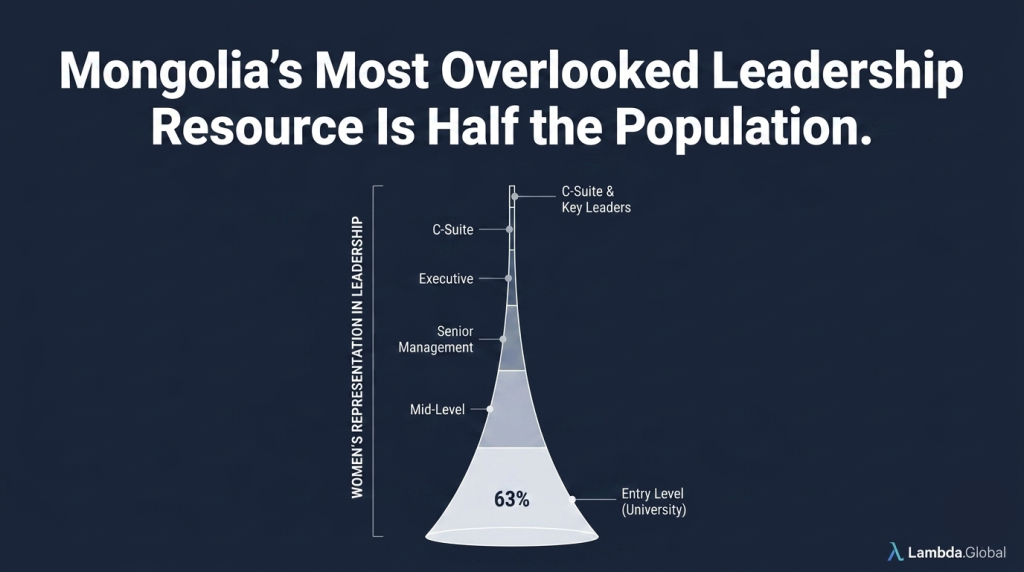
    In the corporate world of Mongolia, women seem to be everywhere. Managers to staff, seminars to networking events you can see outnumbering women. Nevertheless, studies are telling us a different story. In the last decade women’s education attainment was mostly higher than men. Unfortunately, this does not automatically translate to women’s labor force participation. According to the latest available study of 2022, the women’s labor force participation rate in Mongolia was 51.5%, while men’s was significantly higher at 66.4%. Position wise, women also fall behind. From the total of 58,300 managerial positions, 23,300 – 40% were women, whereas male was 35,000 – 60%. Furthermore, gender-based salary gap is still persistent in Mongolia. According to the study, average hourly wage of male worker was 6,400 MNT, meanwhile women’s 5,100 MNT. All these numbers are indicating a disadvantaged career opportunity for female employees.

    Women with small children are subject to further marginalization. There are very few remote and part-time positions available at the labour market. Especially, with a promotion to a higher position, you have to show up at the office every day. These conditions leave women with an option to start their own business.

    The small and medium sized enterprise is dominated by women, making 68%. If we look closely, we can have more understanding of what type of businesses these women run. 75.2% of these women owned enterprises have no paid employees. Most women indicates that they take their family support in their business. Family members take part in the business in a form of helping with product sales, delivery, marketing and social network. It means online shops, bakery, sewing and handmade business sector is prevalent among women with small children.
    Only one out of five women is a member of business support network or association. Female business owners with family caring obligations does not take part in such networks. They struggle between family obligations and the business. Lack of self-development affects the business development.

    Women, who has no skills of sewing or make anything with hands, has a limited option of participation in the market. Consequently, women with small children even though they have a university degree finds themselves in much more disadvantaged place. If there were more options and support, women do not have to struggle between children and career. Essentially, family obligations do not have to mostly fall onto women’s shoulders. Unfortunately, this is an issue for most women not participating in the labor market.

    I have an experience working from home part-time with my former employer. From this experience, I can tell part-time work is the most suitable option for women with children. I have worked mostly from home, thus my occasional visit to our office always felt refreshing and delightful. It was pleasant to see my co-workers in person time to time. Also, I had an option to participate in all organizational activities including the retreats, trainings and a New Year party. I felt less stressful, more productive and more importantly felt part of the society.

    Recently, I have found a remote and part time job with Lambda Global, which is this work – an English writer. Platform based remote work feels different than the contracted part-time employee. Mostly, because I do not have co-workers, I am not an official member of the organization. Nonetheless, as everything has two sides, this remote work has its advantages. There are no strict deadlines and I can manage my time. I only have one specific clear task, which allows me to improve my writing skill day by day.

    I know a start-up aiming to address the unemployment issue of mothers. Momade agency Mongolia allows mothers to work from home and provide services such as translation, social marketing, finance and human resources among others. This is a great initiative supporting mothers to build their career. We need more of these in Mongolia.

    From Lambda Global, if we search for remote jobs, today there are only 12 job vacancies available. Only seven vacancies for part-time work. It is quite surprising to see such low number of remote and part-time jobs availability. As I have mentioned in my article “Prepare the bucket before the milk: Mongolia’s closing window on young talent” organizations should start changing the existing practices. It is my sincere hope that women with small children will have more opportunity to work part-time and still be able to build their career.

    References:

    1. Comparative study on international law and regulations for women business enterprises and study on current conditions in Mongolia, Ts. Norovdondog Phd et al, 2021.
    2. Covid-19 impact assessment on micro and small-scale women business enterprises in Mongolia, National Committee on Gender Equality and Independent Research Institute of Mongolia,2021.
    3. Labor Market Of Mongolia: Mid-Term Demand and Supply Forecasting Study Report, the Ministry Of Labour and Social Protection, Research Institute Of Labour And Social Protection, MMCG,2024.

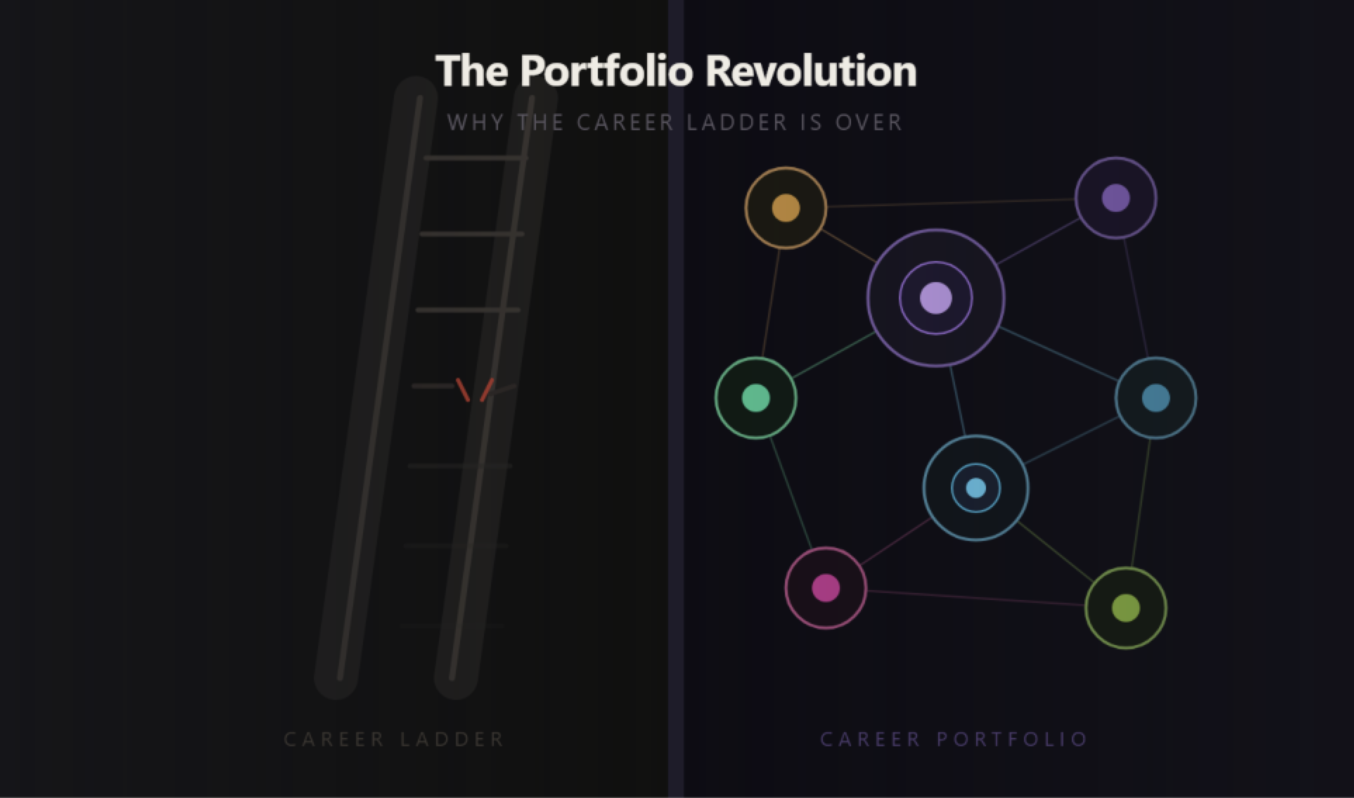
  • AI and Remote work are threat to The middle managers

    AI and Remote work are threat to The middle managers

    The Attack on the Middle Layer: A Big Change

    In the past the “Middle Manager” was very important to a company. For over a hundred years their job was clear: they helped the top bosses and the workers on the line understand each other. They took ideas and turned them into small tasks watched how hard people worked and made sure everything ran smoothly. This system was great for the industrial era, when information moved slowly and people needed to be watched all the time.

    Now in 2026 the “middle layer” is in big trouble. From Ulaanbaatar to London the traditional supervisor. The one who just watches over a team or asks for reports. Is struggling to survive. The reasons for this are not temporary they are the two drivers of the modern economy: Artificial Intelligence and Remote Work.

    Artificial Intelligence: The End of “Management by Numbers”

    In the past a middle manager spent most of their time collecting data making spreadsheets and reporting to their bosses. Now in 2026 this job is no longer needed because of Artificial Intelligence.

    Real Time Information: New project management software, powered by Artificial Intelligence gives bosses up to date information. When a CEO can see how a project is going how sales are doing or how productive a team is, with just one click, the human manager who used to give them this information is no longer needed.

    Autonomous Decision Making: Artificial Intelligence is not a tool for reporting it is also a decision maker. Whether it is optimizing supply chains predicting market changes or allocating resources algorithms can make data driven choices faster and more accurately than a supervisor. The part of management that was about numbers. Once the main job of the middle layer. Is being automated.

    The result is that the “Middle Layer” is disappearing. Companies no longer need a layer to filter information. They need systems that give data directly to the people who do the work and the people who lead.

    Remote Work: From Watching to Trusting

    The second blow to the supervisor came with the shift to remote and hybrid work models. The supervisors power came from being able to see that an employee was at their desk from 9 to 5. This was management by watching.

    In a world watching is not possible and it is not helpful. You cannot control someone who works from a time zone or a home office without hurting their morale and productivity. This shift has forced a cultural change: from watching to trusting.

    The best workers today. The kind of talent that Lambda Global supports. Do not like being controlled. They need goals and the freedom to achieve them. If a company still uses managers who do not trust their workers it is wasting a lot of time and money. Those managers are not adding value they are just causing problems.

    The “End” of the Bureaucrat

    As companies get flatter we are seeing a divide between two types of leaders. One is becoming less important while the other is becoming more valuable.

    The Bureaucrat: These are the managers who were good at administration. They were good at attending meetings watching workers and doing paperwork. Without a physical office to control and with Artificial Intelligence doing their reports they have no job left.

    The Expert Leader: These are the leaders who have technical or domain knowledge. They do not just supervise they contribute. They are the mentors who can solve problems the strategists who can close big deals and the coaches who can improve the skills of their team.

    At Lambda Global we believe the future belongs to the Expert Leader. In a company there is no room for someone who just manages. Everyone must add value.

    Strategic Implications: How to Change

    For a boss in 2026 the question is no longer “How many people work for me?” This is a way of thinking. The modern question is: “How well can my team work without me?”

    Changing to this way of leading requires three big steps:

    1. Remove unnecessary layers of management that slow down decision-making. Every layer between the customer and the CEO is a problem.
    2. Hire workers who are self-driven. Of hiring supervisors to watch people hire professionals who can manage themselves.
    3. Change the job of managers from “supervising” to “enabling”. Their job is to remove obstacles that prevent their team from winning.

    The New Era: Leadership as System Design

    The “end” of the supervisor is not a disaster for companies it is an opportunity. It allows organizations to be leaner, faster and more human. When you remove the layer of watching and manual reporting you create a culture of high trust and high performance.

    Companies today do not need “bosses”. They need architects who can design systems and mentors who can nurture great talent. The companies that thrive in this era will be those that embrace the flat structure use Artificial Intelligence to handle logistics and empower their teams to lead themselves.

    Clarity Over Control

    The change from a hierarchy of control to a network of autonomy is the challenge for Mongolian businesses and global companies alike, in 2026. The supervisor as we knew them is gone. In their place we must build a standard of leadership based on expertise, trust and results.

    Giving your team the space to work autonomously is not a nice thing to do it is necessary. The future is flat the future is autonomous. The future is led by experts. It is time to stop watching and start making an impact.

  • Burnout in the C-Suite in Mongolia

    Burnout in the C-Suite in Mongolia

    The Heroic Mirage: Why “Always-On” Isn’t Real Leadership

    These days something strange is happening in Mongolian boardrooms. A lot of executives think that being a leader means they have to be available all the time. They answer emails at night they take calls on Sundays and they go to meeting after meeting. You see this everywhere. People are smiling,. They look tired. Their offices are always open. The idea is, if you really care about your job you never stop working.

    The truth is, this way of thinking is bad for people. It does not make companies stronger. At Lambda Global we think the “Always-On” culture is a problem, not something to be proud of. Working all the time hides issues it hides the fact that things are not working well and in the end it costs the company a lot more than it helps.

    Decision Fatigue: The Profit Killer Hiding In Plain Sight

    The important work for leaders is making big decisions. They have to navigate risks find opportunities and set the direction for the company. This is not work. It takes a lot of energy.

    We know from science that our minds can only do much. When CEOs and founders work much they get tired and their judgment suffers. They are not as good at making decisions. Studies show that being very tired can affect your thinking much as drinking too much alcohol. You would not want a CEO to make decisions if they were drunk would you?. Companies expect their leaders to work too much and then they are surprised when those leaders make mistakes. Leaders are busy fighting fires that they do not have time to think about the bigger picture.

    Negative Signaling: How “Busyness” Turns Toxic

    It is not about the person in charge. When a CEO does not take time off their team thinks that rest is not important. Soon everyone is pretending to be busy to look good. People stay late at the office not to get work done. To look busy. The whole company starts to care about looking busy than getting results.. When that happens people are not creative anymore.

    The best employees, the ones who’re really good at their jobs and think globally do not want to work in a place like that. They want to make a difference not just work all the time. So they. What is left is a team that is good at looking busy but not good at moving the company forward. That is a loss of talent. It costs a lot.

    Strategic Rest: A Way to Lead

    In countries with strong economies top executives know that rest is important. They know it is not a luxury. Something they need to do their jobs well. Taking time off like Bill Gates does is not a vacation. It is time to plan to recharge and to think clearly. In places like Mongolia, where things can change quickly taking time off is more important.

    Here is why it matters:

    – Your brain needs rest to come up with ideas. You need to let your mind wander sometimes.

    – Leaders need to step from their work to see the bigger picture. That is how they can prepare for what’s coming.

    – Being a leader is a marathon, not a sprint. If you burn out fast you will not be able to lead your company well.

    Shifting to “Ready”: The Lambda Global Approach

    To really change companies need to do more than just give their employees long weekends. They need to build teams that can work independently without the boss always telling them what to do. That is why Lambda Global helps Mongolian companies find talent and build strong teams. We help leaders focus on the work not just the routine tasks.

    When you trust your team you do not need to control every thing. You can focus on the decisions that really matter. A company that can run well even when the boss is not there is a company that will last.

    Clarity Wins, Not Clutter

    The future of Mongolia will not be led by the exhausted leader. It will be led by people who can think clearly even when things are tough and who are not afraid to take time off. It is time to stop thinking that being “Always-On” is a thing and start thinking that rest is important for good leadership.

    For companies that want to compete globally the right investment is not in working more hours. It is in being leaders. That means taking time off delegating tasks and finding the talent. At Lambda Global we want to help you do that. Lets stop being “On” and start being smarter, about how we work. The future depends on it.