Author: Admin

  • The Skill That Keeps You Employed Is Not on Your CV

    The Skill That Keeps You Employed Is Not on Your CV

    Somewhere between the ages of 30 and 40 when professionals reach their mid-career period, there is an unexpected onset of anxiety. The realization that the skills learned five years ago have advanced to version 7.0, the new employees use terminology that sounds foreign, and the job once thought secure does not seem so stable any more sneaks up on the worker one day while sitting at their desk.

    This is not something particular to the local case. This happens all over the world. However, the situation becomes more critical in small markets such as Ulaanbaatar city, where the career opportunities may be limited and side tracks less available.

    Degrees expire faster than we admit

    A university degree used to be a ticket to a lasting career, but that is no longer true. The shelf life of technical knowledge is shrinking across every sector. A financial modelling approach that worked in 2020 is now automated. A marketing skill set built around Facebook ads is now only one piece of a vastly more complicated puzzle. The software you use today may be replaced within several months.

    The World Bank’s 2022 skills survey in Mongolia found something telling. According to the survey, employers struggled the most with finding people who could solve problems without a script, communicate clearly across teams and keep learning after being hired. They didn’t say they struggled with finding people who had the right certificates. In fact, those three key qualities are rarely listed in job descriptions. They show up in the work itself.

    So if the most valuable qualities are the ones that cannot be stapled to a CV, how can one prove they have them?

    Learning like it is a responsibility, not a side project

    Although most professionals agree that continuous learning is important, barely anyone does it. The simple reason is that the learning gets squeezed into whatever is left at the end of the week and by then there is no energy left. However, the people who stay ahead treat learning as part of the job, not an addition to their responsibilities.

    A practical starting point is to ask a question from yourself. If I had to apply for my own role today, what would make me a strong candidate? What would expose me? The answers point directly to where learning should happen. Maybe it is data analysis. Maybe it is working with AI tools instead of ignoring them. Maybe it is public speaking, or better written communication. The specific answer matters less than the honesty behind it.

    There is no need to enroll in a two-year master’s program. Small, consistent actions work with a short online course in a relevant tool, a month spent reading everything credible about a new trend in your industry and a deliberate effort to take on a project at work that forces you outside your comfort zone. Over a year, those small actions will compound. Over three years, they separate the people who are still advancing from the people who are just holding on.

    Why the local market rewards adaptability

    Mongolia’s private sector is not static. Logistics companies are becoming more sophisticated. Professional service firms are competing for regional work. They need people who can figure out how things should be done now, not someone who only knows how things were done in 2019.

    This is a genuine advantage for professionals who are willing to be uncomfortable. While a traditional resume might list years of experience and a series of well-known company names in the same sector, the thing that makes an employer lean forward in a conversation is evidence of adaptability. A story about learning something new and applying it fast. These things do not require a senior title. They require a mindset.

    Where Lambda.Global becomes relevant

    Lambda.Global is not only a hiring platform, but also a source of market intelligence for professionals who want to understand what the economy demands. Through the salary and skills reports, Lambda can show which roles are growing, which skills are becoming more requested, and where the gaps between supply and demand are widening.

    In the case of someone looking at their future career, this kind of knowledge will prove to be far more useful than any generic career advice. This knowledge will not only tell us what we are supposed to value according to what people claim, but also what our employers consider valuable and relevant at the moment. Being employable does not imply knowing everything, but knowing what others do not yet know.

    Endnote

    No one is coming to protect your career. That may sound harsh, but it is also freeing. It means the decisions you make about what you learn and how you grow are completely yours. There will be no bureaucracy, no manager, no company policy that can take that away.

    In 2026, the safest professional in Ulaanbaatar city is not the one with the highest title or the largest network. It is the one who can walk into a new situation, admit what they do not know and start figuring it out faster than anyone expected.

    That skill will never appear on a CV. It is also the one thing that will keep you employed for as long as you want to be.

    References

    • World Bank, Skills demand in Mongolia: Main Findings of the Skills Module of the Barometer Survey (2022) – employer valuation of soft skills and learning agility.
    • Lambda.Global, Sector Salary Reports (2025) – data on emerging skill demands across industries in Mongolia.
    • LinkedIn Learning, Workplace Learning Report (2024) – global trends on skill shelf life and continuous learning habits.
  • Mongolia’s Untapped Talent Edge: A Practical Guide for HR Leaders

    Mongolia’s Untapped Talent Edge: A Practical Guide for HR Leaders

    10 Ways to Understand Mongolia’s Talent Market Opportunity

    Mongolia is still one of Asia’s most overlooked talent markets, but that is changing rapidly. For HR managers and executives who want to hire smarter, reduce costs, and build stable teams, this market offers a strong mix of young workers, growing digital skills, and significant room for growth.

    1. Mongolia’s young workforce creates long-term value

    The real question is not whether Mongolia has talent. It is whether companies are ready to recognize it. In this post, you will learn what makes Mongolia stand out, why its workforce matters, and how employers can approach the market with a practical hiring plan.

    Mongolia’s demographics give employers a clear advantage. A large share of workers is young and already active in the labor market, which means companies can hire people who will grow with the business over time. For HR leaders, this is not just about filling roles today. It is also about building a team for the next five to ten years.

    Younger workers tend to adapt quickly, which helps in roles where tools, systems, and tasks change often. This makes them well suited for support, administration, operations, and junior professional positions. A young workforce becomes even more valuable when employers invest in training, feedback, and clear paths for advancement, which also helps reduce turnover.

    2. Education and English skills are improving

    Mongolia continues to produce graduates in business, IT, finance, and related fields, including strong alumni from universities around the world. English proficiency is also improving among younger professionals, particularly in Ulaanbaatar. This makes the market more accessible for international teams and cross-border collaboration.

    Strong language skills and solid academic backgrounds make onboarding easier for employers. Teams can work across borders with less friction, adopt global tools more readily, and demonstrate broader business standards. This is especially useful in accounting support, customer success, digital marketing, and junior tech roles. Companies can strengthen these capabilities further through structured interviews, skills assessments, and role-specific training.

    3. Remote work expands access to Mongolian talent

    Remote and hybrid work have changed how companies think about location. Mongolia no longer needs to be seen as geographically distant from major business centers, it can now be viewed as a source of talent that works seamlessly with teams in many places.

    This model works especially well for tasks that follow clear processes and rely on digital tools. Back-office support, coordination, data work, and certain tech roles fit this approach well. For HR teams, remote hiring also provides greater flexibility in workforce planning. The key is to keep work clearly defined, document processes thoroughly, and establish straightforward communication habits. Without structure, remote work becomes difficult to manage. With structure, it can work very well.

    4. Salary efficiency supports steady growth

    One of Mongolia’s most compelling advantages is salary efficiency. Compared to more established Asian talent hubs, companies may be able to hire strong candidates at a lower cost — without sacrificing quality. This means businesses can grow faster, add more staff, and preserve budget for training and retention.

    For executives, that can be a genuine strategic advantage. It allows companies to scale thoughtfully rather than overspending in crowded markets. However, lower salary costs only deliver value when the rest of the offer is fair. Companies still need clearly defined roles, competitive local compensation, and benefits that matter to workers. Paying less on its own is not a sustainable strategy.

    5. Retention depends on workplace quality

    Hiring talent is only half the job — keeping it is just as important. Employers that expect long hours, apply rigid pay structures, or offer no clear path for advancement often lose younger workers quickly. HR teams must therefore focus on fairness, communication, and growth.

    This is where local knowledge matters most. Some global companies apply hiring practices from larger markets without adapting them to local expectations, and in Mongolia, that gap shows. Better retention comes from salary transparency, manageable workloads, well-trained managers, and regular feedback. When people feel respected and can see a future with the company, they are far more likely to stay.

    Lambda Global notes that by 2035, working-age people could make up 64.7% of Mongolia’s population, with younger generations still entering the labor market. That gives companies a genuine opportunity to build teams now, before demand rises further. Lambda also points out that many employers are already struggling to retain young workers, which makes fair pay, clear growth paths, and stronger hiring systems even more critical.

    6. Mongolia can support key business functions

    Mongolia is not only suited to basic outsourcing. It can also support finance, accounting, software development, digital marketing, customer support, and operations making it a viable option for companies building regional teams or shared service centers.

    The best fit is typically work with defined processes, measurable outcomes, and digital systems. A finance support team, for example, may find strong analytical professionals in Mongolia. A startup may find junior developers or product support staff who are eager to learn and grow. The opportunity strengthens further when companies invest in local employer branding and build relationships with universities, recruiters, and professional communities.

    7. Early movers gain a hiring edge

    The market is still developing, which means top talent is not yet as competitive to attract as it is in well-known Asian hubs. That creates an opening for early movers. Companies that build a presence now can earn trust, attract stronger candidates, and develop better referral networks before the market becomes crowded.

    This matters because talent markets reward visibility. If people know your company as a good employer, they are more likely to apply when opportunities arise. HR leaders should think beyond one-off hires and focus on sustained market presence. Building local trust, refining hiring processes, and developing strong ties with people who understand the local landscape. The sooner a company gets involved, the better its long-term access to talent.

    8. Bonus tip: localize your hiring process

    A simple way to improve hiring outcomes in Mongolia is to localize the process. This means adapting job postings, interview formats, salary ranges, and communication styles to fit the local market. This small adjustment can meaningfully improve applicant quality and reduce drop-off rates.

    Transparent salary ranges and clearly defined roles help build trust quickly, as do practical interview formats that assess real skills rather than relying on vague corporate signals. Localizing the hiring process is often the difference between generating interest and finding the right person.

    9. Build local employer trust

    Mongolia’s talent market is still maturing, so trust carries significant weight. Many strong candidates want to know that a company will pay fairly, communicate openly, and offer genuine growth. Employer branding, therefore, is not a secondary concern. It is a core part of the hiring strategy.

    HR teams should focus on the basics that build trust quickly: clear job postings, honest salary ranges, and prompt feedback. When candidates see a company that respects their time, they are more likely to apply and remain engaged throughout the process.

    10. Use local partners and market insight

    Global hiring models do not always translate well in Mongolia. Local hiring partners, recruiters, and market specialists can help companies avoid common mistakes and provide better guidance on compensation, job titles, candidate expectations, and interview practices. Useful resources include lambda.global, zangia.mn, and worki.mn

    The local market has its own pace and norms. Companies that learn from people who already know the space can hire faster and make better decisions. For HR leaders, this is one of the most reliable ways to reduce risk and improve results.

    Conclusion

    Mongolia’s talent market is frequently overlooked because many companies focus only on familiar hiring hubs. But for HR managers and executives who think ahead, the country offers a compelling combination of youth, adaptability, improving skills, and cost efficiency.

    The real opportunity lies in building access to talent before the market becomes crowded. Companies that move early, hire thoughtfully, and adapt to local conditions can build a meaningful competitive edge. In a crowded region, the smartest talent strategy often starts where others are not yet looking.

  • Do You Actually Know What You are Worth?

    Do You Actually Know What You are Worth?

    Mongolia has a salary problem — not just a low-pay problem. A silence problem. And until that changes, workers will keep leaving money on the table, and companies will keep losing people they didn’t know they were underpaying.

    Let’s start with an uncomfortable question. When did you last know with real confidence, not a gut feeling, exactly what your role pays at a competing organization? Not a rumor from a colleague. Not a number someone whispered at a get-together. Actual, comparable, verified market data.

    If the answer is ‘rarely’ or ‘never,’ you are in excellent company. Mongolia’s professional culture has a deep, stubborn, almost ritually observed silence around salary. People change jobs, negotiate offers, and build decade-long careers without ever having an honest, data-backed conversation about what they are actually worth in the market. That silence is not neutral. It has winners and losers, and the losers are almost always the employees.


    What the Numbers Actually Look Like

    Here is what we know from available data. Mongolia’s average monthly salary reached 2,877,800 MNT by late 2025 — roughly $720 at current exchange rates. That is meaningful growth from the 2 million MNT average recorded just a year earlier, partly driven by a 20% minimum wage increase in 2024, which pushed the floor to 660,000 MNT, followed by a further rise to 792,000 MNT in 2025.

    But averages hide more than they reveal. Engineers and technical specialists in demand can earn above 5 million MNT per month. Mining sector professionals sit well above the national mean. Arts and entertainment workers average around 615,000 MNT, barely above the new minimum wage. In banking and financial services, C-suite executives command 15 to 30 million MNT monthly. The spread is not just wide. It is enormous.

    And then there is gender. Mongolia is frequently cited as a country with strong female educational attainment. Women consistently outperform men at the university level and are well represented in banking, education, and social enterprise leadership. Yet female executives earn 10 to 18% less than men in equivalent positions. Overall, women’s average salary is 1.7 million MNT, while men’s is 2.3 million. Qualifications do not explain the gap. It is explained, in large part, by who negotiates and who doesn’t — and who has the information to negotiate from.


    Why Nobody Talks About It

    The salary silence in Mongolia is cultural, institutional, and in some workplaces, effectively enforced. Many employment contracts in Ulaanbaatar include informal or explicit expectations of confidentiality around compensation. Asking a colleague what they earn is considered somewhere between impolite and disloyal. Sharing your own number feels like a risk of resentment, of being marked as a troublemaker, of somehow weakening your position with a manager who now knows exactly how much you value yourself.

    The result is that most employees negotiate when they negotiate at all from a position of almost complete information blindness. They anchor to the last salary they received, not to what the market actually pays for what they do. Employers, by contrast, almost always know the market. They use compensation surveys, talk to recruiters, and have access to benchmarking data that their own candidates rarely see. The information asymmetry is profound, and it systematically favors the organization over the individual.

    This is not a coincidence. It is a structural arrangement that keeps payroll costs manageable by keeping employees uncertain. The most direct remedy for transparent salary data is available. It is just not widely used.


    What Happens When You Don’t Know Your Number

    Here is a scenario that plays out constantly in Mongolia’s professional class. A mid-career professional, let’s say a finance manager at a logistics company, has been with her employer for four years. She is good at her job. She has taken on more scope than her original role description. She has not had a meaningful salary conversation in two years, partly because she does not want to seem demanding, and partly because she has no clear idea what she should be asking for.

    Meanwhile, a competitor has posted a similar role at 40% above what she currently earns. She does not know this because she has not been looking, and the posting language is vague enough that the compensation is not listed. She stays. The competitor eventually fills the role with someone external. Her employer, having never been challenged, assumes she is content. In three years, she leaves anyway, frustrated, for a number she could have negotiated two years earlier.

    This story is not hypothetical. It is the career arc of a significant portion of Mongolia’s mid-senior professional class who are not underskilled, not underperforming, simply underinformed. The cost is borne by the individual. But the company pays it too, eventually, in the form of turnover, retraining, and the slow organizational loss of institutional knowledge.


    What Is Changing and What Needs To

    There are genuine signs of movement. Mongolia’s income tax rate of 10% one of the region’s simplest and lowest flat structures, making gross-to-net salary conversions relatively straightforward compared to higher-tax environments. The government’s willingness to mandate significant minimum wage increases signals at least a structural acknowledgment that the pay floor was not keeping pace with living costs in Ulaanbaatar, where household expenses average 1,223,854 MNT per month against a household income that, for many, barely clears that threshold.

    In the private sector, Mongolia’s most internationally connected companies, particularly in mining, fintech, and financial services, have started adopting formal compensation benchmarking as part of their HR strategy. Organizations like Higher Careers and Lambda.Global is bringing compensation data into executive and mid-senior hiring conversations in ways that simply did not exist five years ago. When a candidate walks into a negotiation knowing the verified market range for their role, the dynamic changes. The conversation becomes less about what the employer is willing to offer and more about where within the established range the hire will land.

    But formal benchmarking is still not the norm. Most Mongolian companies, particularly SMEs and state-adjacent organizations, still set salaries based on internal precedent and managerial discretion rather than market data. The result is wide, arbitrary pay variation even within the same organization: two people with equivalent titles and experience earning meaningfully different amounts, not because one negotiated harder, but because one was hired at a different point in the company’s growth, by a different manager, in a different mood.


    The Practical Ask

    If you are an employer: publish salary ranges in job postings, or at a minimum, share them at the first interview. The evidence from markets that have moved toward pay transparency most recently, several U.S. states, and increasingly across OECD countries, is that it reduces turnover, narrows gender pay gaps, and does not materially inflate payroll costs. Employees who know what they are paid relative to the market and relative to peers are more settled, not more demanding.

    If you are a professional: treat your market value as information you are responsible for knowing and maintaining. Use every recruitment conversation as a data point, not just an opportunity. Talk to peers carefully, but honestly. The culture of salary silence benefits the person with the most information, and right now, that is rarely you.

    Mongolia’s economy is growing. Its professional class is maturing. Its talent market is getting more competitive by the quarter. The only thing that is not keeping pace is the conversation around what work is actually worth, and that is a problem every senior professional in this country has both the standing and the self-interest to start changing.

    SOURCES & REFERENCES

    1.  Higher Careers Mongolia — Executive Compensation Trends 2025

     10–18% executive gender pay gap; 8–12% salary growth; variable compensation trends; compensation benchmarking insights.

    https://www.higher.careers/blog/2025/10/executive-compensation-trends-mongolia-2025

    2.  WageCentre — Salary in Mongolia 2025

     Average monthly salary 2,479,600 MNT (~$720); minimum wage 792,000 MNT; mining sector averages; household income & expense data.

    https://wagecentre.com/work/work-in-asia-and-oceania/salary-in-mongolia

    3.  Trading Economics — Mongolia Wages, Q4 2025

    Q4 2025 average wages: 2,877,800 MNT/month; quarter-on-quarter wage growth tracking.

    https://tradingeconomics.com/mongolia/wages

    4.  TimeCamp — Average Salary in Mongolia 2024

    Gender wage gap analysis; men’s average. 2.3M MNT vs women 1.7M MNT; occupational segregation and labor force participation data.

    https://statistics.timecamp.com/average-salary/mongolia

    5.  Mongolia Inc. — Minimum Wage Increase 2024

    20% minimum wage increase to 660,000 MNT effective January 2024; Mongolia’s regional wage ranking context.

    https://mongoliainc.com/8794/

    6.  Playroll — Employer of Record Mongolia 2026

    Minimum wage confirmed at 792,000 MNT as of April 1, 2025; payroll cycle and compliance framework.

    https://www.playroll.com/global-hiring-guides/mongolia

  • Potential Solution to Employee Training Gaps in Mongolia

    Potential Solution to Employee Training Gaps in Mongolia

    Employee development training has become an indispensable component of today’s professional environment. It is a key consideration for the new generation, when choosing their employer. Employee development training is beneficial for both the employee and the employer. However, not every employer has the financial and human resources to provide necessary skills training for their employees.

    In Mongolia from the total of 101,582 registered legal entities 97% or 98,659 entities employ fewer than 50 people. I have both experiences working in small organizations with fewer than 50 employees and large enterprise with 100+ employees. Small organizations often lack a designated Human Resources manager, not to mention a designated team. Usually, operations manager covers the human resources responsibilities. Large enterprises have separate human resources team and budget to finance on-the-job and off-the-job trainings. 

    Types of on-the-job training:

    • Coaching
    • Mentoring
    • Job shadowing
    • Job rotation
    • Apprenticeship
    • Understudy
    • Committee assignment/action learning
    • Job instruction technique
    • Blended learning

    Types off-the-job training:

    • Classroom lectures and seminars
    • Simulation training
    • Workshop and conferences
    • E-learning/Online modules
    • Mentoring and Coaching from outside the organization
    • Case study analysis
    • Role-playing
    • External trainings and Industry visits

    The study among small and medium enterprises (SME) found that SMEs neglects to implement the training programme properly, lack understanding of training concept and training objective. The study also discovered that the most SME owners aim to improve employee’s new knowledge and skills, prevent workplace accident, enhance employee’s capability and efficiency. The problem is they do not know how. 
    Lambda Global is here to solve this problem by introducing AI trainings for the registered employers on its platform. According to the statistics, 79% the of the Mongolian legal entities are in retail, trade and services sector. These sectors heavily rely on marketing and customer interaction. AI assistance in these sectors could increase the efficiency by 15-40%. 

    Currently Lambda Global has 150 AI practical courses. All the trainings are in Mongolian language, therefore even the employees without English language skills could directly apply the skills to their work. This is one of the main advantages, as many employers indicate that language barrier is the most noticeable factor that delays the employee development. 

    Second problem is we are all aware that AI can automate and assist our daily repetitive tasks. But in reality, most of us using an AI only on chat base, asking questions and receiving answers. Without proper training, most people do not know from where to start, what AI can actually do.
    When I first went through the Lambda Global’s AI course list, I was surprised to see how many things can be automated or created with AI assistance. Before that, I had little understanding of AI’s capability. From the training list I have got new ideas on AI usage for my daily work. I am confident that this resonates with most of you. 

    Lambda Global’s training will help the employees and employers to conduct the following with the AI assistance:

    – Create a financial assistant and categorize the bank statements
    – Create a self-development personal assistant 
    – Develop an evaluation package for the employees on probation 
    – Develop performance evaluation design
    – Develop an assistant for the evaluation of customer’s feedbacks and comments
    – Current trends and competitors’ research
    – Create and analyze user persona 
    – Develop and interview score card
    – Analysis on exit interview results
    – Develop a manual and digital content
    – Newsletter automation
    – Financial report development
    – Employee portal development
    – Report writing
    – Email writing
    – Marketing content development
    – Website development
    – Business and market research
    – Data analysis
    – Presentation development
    – Brochure design development
    – Create dashboard
    – Training evaluation and feedback of employees.

    Organizations would greatly benefit by joining the Lambda Global. So why wait? Join now and level up your employee today. 

    References:

    1. Business Register Statistics, National Statistics Office, 2023
    2. Employee training in small and medium-sized enterprises in Mongolia, Tuul.O and Shao Jian Bing,2019
    3. Lambda Global AI skills training, 2026, https://lambda.global/ai

  • Digital Nomadism is Dead Long Live the Global Mobility Elite: The Case of Mongolia

    Digital Nomadism is Dead Long Live the Global Mobility Elite: The Case of Mongolia

    Digital Nomadism is Dead Long Live the Global Mobility Elite

    Back in the 2020s everyone wanted to be a Digital Nomad. They would talk about professionals working on their laptops on a beach in Bali wearing sunglasses. This was about freedom. By 2026 that conversation became a joke. Digital Nomads couldn’t get work done anywhere. They couldn’t help their companies.

    The new era is the age of Global Mobility. This is about working in an planned way. It’s not about how you want your life to be. It’s about becoming part of a high-level workgroup in the labor market. These workers are not nomads. They are leaders who’re good at Global Mobility.

    So why didn’t the Digital Nomad concept work?

    Some research in 2025 showed that 62% of workers went back to an office. They couldn’t work well with their colleagues. Advance their careers. The problem with Digital Nomads was that they thought work was a part-time thing. They got frustrated with time zones and didn’t understand different cultures.

    Global Mobility is different. Work is a part of a global network. Whether the manager, engineer or creative director works from Ulaanbaatar, Berlin, Tokyo or even Mars they’re all working on the projects. We call this Systemic Mobility.

    Systemic Mobility is based on three concepts:

    * Cultural Intelligence. Research by the World Bank shows that 80% of a leaders success with teams from countries depends on understanding different cultures. A global mobility expert works like a decoder. They know that an engineers silence at a meeting means they’re probably thinking, not that they agree.

    * Follow-the-Sun architecture. The expert works at 9, 5 or whatever. They design work so that when its night in Ulaanbaatar work continues in Europe. When its night in Europe work goes to the Americas. This allows for work to happen all the time.

    * Asynchronous Diplomat. In 2026 people were tired of using Zoom all the time. Top specialists in Global Mobility communicate with videos and long texts. They don’t need real-time conversations. They just need results.

    Ulaanbaatar: The new center of the global network

    Mongolia is in a position. It links Central Asia with the rest of the world. The time zone is perfect for working with markets. A study showed that high-level specialists working in Mongolia for companies increased by 45% in just 18 months. These are not nomads. These are leaders who’re good at Global Mobility.

    What kind of worker are you?

    In 2026 there are two types of specialists.

    * Digital Nomad: The main goal is comfort and travel.

    * Global Mobility: The main goal is to make an impact and be efficient.

    FeatureDigital Nomad (Legacy)Global Mobility Elite (Future)
    Primary GoalPersonal comfort & travelGlobal impact & systemic efficiency
    CommunicationSynchronous (Real-time/Zoom)Asynchronous (Systematized)
    Value MetricHours worked (Input)Value added (Output)
    MindsetEscaping the systemMastering the network
    Location“Wherever has the best Wi-Fi”Strategic positioning for global reach

    Your communication style is also different. Digital Nomads communicate in time. Global Mobility workers use communication. The value attached to employees is also different. Digital Nomads are paid for their hours. Global Mobility workers are paid for the value they add.

    Lambda Global Manifesto: Capability over Coordinates

    Our message to companies is simple. You don’t need an office in a perfect location. You need workers. Global Mobility is not something that employees need. It’s something that companies need to succeed. It’s not unusual for a young professional in Ulaanbaatar to work with a team from India, Germany and Brazil at the time.

    Lambda Global helps businesses find talent. We don’t just fill positions. We bring a Global Brain to your company. We do this in a way.

    FeatureTraditional RecruitmentLambda Global (Global Brain)
    Talent ReachGeographically restricted (Local)Unlocking the Global Talent Pool
    Evaluation CriteriaTechnical Skill-set onlyAssessing “Mobility Mindset” and CQ
    Primary ObjectiveFilling a vacancyDelivering Strategic “Brainpower”
    Operational ScopeLocal market limitationsBorderless workforce integration

    The era of the Digital Nomad is over. We’re entering the era of the leader. Where you are located doesn’t matter. What matters is your connections, leadership and value. This is your passport to success, in the labor market. Will you stay a Digital Nomad? Will you become a member of the Global Mobility elite?

  • Hired in a Heartbeat: the Future of Rapid Recruitment in Mongolia

    Hired in a Heartbeat: the Future of Rapid Recruitment in Mongolia

    What’s your recruitment experience in Mongolia? After how long have you been hired by an organization? As a millennial, I have quite few experiences of being hired into an organization. But the recent experience was the fastest one in my entire career history. 

    Two weeks ago, I have seen an advertisement of an English Writer on Lambda Global. As a full time mother, I was interested in remote writing job, which will allow me to spend more time with my children. Consequently, I have applied for the job the next day. Two days later I have received an email from the CEO and founder of the Lambda Global, congratulating me for passing the first screening. The final stage was to send a 800-1200 word article by Sunday strictly written by myself, without any AI assistance. I have sent my article within the given deadline. I was assuming that the CEO or the other team members of Lambda Global will read my article on Monday, and I will hear back from them by Tuesday at the earliest. To my big surprise I have received the results after two hours on the same day. It was not only the results, but it contained all the necessary information to start my work immediately. By Friday the same week I have already received my first payment. For someone, who was expecting the response at least two days after the test article submission, it felt super quick. This whole experience of gig work is new to me and certainly it gave me an idea of a future work. Lambda Global is a start-up business, hence everything is swift and different from the traditional organizations that I have worked.

    In the future, I think not only start-ups, but with the further development of an AI and the new generation’s demand the most organizations will be similar to today’s start-ups. 

    Hiring trend

    I have experience of being recruited in a big and small organizations with international and national management. Depending on the urgency of the position, the entire process usually took at least 2-3 weeks. That will not be the case in the near future. It will not be surprising, if someone applies for a job and starts the work next day. AI involvement in the recruitment process will speed up the process significantly. Lengthy processes of an interview, exam, negotiation and signing of a contract will be much shorter. After I was selected as an English writer, the Lambda Global’s CEO shared a spreadsheet with me. The spreadsheet contained all the other writer’s payment and deliveries. At first, I thought he had sent it mistakenly. It turned out it was not. Everything is transparent at Lambda Global. I could see, who has what payment scale, based on what delivery. It made everything clear, no guessing and confusion. Lambda Global is promoting exactly this to other organizations – to be transparent on the salary. I could see how much time it saves for both the company and the contractor. You have a clear task, this is what we pay for the task, this is what others get, if you agree come and join. 

    Automated emails and the system 

    I have received an email from the CEO and founder of the Lambda Global, Bayarsaikhan Volodya. Somehow, it felt like an AI email. I presume the CEO does not intend to hide AI assistance, on contrary he is embracing the AI. Lambda Global is developing an AI driven system to enhance the human resources efficiency and to shape fair labor ecosystem in Mongolia. Consequently, from the recruitment process I could sense some involvement of an AI. In the future, the new generation might receive clear and concise emails from an AI. Email exchanges might look and feel very different from the traditional ones. That made me to question, whether the communication skill will be crucial as it is today. Computer to computer interaction seemed to require minimal communication skill, especially the oral communications. Today, I am performing my task not interacting with anyone. I have received one email with clear instruction and expectation. That was it. I do not have to deal with an accountant or any other personnel. 

    Full time office work 

    Current gig work is perfect for me. I can spend my time with my children and manage my time. Plus, I get paid every week. How convenient is that! I could completely understand why Gen Z reluctant to have full time office work, where you get paid twice a month. In the future, it will not be surprising, if all the full time office works replaced by an output based remote jobs. Most organizations will likely to hire highly skilled contractors, who will perform tasks with a clear goal. There will be no so-called “pointless” jobs that fills an office desk. 

    My current work as an English Writer at Lambda Global could be an expectational case today, but this is what attracting the new generation. Start-ups such as the Lambda Global is already defining new practices of future work. The “future work” ,widely discussed as something faraway, is already unfolding around us.

  • The State of the Male Workforce in Mongolia

    The State of the Male Workforce in Mongolia

    I remember there were a podcast called “Where are the Mongolian men?” hosted by three men. Three hosts worked in a corporate sector. They have claimed that everywhere they go, in the office, restaurants, networking events, different clubs and training, there were always women outnumbering the men. Hence, they have started a podcast to discuss this issue. 

    According to the study the state is one of the major employers in Mongolia, especially in the rural provinces. One out of five people in Mongolia are employed by the state. Head of the government agencies are dominated by men. 
    There are around 120 state owned enterprises, if the subsidiary and local government owned enterprises will be added this number will rocket to 450. Men are dominantly working in these state-owned enterprises. It is not a secret that recruiting process of ministries, government agencies and state-owned enterprises are very different than the private enterprises. Private enterprises have largely merit based recruiting system. Candidates have to pass the interview and exam to get into the big company, whereas in the state-owned enterprise connection is more important than the candidates’ education and skills. This connection-based system allows a number of incompetent workforces to easily get a job.
    Majority of Mongolian men are heavily interested in politics. Therefore, most of them see state enterprises as a ladder to the political leadership role. It is public knowledge that the heads of the state-owned enterprises are appointed by a political party. 
    The rest, who are not aspiring to the political leadership role, stays in the organization even if they dislike the job. The main reason is they are aware that, if they lose this job, they will face hard time to get another one as they have poor skills and qualifications. 

    For both government agencies and corporate sector, in the office environment men are either at the top or the bottom. Middle positions are dominated by women. That’s why women seem to be everywhere in the corporate world. 
    Educated and skilled Mongolian men are predominantly working in construction, mining and energy sectors in the home country. Rest is the business owners. If we look into the number of medical professionals of Mongolia, men comprise only around 20%, which is a huge gap. 

    Men, who have no connection to government agencies and state-owned enterprises among others, choose to go abroad and work there. Working abroad allows men to earn a decent salary to build their life. Today approximately 55,000 Mongolians are residing in South Korea, from which 37,000 are contracted workers. It is the number one destination for Mongolians. Consequently, South Korea is the largest country with bilateral social security agreement with Mongolia, where Mongolians are granted an option to be covered by Mongolian social insurance. It is not clear when will the outflow to South Korea cease, as the system sending the contractor workers is well established that even the legal regulations are in favor of it. 

    Another group of men are the men who are continuing the Mongolian heritage, undertaking a herding work. They regarded as a workforce in the agricultural sector. Herding is a hard work. Consequently, most herder families keep the boys to help with herding, while sending the girls to go to the university. It created a so-called reverse gender gap in education. 

    This is the overall picture of male workforce of Mongolia. They are either directors or a contract worker, they are a business owner or a herder. There are small number of doctors, software engineers and other specialists. Thus, there is need to support the male professionals and increase the number of highly skilled workforce.

    Tips to support existing male professionals:

    – Involve in professional training to upgrade their qualifications
    – Involve in other self-development training 
    – Provide clear career path
    – Provide incentives aside the salary, such as transportation and communication allowances
    – Provide attractive packages such as a health insurance.

    References:

    1. Agreement between Mongolia and the Republic of Korea on Social Security, the Ministry of Family, Labour and Social Protection, 2006
    2. Employment of Mongolians in South Korea and Changes of Foreign Labor Policy of South Korea,2024
    3. Gender bias in medicine: which countries have the most female doctors, the World Health Organization, 2023
    4. Mongolia’s Workforce in the Public Sector is 18.4%, Inside Mongolia, 2026
    5. Reports of State-owned enterprises, Agency for State Property Policy and Coordination,2023. 

  • Most of Mongolia’s Best Candidates Are Invisible. Lambda Is Changing That.

    Most of Mongolia’s Best Candidates Are Invisible. Lambda Is Changing That.

    Anywhere from 70% to 80% of professional roles are never advertised before they are filled. This figure could actually be higher in Mongolia. It is no secret. It is a common practice. And if you are a hiring manager, then it may be slowly draining away potential applicants you may never come across.

    The best professionals in Mongolia are usually off the radar. Not because of any skill deficiencies, but rather because they do not belong to the correct chat groups or networking events in the city of Ulaanbaatar. They are out there somewhere, and yet the market never sees them.

    The comfort of the small circle, and why it is not enough

    In a simple term, Mongolia’s professional network is compact. When a leadership or specialist role opens, it’s usually the same scenario for many places. They call a few people they trust and ask who they know. Those people are often already employed, known, or being chased by someone else. The pool looks busy but it is certainly shallow.

    It makes total sense that this approach is prevalent and it’s not because of laziness. It came from logic. In a market where salaries are opaque and credentials can be inflated, a referral feels safe. The person vouching has a reputation in the game. That is the real value.

    Unfortunately, the same small group of candidates gets approached again and again. Their salary expectations inflate and the thousands of capable people who are not in that circle stay invisible, including people in Darkhan or Erdenet city, Mongolians quietly returning from years abroad, and professionals who simply never learned how or never had the time to network in the right rooms.

    The market is bigger than it feels

    But the facts paint a completely different picture. For example, Mongolia boasts 2.8 million Internet users. And that is only the number of people registered on LinkedIn. This number exceeds half a million profiles belonging to residents of the country. That figure does not even take into consideration the individuals whose information needs updating, as well as those people who have never used social networking sites like LinkedIn at all.

    The old way worked when the economy was simpler and everyone knew everyone. But Mongolia’s private sector is changing. Fintech, logistics, professional services, and technology are growing. They need skills that did not exist in the local market a decade ago. You cannot fill a niche compliance role or a data leadership position by asking your old classmate if he knows someone. You need to see a bigger picture.

    What Lambda.Global is doing about it

    Lambda.Global was not built to be a job board. A job board lists vacancies. It does not solve the problem of who gets seen. Lambda works the other way around. It all begins with the talent pool, but with the help of data, it connects the right individuals to the right opportunities, no matter whether these two never would have met under normal circumstances. This results in three things being done differently.

    Lambda.Global keeps a running map of professionals across sectors, locations, and experience levels, including Mongolians abroad who are open to working here but have no obvious way to wave their hand and say “I exist”. That alone changes a hiring conversation before it even begins.

    Then there’s the money question. In a market where salary talks often collapse because nobody knows what’s real, Lambda pulls compensation data from actual placements, not from surveys that have been sitting in a drawer for two years. Therefore, both sides can show up with numbers they can defend, not numbers they pulled from nowhere. A lot of good matches die simply because someone guessed wrong. Lambda makes guessing less necessary.

    And when it’s time to find the person, the platform uses AI not to judge who is best, but to pull forward candidates who actually fit. It means the search stops being about who you already know and starts being about who you should be talking to. Lambda’s own placement data backs this up. Roles that are posted with clear pay ranges and an open search scope fill about twice as fast as the ones that still run on the old model.

    Another part worth paying attention to is who finally gets considered. People who would never have landed on a referral shortlist start showing up in final interviews. That’s not a minor improvement. It’s a different hiring market entirely.

    Let’s take an example where a Mongolian manufacturing firm needed a lead role. The role had been empty for several months. The CEO had exhausted every contact he had, but someone on his team suggested Lambda. Within a few weeks, the platform surfaced a candidate the CEO had never heard of. The candidate was not in any chat group and he was not on anyone’s referral list. He took the job. This is not technology saving the day. It is seeing what was already there. The talent did not appear because Lambda created it. It appeared because Lambda made it visible.

    Moreover, Lambda.Global is not trying to kill referrals. Referrals will always matter and they should. What Lambda is doing is putting data and transparency alongside personal relationships, so the referral is not the only door. So a company can still trust its network while also growing it.

    Lambda.Global gives companies a map of the talent that is actually out there, not just the talent that happens to be in the same group. Mongolia’s hiring problem is not a shortage of capable people. It is a habit of looking in the same small places and pretending that is the whole market. Breaking that habit does not require a revolution. It requires a decision that can be made tomorrow morning.

    References

    • Internet penetration: Mongolia has approx. 2.8 million internet users (DataReportal, Digital 2025 Mongolia).
    • LinkedIn profiles in Mongolia: over 550,000 active professionals
    • Lambda.Global internal placement data (2025–2026)
    • World Bank, Skills demand in Mongolia: Main Findings of the Skills Module of the Barometer Survey (2022)
  • The C-Suite Squeeze in Mongolia

    The C-Suite Squeeze in Mongolia

    Why Mongolia’s Executive Talent Market Is Tighter Than Any Salary Number Suggests

    When a senior executive role opens at a mid-sized Mongolian company today, the hiring team faces a challenge that did not exist a decade ago. It is not that qualified candidates are impossible to find. It is that the definition of ‘qualified’ has fundamentally shifted, and many organizations are still evaluating candidates against criteria that no longer match the roles they are trying to fill.

    Mongolia’s C-suite talent market in 2025 is tighter, more competitive, and more technically demanding than at any point in the country’s post-transition economic history. Understanding why and what companies can do about it matters far beyond any single hiring decision.


    The Numbers Behind the Squeeze

    Start with compensation, because it tells the story quickly. Average monthly salaries for senior management in Mongolia now sit around 4.37 million MNT, roughly $1,250 at current exchange rates. But that number is almost misleading in isolation. In Mongolia’s banking sector, C-suite executives at major institutions like Khan Bank, Golomt, and TDB command between 15 and 30 million MNT per month, plus performance bonuses, housing allowances, and, in some cases, international schooling coverage for families. In mining, still the economy’s dominant force, C-suite total annual compensation at operations tied to Oyu Tolgoi and major coal projects can exceed 400 to 600 million MNT, inclusive of bonuses.

    The finance sector tells a more specific story. A seasoned CFO who can operate across both Mongolian regulatory requirements and international accounting standards, IFRS, Basel III, AML/KYC frameworks, can command 90 to 150 million MNT annually. The problem is not that companies refuse to pay that figure. The problem is that there are not enough people who can credibly do the job at that level.

    The pool of executives with deep boardroom experience in Mongolia remains small. Every qualified placement carries significant weight.

    Executive base salaries across sectors grew 8 to 12 percent on average between 2024 and 2025. That growth rate, while positive, still trails comparable emerging markets in Southeast Asia. Vietnam and Indonesia, often cited as peer comparators, are seeing faster compensation escalation partly because they have larger domestic talent pools that create genuine competitive pressure. Mongolia’s market is moving, but it is moving slowly relative to the demand it now faces.


    What Companies Are Actually Looking For And Not Finding

    The shift in what defines a strong executive hire is worth examining directly, because it explains why the shortage feels so acute even when the labor market technically contains experienced professionals.

    Ten years ago, the profile of a successful Mongolian executive was largely defined by two things: deep sector knowledge and strong domestic relationships. A bank branch manager with 20 years of experience and a reliable network was a credible candidate for a regional director role. That model worked in a relatively closed, relationship-driven economy.

    Today, that profile is necessary but not sufficient. The modern Mongolian executive candidate needs to layer international competency on top of local fluency. Banks are integrating with global compliance systems. Mining operations are reporting ESG metrics to international lenders. Fintech companies — LendMN, AND Global, HiPay, and Ard App are building products that compete regionally. Every one of these contexts requires a leader who can read a room in Ulaanbaatar and a term sheet in Singapore.

    The skills in shortest supply right now are specific: financial executives with genuine IFRS and investor relations experience, technology leaders who understand both product development and regulatory risk, operations executives who can manage large Mongolian workforces while satisfying the governance requirements of international joint venture partners. These are not entry-level gaps. They are senior-level gaps, the hardest and most expensive kind to fill.


    The Returnee Opportunity – Real, But Overestimated

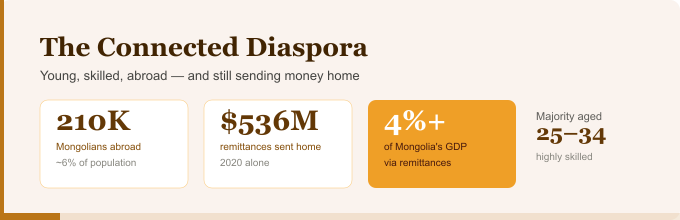
    The most discussed solution to this gap is the returnee pipeline: Mongolians who studied and worked abroad in South Korea, Australia, Singapore, or the United States, and are now returning to Ulaanbaatar with global-standard experience and negotiation confidence.

    This pipeline is real. It is growing. And it is genuinely changing the composition of senior leadership in certain sectors, particularly fintech and financial services. Companies actively recruiting from this pool are offering expatriate-style packages to compete with housing stipends, travel budgets, and international schooling for childrenprecisely because returnees have an honest alternative in the markets they are being asked to leave.

    But the returnee pipeline is also overestimated as a near-term solution. The total pool is limited. Many returnees are mid-career, not yet ready for C-suite mandates. Others are selectively returning, taking roles at organizations they personally respect, not necessarily at companies most desperate to fill leadership gaps. And a meaningful portion hesitate to return at all, citing concerns about market stability, governance culture, and limited professional development infrastructure once they arrive.

    79% of Mongolian executives rate professional development and global exposure as top motivators — often ranking above salary increases.

    That statistic, from Higher Careers’ 2025 research, is worth sitting with. The companies winning the executive talent competition in Mongolia right now are not always the ones paying the most. They are the ones offering a career trajectory that a serious professional actually wants: international exposure, governance autonomy, and the sense that their work will have measurable institutional impact.


    A Structural Problem Requiring a Structural Response

    The organizations that treat Mongolia’s executive talent shortage as a recruiting problem will keep losing. Post a role, receive thin applications, extend an offer, get declined, repeat. That cycle is expensive, time-consuming, and demoralizing for everyone involved.

    The organizations making progress are treating it as a pipeline problem, which requires a different set of actions. Internal succession planning that identifies and deliberately develops mid-career managers three to five years before they need to fill senior roles. Structured mentorship that pairs domestic professionals with returning or expatriate executives. Compensation architecture that goes beyond base salary to include long-term incentives,phantom shares, retention bonuses, and performance-linked equity that signal genuine organizational confidence in a leader’s tenure.

    Externally, specialized executive search is no longer a luxury reserved for multinationals. In a market this small and this competitive, the difference between a structured headhunting process and a word-of-mouth hire is often the difference between finding the person who can do the job and settling for the available person. Lambda.Global’s approach to executive search in the Mongolian market is built precisely on this premise: the best candidates for most senior roles in Mongolia are not actively looking. They need to be found, evaluated properly, and offered a compelling reason to move.


    The Opportunity Side of This Story

    It would be incomplete to describe Mongolia’s executive hiring market purely as a crisis. There is a genuine opportunity embedded in the scarcity. For Mongolian professionals who have invested in building international-standard competence through education, through cross-sector experience, through deliberate skill development, the demand has never been higher. Senior finance, technology, and operations roles are commanding compensation that competes with regional markets. Organizations are offering development programs and governance roles that did not exist five years ago.

    The next generation of Mongolian C-suite leaders will be defined by something their predecessors were rarely asked to demonstrate: the ability to operate simultaneously in Mongolian and global professional registers, to hold both relationship networks and technical rigor, to lead organizations that are growing in complexity faster than the leadership pipeline that is supposed to serve them.

    That is a hard set of capabilities to build. It is also why the executives who possess them, and the companies that know how to find them, will disproportionately shape what Mongolia’s economy looks like in a decade.

  • They Came Back to Mongolia for the Salary. They Stayed for Something Else.

    They Came Back to Mongolia for the Salary. They Stayed for Something Else.

    Bilguun left for Singapore in 2014. He was 24 when he left and he had a finance degree from a university in Ulaanbaatar city that nobody outside Mongolia had heard of. For seven years he climbed in a foreign land. He began working with a local bank, followed by a startup, and ended up doing business across three countries. By 2023, he was earning what those back home that he grew up with would only earn in ten years.

    In a surprising turn of events, he moved back to Mongolia last November. Not for family, not because he got pushed out. He moved back because a Mongolian company offered him something that surprised even him. Not a fancy title, not a company car, not a salary that matched Singapore dollar for dollar. None of that was on the table when he got the offer. What they offered was a real authority where he could rebuild a broken finance function however he saw fit. The CEO told him “You’ll have my ear and my backing. The rest is yours.” He took the job before they even finished negotiating the bonus salary.

    I am telling this story because it says something about Mongolia’s job market that most compensation surveys miss. We still have a gap between what executives earn in Mongolia and what their equivalent roles pay in Singapore, Australia, or Korea. Let’s say a senior finance director in UB will bring home 25 to 45 million tugriks a month. Their counterpart in a foreign country makes two or three times that, sometimes more. Money is always part of the conversation. But it’s rarely the whole conversation.

    The Ministry of Labour’s own mid-term labour forecast from 2024 showed something interesting. Within highly skilled Mongolians abroad, the top reason for considering a return to Mongolia was not a competitive salary, but a meaningful work with decision-making power. According to the info, salary came third on the list after career progression. When I first read that, it felt counterintuitive to me. But then I thought about Bilguun and it started making sense.

    What changes when someone reaches the senior level

    Early-career employees need money. They have student loans, young families, rent, etc. But by the time someone is being recruited for a director-level role or above, the arithmetic changes. What keeps them up at night is not the difference between a 20 million and a 25 million tugrik package. It’s the fear of being positioned in a role where they have the title but not the tools. They may spend six months fighting approvals, waiting for decisions that never come, and end up watching their credibility fade because nobody empowered them to actually lead.

    In a small professional market like this city, that reputation damage is permanent. Word gets around. A story about a senior hire who gets hired with fanfare and leaves quietly six months later because they couldn’t get anything done will keep following them. So experienced professionals ask harder questions in interviews. They are required to know who controls budget, who hires their team, whether the board actually wants change or just wants to announce it for the day. Companies that cannot answer those questions clearly lose the candidate.

    What the data quietly shows

    According to a skills survey carried out by the World Bank in 2022, Mongolian employers consider soft skills such as reliability and communication to be more crucial than technical skills. However, the same applies when senior professionals are picking their employers, based on factors like vision and leadership.

    And then there’s the flexibility piece. More than 70 percent of Gen Z and Millennial professionals globally say they value flexibility over a small salary bump. In Mongolia, that number is harder to pin down with precision, but anyone who spends time talking to candidates in the 30-45 age bracket will hear a version of it. They don’t want to be chained to a desk in Central Tower for appearance’s sake. They want to work where the work happens and be judged by output, not attendance. That mindset shift is already here. The companies ignoring it are quietly losing access to the very people they say they need most.

    Where Lambda.Global fits into this

    At Lambda.Global, we see this play out in near real time. The platform surfaces not just who is looking, but what they’re actually looking for. Roles that clearly articulate decision-making authority and offer genuine flexibility fill noticeably faster than roles that offer a slightly higher salary but give vague answers about their “scope”. It’s a huge difference between a role sitting open for three months versus being filled in three weeks.

    The other thing the data makes plain is how much talent is simply invisible to traditional network-based hiring. A Mongolian professional who has spent eight years in Seoul or Sydney doesn’t show up at the usual Ulaanbaatar city networking drinks. They’re not in the group chats that produce the same shortlists. Lambda.Global helps companies get past their own limited Rolodex and actually see the wider pool that surrounds them. Not as a database of CVs, but as a map of who is reachable and what it would take to bring them home.

    A different kind of negotiation

    If you’re a company trying to hire senior talent right now, some changes are needed to be made. Not because the old one is wrong. But because candidates have already changed. Before putting a number on the table, the company should know what a person can actually do in the role. Not what they’ve done in the past. But what they’ll be allowed to do with you. If that cannot be described that with confidence, the negotiation hasn’t even started yet.

    And if you’re a professional sitting abroad or sitting at home thinking about a move, please start asking those questions early. The companies worth your time will have answers. The rest will fumble and change the subject. That alone tells you everything.

    Mongolia’s talent market in 2026 isn’t suffering from a lack of capable people. It’s suffering from a mismatch between what is being offered and what senior professionals actually want. The gap is not about money first. It’s about trust, autonomy, and respect. The organizations that understand this are not only hiring faster. They’re building teams that stay.

    A big salary might open the door. But clarity about the job is what gets someone to walk through it.

    References

    1. Ministry of Labour and Social Protection / Research Institute of Labour and Social Protection, Labor Market of Mongolia: Mid-Term Demand and Supply Forecasting Study Report (2024) – diaspora return motivations.
    2. World Bank, Skills demand in Mongolia: Main Findings of the Skills Module of the Barometer Survey (2022) – employer rankings of soft vs. technical skills.
    3. Lambda.Global internal hiring platform insights (2025–2026) – observed time-to-fill patterns for roles with vs. without clearly defined authority and flexibility.
    4. General background, Youth Employment Forum highlights, Unread / ADB / Ministry of Labour and Social Protection (2025) – generational preference for flexibility.