We’ve all been told the same story about the career ladder. You have to work hard, promote yourself, manage people and climb again. The climb seems so obvious that no one ever wonders why it should be so clear. Yet something winds up happening to many people once they level up to these stages. They end up in jobs they dislike, doing tasks they don’t care about and feeling more insecure than they used to.
There’s nothing wrong with the career ladder. The problem is that the ladder is missing one crucial element which may be the only way to avoid a stagnant career. It’s called going sideways.
A promotion is not the only measure of progress
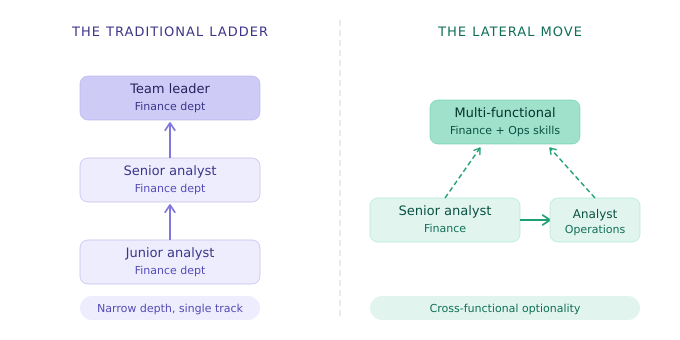
In Ulaanbaatar city, when an individual transitions from being a senior analyst to becoming a team leader, everyone congratulates them. If this same individual transitions from being in the finance department to the operations department at the same seniority, questions will be whispered behind their back.
The second possibility can do three things a promotion often cannot. It can broaden a skill set across functions instead of deepening one narrow field. It can open up a network in a different part of the business or industry. Moreover, it can reignite curiosity in someone who was sleepwalking through a role they mastered years ago. None of that looks like a step forward on paper. All of it makes a professional harder to replace.
Mongolia’s professional community is compact where most people spend years building a reputation in one area. That depth is valuable until the market shifts. If you have been a mining logistics expert for ten years and the commodity cycle turns down, depth becomes a waiting game. If you know how procurement works across three different sectors, you have the option to move when others are stuck.
Moving sideways create such optionality. It makes a person learn a new functional language and they instill a form of intellectual humility that is impossible to develop otherwise. You become humble because you have to ask better questions as someone who knows nothing for the first time since forever ago.
The data behind this logic
OECD labor market analysis research conducted on a global scale shows that people with various work experience in different functional areas are resilient in the event of economic shocks. Additionally, those employees have a greater chance of becoming top leaders in their career trajectories over time despite their careers appearing less linear in the short term.
The skills report published by the World Bank in Mongolia in 2022 indicated that businesses prefer employees capable of working in diverse areas and coping with change. Although that is an obvious ask from businesses, they do not develop career pathways promoting cross-functional experience for their employees. As a result, the few individuals willing to go off the lateral path develop a unique skill set that their colleagues do not acquire at all.
What a sideways move actually looks like
It doesn’t have to mean a dramatic leap into the unknown. The simplest version of moving sideways is shifting from a line role to a project-based role in a different part of the company. Another version is taking a secondment to a partner organization or moving from a large firm to a smaller one.
What makes these moves work is certainly not the title change. It is the deliberate decision made by the individual to learn something unfamiliar. A financial controller who spends a year in a business development team will never look at a spreadsheet the same way again. The person will start seeing the assumptions behind the numbers, not just the numbers themselves. That perspective is worth far more than another promotion that simply adds headcount to her oversight.
Lambda.Global helps connect the dots
Lambda.Global tracks which combinations of skills are becoming more requested across sectors. The sectoral reports and job statistics reveal an interesting trend where job openings that require multi-functionality skills are rising more rapidly than job openings requiring specialization. Companies in areas such as fintech, logistics, and professional services are writing job postings that emphasize functions instead of compartmentalizing them.
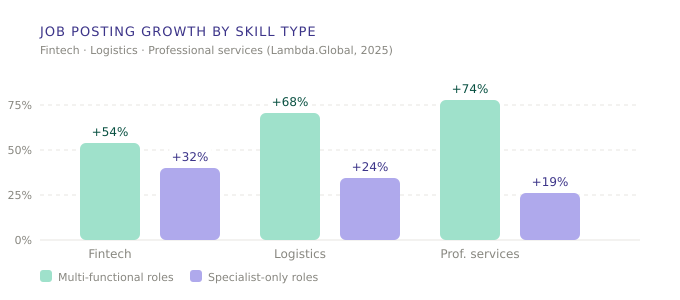
For the people who are considering a lateral move, that data is a practical guide. It shows which industries value broad experience. It signals what adjacent skills might make a person more competitive. Lambda does not make the move for anyone, but it makes the opportunity set visible. In a market where most career advice usually sounds like “stay loyal and get promoted,” having real data on what the market actually rewards is a quiet advantage.
A different kind of ambition
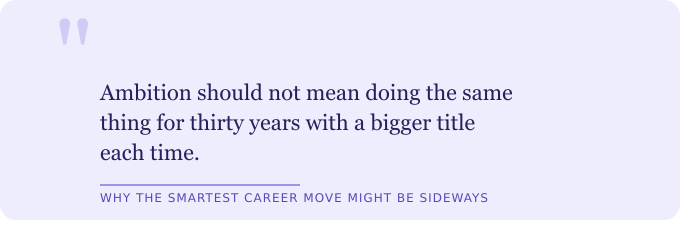
Ambition should not mean doing the same thing for thirty years with a bigger title each time. That is one version of a successful career. There is another version that values curiosity, adaptability, and the willingness to be a beginner again. That option may be a better path for many individuals who prefer to develop themselves in various skill sets. Sure, it is scarier in the short term. But it’s far more rewarding in the long one.
After all, the ladder can wait. The quickest climbers aren’t always the ones who’ve seen the best scenery from up top.
References
- OECD, Employment Outlook (2021) – resilience and career mobility across functional areas.
- World Bank, Skills demand in Mongolia: Main Findings of the Skills Module of the Barometer Survey (2022).
- Harvard Business Review, Lateral Moves Are a Better Way to Grow Your Career (2020).
- Lambda.Global, Sector Skills and Salary Reports (2025) – cross-functional demand signals in Mongolian employers.