Category: Карьер Хөгжил

  • Why the Smartest Career Move Might Be Sideways

    Why the Smartest Career Move Might Be Sideways

    We’ve all been told the same story about the career ladder. You have to work hard, promote yourself, manage people and climb again. The climb seems so obvious that no one ever wonders why it should be so clear. Yet something winds up happening to many people once they level up to these stages. They end up in jobs they dislike, doing tasks they don’t care about and feeling more insecure than they used to.

    There’s nothing wrong with the career ladder. The problem is that the ladder is missing one crucial element which may be the only way to avoid a stagnant career. It’s called going sideways.

    A promotion is not the only measure of progress

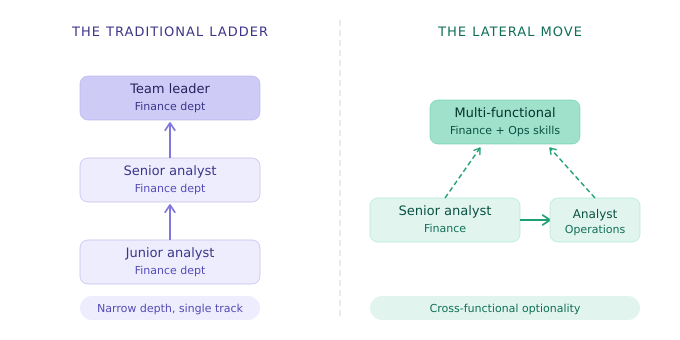
    In Ulaanbaatar city, when an individual transitions from being a senior analyst to becoming a team leader, everyone congratulates them. If this same individual transitions from being in the finance department to the operations department at the same seniority, questions will be whispered behind their back.

    The second possibility can do three things a promotion often cannot. It can broaden a skill set across functions instead of deepening one narrow field. It can open up a network in a different part of the business or industry. Moreover, it can reignite curiosity in someone who was sleepwalking through a role they mastered years ago. None of that looks like a step forward on paper. All of it makes a professional harder to replace.

    Mongolia’s professional community is compact where most people spend years building a reputation in one area. That depth is valuable until the market shifts. If you have been a mining logistics expert for ten years and the commodity cycle turns down, depth becomes a waiting game. If you know how procurement works across three different sectors, you have the option to move when others are stuck.

    Moving sideways create such optionality. It makes a person learn a new functional language and they instill a form of intellectual humility that is impossible to develop otherwise. You become humble because you have to ask better questions as someone who knows nothing for the first time since forever ago.

    The data behind this logic

    OECD labor market analysis research conducted on a global scale shows that people with various work experience in different functional areas are resilient in the event of economic shocks. Additionally, those employees have a greater chance of becoming top leaders in their career trajectories over time despite their careers appearing less linear in the short term.

    The skills report published by the World Bank in Mongolia in 2022 indicated that businesses prefer employees capable of working in diverse areas and coping with change. Although that is an obvious ask from businesses, they do not develop career pathways promoting cross-functional experience for their employees. As a result, the few individuals willing to go off the lateral path develop a unique skill set that their colleagues do not acquire at all.

    What a sideways move actually looks like

    It doesn’t have to mean a dramatic leap into the unknown. The simplest version of moving sideways is shifting from a line role to a project-based role in a different part of the company. Another version is taking a secondment to a partner organization or moving from a large firm to a smaller one.

    What makes these moves work is certainly not the title change. It is the deliberate decision made by the individual to learn something unfamiliar. A financial controller who spends a year in a business development team will never look at a spreadsheet the same way again. The person will start seeing the assumptions behind the numbers, not just the numbers themselves. That perspective is worth far more than another promotion that simply adds headcount to her oversight.

    Lambda.Global helps connect the dots

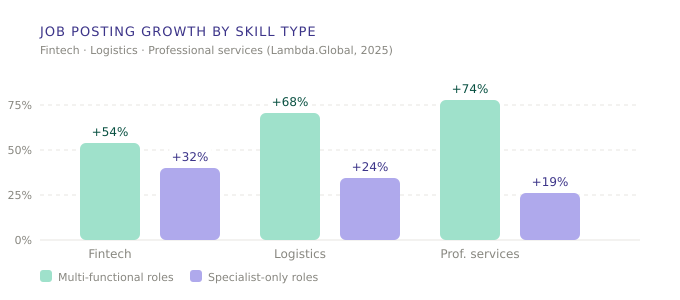
    Lambda.Global tracks which combinations of skills are becoming more requested across sectors. The sectoral reports and job statistics reveal an interesting trend where job openings that require multi-functionality skills are rising more rapidly than job openings requiring specialization. Companies in areas such as fintech, logistics, and professional services are writing job postings that emphasize functions instead of compartmentalizing them.

    For the people who are considering a lateral move, that data is a practical guide. It shows which industries value broad experience. It signals what adjacent skills might make a person more competitive. Lambda does not make the move for anyone, but it makes the opportunity set visible. In a market where most career advice usually sounds like “stay loyal and get promoted,” having real data on what the market actually rewards is a quiet advantage.

    A different kind of ambition

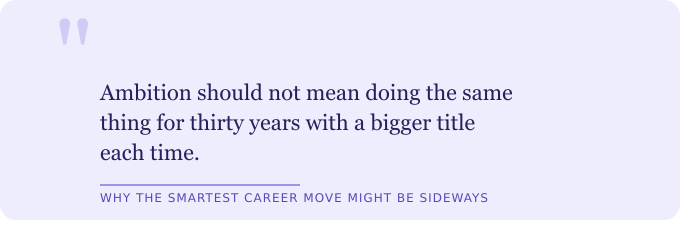
    Ambition should not mean doing the same thing for thirty years with a bigger title each time. That is one version of a successful career. There is another version that values curiosity, adaptability, and the willingness to be a beginner again. That option may be a better path for many individuals who prefer to develop themselves in various skill sets. Sure, it is scarier in the short term. But it’s far more rewarding in the long one.

    After all, the ladder can wait. The quickest climbers aren’t always the ones who’ve seen the best scenery from up top.

    References

    • OECD, Employment Outlook (2021) – resilience and career mobility across functional areas.
    • World Bank, Skills demand in Mongolia: Main Findings of the Skills Module of the Barometer Survey (2022).
    • Harvard Business Review, Lateral Moves Are a Better Way to Grow Your Career (2020).
    • Lambda.Global, Sector Skills and Salary Reports (2025) – cross-functional demand signals in Mongolian employers.
  • The Portfolio Revolution: Redefining Careers in Mongolia

    The Portfolio Revolution: Redefining Careers in Mongolia

    The Problem with Moving Up the Career Ladder 

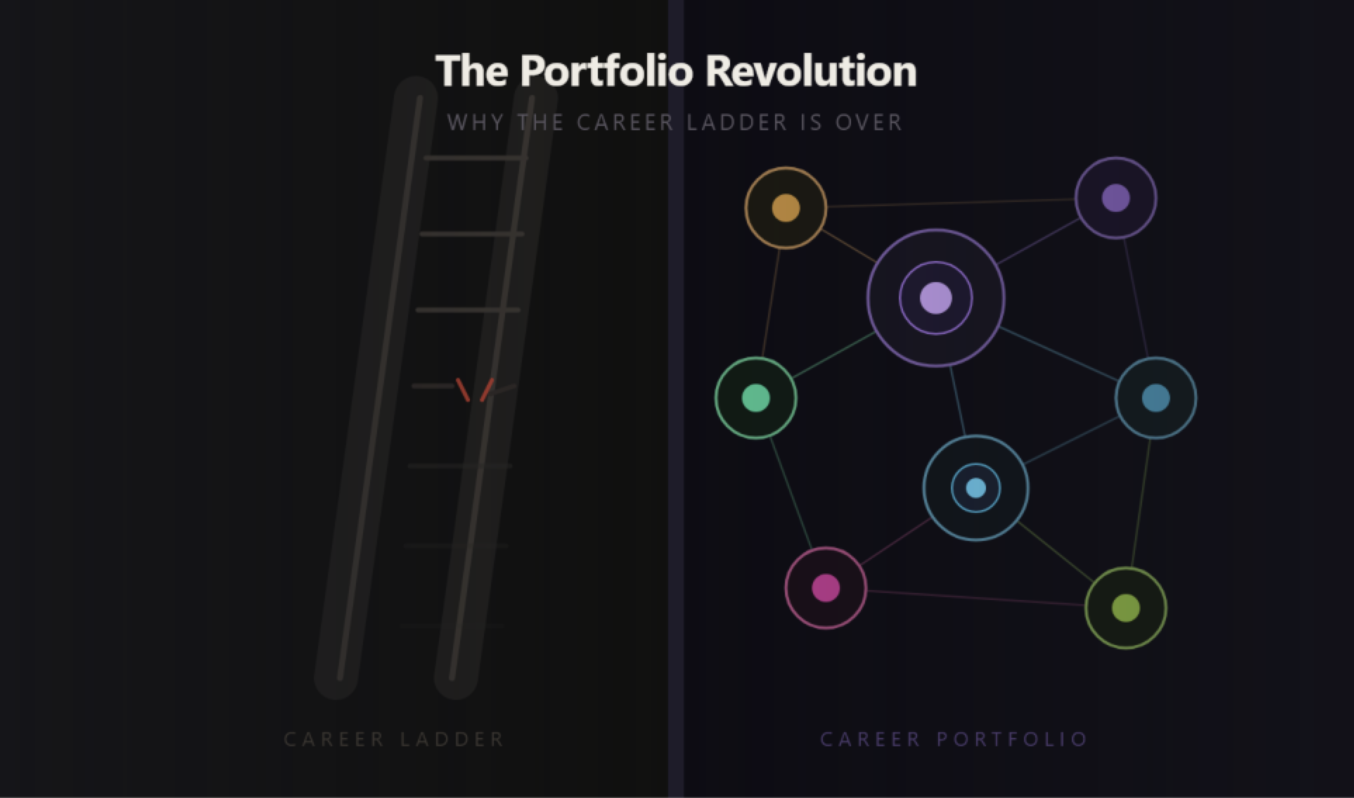
    For a time people thought that the key to being successful was to climb the Career Ladder. This meant starting at the bottom moving up to the middle becoming a manager and eventually retiring from a position. You would stay with one company that gave you benefits a sense of identity and financial security.

    The Career Ladder used to work when things were more stable.. Things are very different now. We are living in a time of changes with artificial intelligence replacing jobs and companies rising and falling quickly. In this world the Career Ladder is no longer a path to success. It is a recipe for disaster. If your income, your professional growth and your reputation depend on one company or one industry you are not in control. You are at the mercy of circumstances.

    The End of the “Company Man” and the Rise of the “Sovereign Expert” 

    We are seeing a change in the way people work. The old idea of the “Company Man” who’s loyal to one company is disappearing. Instead we are seeing the rise of the “Sovereign Expert” who’s in control of their own Career Portfolio. In the past people thought that being loyal to a company was the key to success. They would trade their freedom for the security of a job. This is no longer the case. Companies are no longer able to offer the level of security and people are realizing that they need to be in control of their careers.

    Research shows that the average time a high-level executive stays in a job is now short. 3.2 Years. This is because companies are changing quickly and they no longer need to keep all their employees on staff all the time. With the rise of intelligence and the Fractional Economy companies can get the talent they need for specific projects without having to hire someone full-time.

    When you have a Career Portfolio you are not limited to one company or one industry. You can work on projects and with many different companies at the same time. This means that you are not an employee. You are an asset who can be used in many different ways. A Career Portfolio is like an investment fund. You would not put all your money into one stock so why put all your time and energy into one job?

    What is a High-Impact Career Portfolio? 

    A Career Portfolio is when you use your skills in areas, projects and companies at the same time. A typical expert in 2026 does not have a job title. Instead they have a portfolio of projects and clients.

    To build a portfolio you need to use the 70/20/10 Rule of Intellectual Capital. This means that 50-70% of your time is spent on a long-term project that gives you an income and a sense of security. This is your “Anchor” project.

    Then 20-30% of your time is spent on shorter-term projects that give you the chance to work with companies and industries. These are your “Agility Slots”.

    Finally 10% of your time is spent on learning things and exploring areas. This is your “R&D Lab”.

    The Power of Knowledge Arbitrage 

    The advantage of having a Career Portfolio is that you can use your knowledge in different ways. When you work for one company you can get stuck in a “silo” and only know one industry or area. When you have a portfolio you can work with different companies and industries and use your knowledge to create new and innovative solutions.

    This is called Knowledge Arbitrage. It is when you take an idea or solution from one area and apply it to another area. For example you might take a customer retention strategy from a financial technology company. Apply it to a logistics company. This can create a lot of value. Make you a very valuable expert.

    The Psychological Dividend: From Fragility to Antifragility

    Having a Career Portfolio is not just good for your finances. It is also good for your health. When you are stuck in a job you can feel fragile and vulnerable to changes in the economy or the company. When you have a portfolio you are more resilient and able to adapt to changes.

    You are not an employee. You are an expert who is in control of your own Career Portfolio. You are not afraid of change. You are excited about the opportunities it brings. You are not limited to one company or one industry. You can work with companies and industries and use your knowledge to create new and innovative solutions.

    Tactical Execution: How to Start Placing (Not Hunting)

    If you want to start building a Career Portfolio you need to change the way you think about your career. You are not looking for a job. You are looking for opportunities to use your skills and knowledge.

    You need to identify your “Problem-Solving DNA”. What problems do you. How do you solve them? You need to productize your expertise. Create a framework or system that you can apply to companies and industries.

    You need to deploy your services to companies on a project-by-project basis than looking for a full-time job.

    Lambda Global: Architecting the Future of Work

    At Lambda Global we believe that the individual is the enterprise. We want to help you move from a linear career to a Career Portfolio. We know that managing a client portfolio can be complex and time-consuming so we created the Lambda Skill-Graph to help you.

    Our technology identifies where your skills are in demand and matches you with opportunities around the world. We help you architect your portfolio so you can focus on what you do creating value and solving problems.

    The New Human Contract

    The world of 2026 is very different from the world of the past. We need a contract between professionals and the economy. We need to replace loyalty with impact and stability, with agility. The era of climbing the Career Ladder is over. The era of the diversified high-impact Career Portfolio has begun.

  • The Strategic Placement: The Art of Modern Job Hunting in Mongolia

    The Strategic Placement: The Art of Modern Job Hunting in Mongolia

    Job hunting is a tough experience for people. We have to put everything on the line like our skills and the work we have done for years and hope that someone values it. Most people do not do this in a very active way, which means they do not get the value they deserve.

    In 2026 job hunting is not about applying to every job you see. It is about finding the place for your skills, where you can get the best results for yourself and the company.

    The Psychological Shift: From “Seeker” to “Solution Provider”

    When people start looking for a job they often think “I need a job.” This is the way to think because it makes you seem like you are begging.

    You should think about it like this: you are not trying to sell yourself to a company you are trying to help them solve a problem. You are a partner. Your time is valuable. Talents in the Lambda.Global network do not ask about salary in interviews they ask “What is the problem you are facing right now and how can I help you fix it?”

    The Self-Audit: Mapping Your Skill-Graph

    Before you start looking for a job you need to take a look at your skills and what you can do. This is like what Lambda Global does with their Skill-Graph system.

    • What is your main strength? Are you good at things or are you really good at one thing? For example are you good at stopping customers from leaving or at making engineering teams work better or at increasing revenue?
    • You need to have proof of what you can do. Just saying “I was a Marketing Manager” is not enough. You need to say things like “I reduced marketing costs by 15% and increased sales by 30%.”
    • You also need to be able to adapt to a new team and start getting results. In todays world it is important to be able to start working

    Targeted Hunting: Precision over Volume

    1. Sending your resume to a hundred companies is a waste of time. You should be precise. Focused in your job search.
    2. Choose a few companies that fit with your values and where your skills are a good match. Do your research on these companies read what the CEO is saying and look for problems that customers are having. Find out what the company needs help with.
    3. Then of emailing the human resources department contact someone who can make decisions and offer to help with a specific problem. This is an effective way to get noticed.

    Leveraging the Lambda Global System

    Looking for a job on your own can be really hard. Lambda Global can help.

    Their system matches your skills with what companies need even while you are sleeping. They can also help you work on projects at the same time, which can increase your value in the job market.

    The Interview as a “Diagnosis,” Not a Pitch

    In an interview do not just talk about yourself. Act like a doctor trying to diagnose a problem.

    • Ask questions like “What’s the biggest challenge your team is facing right now?” or “What does success look like for this role in six months?”
    • Then use your experience to offer a solution to the problem. Say something, like “I have seen this problem and I know how to fix it. Here is what I would do.”

    The 2026 Job Hunting Comparison

    ActionLegacy Way (The “Beggar”)The Lambda Way (The “Partner”)
    ToolStatic, long-form CV (PDF)Dynamic Skill-Graph & Case Portfolio
    StrategyApply to every relevant job board postTarget specific gaps in specific companies
    Communication“Please hire me, I am a hard worker”“I can solve this specific problem for you”
    SalaryWaiting for an offer to react toProposing a rate based on “Value Created”
    MindsetSeeking permission and stabilitySeeking impact and intellectual sovereignty

    Final Advice: Patience and Value

    The job hunting process is really tough on people. It can take a time to find the right job that is a good match for you.. You should remember that trying to get people to like you when they are not right for you is a bad idea. It can make you really unhappy with your job.

    In 2026 people do not get paid for showing up to work. They get paid for what they can do to help their company. The goal of Lambda Global is not just to help you find a job but to help you be in charge of your time.

    Do not just look for any job. Look for a place where you can make a difference. Get ready, like a person who knows what they are doing use the tools you have in a way and find a job where you are really needed. This is what Lambda Global calls the way to do things. 

    Strategic Research Insights

    Fractional Leadership: According to the Forbes Agency Council (2025), it is projected that 60% of executives will transition to fractional roles by 2026, prioritizing flexibility over traditional full-time employment.

    Skills-Based Hiring: LinkedIn Economic Graph data reveals that hiring based on specific skills is 5x more effectivein predicting job success than relying on traditional degrees or job titles.

    Productivity Reality: RescueTime analysis shows that knowledge workers are truly productive for only 2.8 hours per day, rendering the “40-hour office week” model obsolete.

  • Potential Solution to Employee Training Gaps in Mongolia

    Potential Solution to Employee Training Gaps in Mongolia

    Employee development training has become an indispensable component of today’s professional environment. It is a key consideration for the new generation, when choosing their employer. Employee development training is beneficial for both the employee and the employer. However, not every employer has the financial and human resources to provide necessary skills training for their employees.

    In Mongolia from the total of 101,582 registered legal entities 97% or 98,659 entities employ fewer than 50 people. I have both experiences working in small organizations with fewer than 50 employees and large enterprise with 100+ employees. Small organizations often lack a designated Human Resources manager, not to mention a designated team. Usually, operations manager covers the human resources responsibilities. Large enterprises have separate human resources team and budget to finance on-the-job and off-the-job trainings. 

    Types of on-the-job training:

    • Coaching
    • Mentoring
    • Job shadowing
    • Job rotation
    • Apprenticeship
    • Understudy
    • Committee assignment/action learning
    • Job instruction technique
    • Blended learning

    Types off-the-job training:

    • Classroom lectures and seminars
    • Simulation training
    • Workshop and conferences
    • E-learning/Online modules
    • Mentoring and Coaching from outside the organization
    • Case study analysis
    • Role-playing
    • External trainings and Industry visits

    The study among small and medium enterprises (SME) found that SMEs neglects to implement the training programme properly, lack understanding of training concept and training objective. The study also discovered that the most SME owners aim to improve employee’s new knowledge and skills, prevent workplace accident, enhance employee’s capability and efficiency. The problem is they do not know how. 
    Lambda Global is here to solve this problem by introducing AI trainings for the registered employers on its platform. According to the statistics, 79% the of the Mongolian legal entities are in retail, trade and services sector. These sectors heavily rely on marketing and customer interaction. AI assistance in these sectors could increase the efficiency by 15-40%. 

    Currently Lambda Global has 150 AI practical courses. All the trainings are in Mongolian language, therefore even the employees without English language skills could directly apply the skills to their work. This is one of the main advantages, as many employers indicate that language barrier is the most noticeable factor that delays the employee development. 

    Second problem is we are all aware that AI can automate and assist our daily repetitive tasks. But in reality, most of us using an AI only on chat base, asking questions and receiving answers. Without proper training, most people do not know from where to start, what AI can actually do.
    When I first went through the Lambda Global’s AI course list, I was surprised to see how many things can be automated or created with AI assistance. Before that, I had little understanding of AI’s capability. From the training list I have got new ideas on AI usage for my daily work. I am confident that this resonates with most of you. 

    Lambda Global’s training will help the employees and employers to conduct the following with the AI assistance:

    – Create a financial assistant and categorize the bank statements
    – Create a self-development personal assistant 
    – Develop an evaluation package for the employees on probation 
    – Develop performance evaluation design
    – Develop an assistant for the evaluation of customer’s feedbacks and comments
    – Current trends and competitors’ research
    – Create and analyze user persona 
    – Develop and interview score card
    – Analysis on exit interview results
    – Develop a manual and digital content
    – Newsletter automation
    – Financial report development
    – Employee portal development
    – Report writing
    – Email writing
    – Marketing content development
    – Website development
    – Business and market research
    – Data analysis
    – Presentation development
    – Brochure design development
    – Create dashboard
    – Training evaluation and feedback of employees.

    Organizations would greatly benefit by joining the Lambda Global. So why wait? Join now and level up your employee today. 

    References:

    1. Business Register Statistics, National Statistics Office, 2023
    2. Employee training in small and medium-sized enterprises in Mongolia, Tuul.O and Shao Jian Bing,2019
    3. Lambda Global AI skills training, 2026, https://lambda.global/ai

  • The C-Suite Squeeze in Mongolia

    The C-Suite Squeeze in Mongolia

    Why Mongolia’s Executive Talent Market Is Tighter Than Any Salary Number Suggests

    When a senior executive role opens at a mid-sized Mongolian company today, the hiring team faces a challenge that did not exist a decade ago. It is not that qualified candidates are impossible to find. It is that the definition of ‘qualified’ has fundamentally shifted, and many organizations are still evaluating candidates against criteria that no longer match the roles they are trying to fill.

    Mongolia’s C-suite talent market in 2025 is tighter, more competitive, and more technically demanding than at any point in the country’s post-transition economic history. Understanding why and what companies can do about it matters far beyond any single hiring decision.


    The Numbers Behind the Squeeze

    Start with compensation, because it tells the story quickly. Average monthly salaries for senior management in Mongolia now sit around 4.37 million MNT, roughly $1,250 at current exchange rates. But that number is almost misleading in isolation. In Mongolia’s banking sector, C-suite executives at major institutions like Khan Bank, Golomt, and TDB command between 15 and 30 million MNT per month, plus performance bonuses, housing allowances, and, in some cases, international schooling coverage for families. In mining, still the economy’s dominant force, C-suite total annual compensation at operations tied to Oyu Tolgoi and major coal projects can exceed 400 to 600 million MNT, inclusive of bonuses.

    The finance sector tells a more specific story. A seasoned CFO who can operate across both Mongolian regulatory requirements and international accounting standards, IFRS, Basel III, AML/KYC frameworks, can command 90 to 150 million MNT annually. The problem is not that companies refuse to pay that figure. The problem is that there are not enough people who can credibly do the job at that level.

    The pool of executives with deep boardroom experience in Mongolia remains small. Every qualified placement carries significant weight.

    Executive base salaries across sectors grew 8 to 12 percent on average between 2024 and 2025. That growth rate, while positive, still trails comparable emerging markets in Southeast Asia. Vietnam and Indonesia, often cited as peer comparators, are seeing faster compensation escalation partly because they have larger domestic talent pools that create genuine competitive pressure. Mongolia’s market is moving, but it is moving slowly relative to the demand it now faces.


    What Companies Are Actually Looking For And Not Finding

    The shift in what defines a strong executive hire is worth examining directly, because it explains why the shortage feels so acute even when the labor market technically contains experienced professionals.

    Ten years ago, the profile of a successful Mongolian executive was largely defined by two things: deep sector knowledge and strong domestic relationships. A bank branch manager with 20 years of experience and a reliable network was a credible candidate for a regional director role. That model worked in a relatively closed, relationship-driven economy.

    Today, that profile is necessary but not sufficient. The modern Mongolian executive candidate needs to layer international competency on top of local fluency. Banks are integrating with global compliance systems. Mining operations are reporting ESG metrics to international lenders. Fintech companies — LendMN, AND Global, HiPay, and Ard App are building products that compete regionally. Every one of these contexts requires a leader who can read a room in Ulaanbaatar and a term sheet in Singapore.

    The skills in shortest supply right now are specific: financial executives with genuine IFRS and investor relations experience, technology leaders who understand both product development and regulatory risk, operations executives who can manage large Mongolian workforces while satisfying the governance requirements of international joint venture partners. These are not entry-level gaps. They are senior-level gaps, the hardest and most expensive kind to fill.


    The Returnee Opportunity – Real, But Overestimated

    The most discussed solution to this gap is the returnee pipeline: Mongolians who studied and worked abroad in South Korea, Australia, Singapore, or the United States, and are now returning to Ulaanbaatar with global-standard experience and negotiation confidence.

    This pipeline is real. It is growing. And it is genuinely changing the composition of senior leadership in certain sectors, particularly fintech and financial services. Companies actively recruiting from this pool are offering expatriate-style packages to compete with housing stipends, travel budgets, and international schooling for childrenprecisely because returnees have an honest alternative in the markets they are being asked to leave.

    But the returnee pipeline is also overestimated as a near-term solution. The total pool is limited. Many returnees are mid-career, not yet ready for C-suite mandates. Others are selectively returning, taking roles at organizations they personally respect, not necessarily at companies most desperate to fill leadership gaps. And a meaningful portion hesitate to return at all, citing concerns about market stability, governance culture, and limited professional development infrastructure once they arrive.

    79% of Mongolian executives rate professional development and global exposure as top motivators — often ranking above salary increases.

    That statistic, from Higher Careers’ 2025 research, is worth sitting with. The companies winning the executive talent competition in Mongolia right now are not always the ones paying the most. They are the ones offering a career trajectory that a serious professional actually wants: international exposure, governance autonomy, and the sense that their work will have measurable institutional impact.


    A Structural Problem Requiring a Structural Response

    The organizations that treat Mongolia’s executive talent shortage as a recruiting problem will keep losing. Post a role, receive thin applications, extend an offer, get declined, repeat. That cycle is expensive, time-consuming, and demoralizing for everyone involved.

    The organizations making progress are treating it as a pipeline problem, which requires a different set of actions. Internal succession planning that identifies and deliberately develops mid-career managers three to five years before they need to fill senior roles. Structured mentorship that pairs domestic professionals with returning or expatriate executives. Compensation architecture that goes beyond base salary to include long-term incentives,phantom shares, retention bonuses, and performance-linked equity that signal genuine organizational confidence in a leader’s tenure.

    Externally, specialized executive search is no longer a luxury reserved for multinationals. In a market this small and this competitive, the difference between a structured headhunting process and a word-of-mouth hire is often the difference between finding the person who can do the job and settling for the available person. Lambda.Global’s approach to executive search in the Mongolian market is built precisely on this premise: the best candidates for most senior roles in Mongolia are not actively looking. They need to be found, evaluated properly, and offered a compelling reason to move.


    The Opportunity Side of This Story

    It would be incomplete to describe Mongolia’s executive hiring market purely as a crisis. There is a genuine opportunity embedded in the scarcity. For Mongolian professionals who have invested in building international-standard competence through education, through cross-sector experience, through deliberate skill development, the demand has never been higher. Senior finance, technology, and operations roles are commanding compensation that competes with regional markets. Organizations are offering development programs and governance roles that did not exist five years ago.

    The next generation of Mongolian C-suite leaders will be defined by something their predecessors were rarely asked to demonstrate: the ability to operate simultaneously in Mongolian and global professional registers, to hold both relationship networks and technical rigor, to lead organizations that are growing in complexity faster than the leadership pipeline that is supposed to serve them.

    That is a hard set of capabilities to build. It is also why the executives who possess them, and the companies that know how to find them, will disproportionately shape what Mongolia’s economy looks like in a decade.

  • What Is the Executive Talent Gap? And Why Is It a Growing Issue in Mongolian Companies

    What Is the Executive Talent Gap? And Why Is It a Growing Issue in Mongolian Companies

    Let’s say a top-tier mining contractor in Mongolia spent close to five months trying to hire a Head of Operations. The role was critical. The salary was already above what most local companies would offer.

    Candidates came and went. Some were not quite ready. Some were already tied into better roles. A few lost interest halfway through the process. In the end, the company hired someone based in Australia. The final package landed at nearly double the original budget once relocation and allowances were factored in.

    No one involved would call this unusual by today’s standard. This is what executive hiring is starting to look like. And it moves slowly. In a market where even mid-level roles can take a month or two to fill, senior positions easily stretch to five or six months—sometimes longer. The search itself becomes more expensive than the salary increase companies were trying to avoid in the first place.

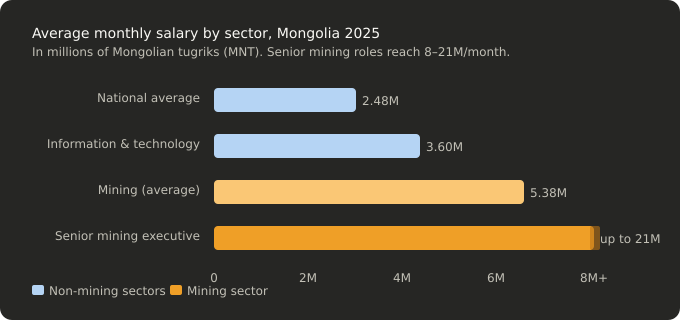
    Mongolia is not short on people. It is short on people who have already seen enough to lead without hesitation. Everything might look fine if you only check the headline numbers. The national average monthly salary reached roughly 2.48 million tugriks last year. Executive base pay climbed another 8–12 percent over the same period. On paper, the market is getting stronger.

    The reality is more awkward. The same handful of candidates keep circling through the same senior roles at different companies. The pool hasn’t grown. The price has. And at some point, salary stops being the main question.

    Early in a career, people chase the number. That’s normal. At the executive level, the questions change. People start asking what they’re walking into. Who actually makes decisions. Whether the team is stable. Whether the business knows where it’s going. Those answers matter more than an extra one or two million tugriks. And when the answers are unclear, the offer begins to fall apart.

    So, companies push harder on the one lever they can control: pay. It feels like action. It rarely fixes the real issue.

    The unevenness of economic growth can be seen from many sources. Mongolia’s economy expanded by 6.9 percent in 2025 according to the World Bank. It was driven largely by mining and agriculture industries. Thanks to that growth, wages were pushed upward, especially in resource-linked industries. But higher wages are not the same as deeper capability.

    Look at the spread. By late 2025, the average monthly salary in mining was about 5.38 million tugriks. In comparison, the information and technology sector had the average hovering around 3.6 million. At the top end, senior mining professionals can earn between 100 million and 250 million tugriks annually—numbers that simply don’t exist in most other industries. Mining companies aren’t being reckless; they have the margins. The problem is that this premium distorts expectations across the entire market. Banks, fintechs, professional service firms—they all end up competing against a benchmark they often cannot match, while trying to attract the same caliber of leader.

    The result is a market that looks competitive but feels unstable. Compensation rises faster than the organizational maturity needed to make these roles stick.

    The diaspora is not the problem. It is the signal.

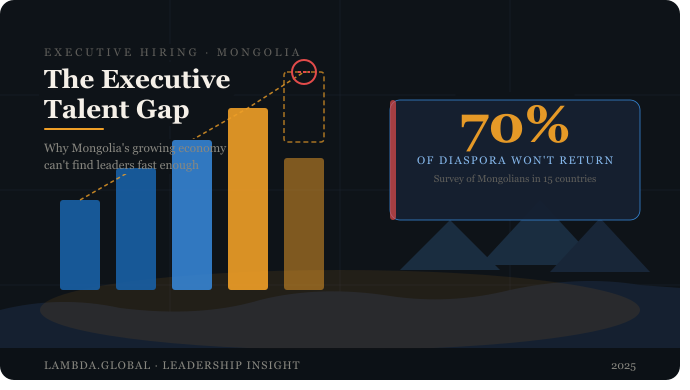
    There is no shortage of Mongolian professionals working abroad. Engineers in Korea, finance professionals in Singapore, consultants in Australia. Estimates put the Mongolian diaspora at well over 200,000 people worldwide—around 6 percent of the country’s entire population. According to a recent survey of Mongolians living across 15 countries, more than 70 percent of them hold a bachelor’s, master’s, or doctoral degree. Yet eight out of ten said they had no intention of returning to their homeland.

    That is often misunderstood as a salary problem. It rarely is. People do return—but only for roles that feel worth returning to. That means clear mandates, real authority, and organizations that operate with a certain seriousness. When those conditions are absent, the global market stays more attractive, even if the pay gap narrows. The shortage of diaspora talent in senior roles isn’t the root cause. It’s a reflection.

    At the executive level, hiring in Mongolia still leans heavily on familiarity. The professional network in Ulaanbaatar is small. Most searches begin with a shortlist that already looks nearly identical across firms. For a while, that works. Then it starts to show its limits. The same people are approached over and over. They become harder to reach, more selective, and predictably more expensive. Hiring timelines stretch. Expectations on both sides drift apart. Offers get pushed higher not because the role demands it, but just to keep the conversation alive.

    It feels like a tight market. In many ways, it is artificially tight—because the search stays too narrow for too long.

    That’s where Lambda.Global starts to matter. Not as a shortcut, but as a way to make the market more visible. Real compensation benchmarks that show what similar roles actually pay—not just the inflated figure a desperate company slapped on at the last minute. Access to professionals who don’t surface in the usual Ulaanbaatar network, including Mongolians abroad who might be open to the right conversation. It doesn’t magically fix hiring. It removes a layer of guesswork that companies have operated with for years.

    The cost of waiting until it’s urgent

    Most companies only think seriously about leadership when something breaks. A key person leaves. A role opens. Suddenly it’s urgent. By then, choices are limited and expensive. The companies that navigate this better do something less dramatic. They spot people early, give them room to grow, and treat leadership development as part of running the business—not a panic button for when a gap appears. It’s quiet work. It doesn’t look impressive from the outside. But when a role opens, they aren’t scrambling.

    The gap will not close on its own

    Mongolia’s economy is still moving towards a positive direction. The World Bank projects 5.0 percent growth for Mongolian economy in 2026. Therefore, demand for experienced leadership will only increase in the future. Supply will take much longer. That gap isn’t going to fix itself.

    Sooner or later, companies will need to stop treating hiring as a response or leverage, and start treating it as recruiting a talent you build over time. That means clearer development paths, leaders who take people seriously, and better data. Compensation visibility, a wider view of the talent pool, and genuine access to diaspora professionals aren’t “nice to have” anymore. They’re part of how modern hiring gets done.

    Right now, most organizations are still reacting. The few that stop reacting first will be in a very different position five years from now.

    Conclusion

    Mongolia isn’t losing because it lacks talent. It’s losing because it hasn’t fully connected that talent to the right opportunities. Rising salaries have made the gap more visible. They haven’t closed it. The companies that will shape the next phase of Mongolia’s economy aren’t the ones offering the highest pay. They’re the ones building leaders before they urgently need them—and using the right tools to see the full market before making their most critical decisions.

    Everyone else will keep searching.

    References

    1. Rivermate, Recruitment in Mongolia (2025) – typical hiring timelines for professional roles.
    2. National Statistics Office of Mongolia / WageCentre – national average monthly salary, 2025.
    3. Higher Careers, Executive Compensation Trends in Mongolia 2025 – executive base salary movement.
    4. World Bank, Mongolia’s Economy Stays Resilient but Faces Rising Uncertainty (April 2026) – GDP figures and 2026 projection.
    5. CEIC Data, Mongolia Average Monthly Wage: Mining & Quarrying – Q4 2025 data.
    6. AmCham Mongolia, Salary Survey 2024 – IT sector average salary.
    7. Higher Careers, Career Paths for Senior Managers in Mongolia’s Key Industries – senior mining manager compensation range.
    8. National Statistics Office & United Nations Migration Agency – diaspora population estimate (via E-Mongolia, April 2025).
    9. UB Post, Should we continue letting talented minds flow outward? (May 2025) – diaspora education levels and return intention survey.
    10. MONTSAME, Mongolia’s Workforce Demand in 2025 to Reach 83.7 Thousand (Jan 2025).
    11. 9cv9 Blog, The State of Recruitment and Hiring in Mongolia in 2025 (April 2025) – recruitment landscape and talent shortage overview.
  • Өөрийн үнэ цэнийг хэрхэн мэдэх вэ?

    Өөрийн үнэ цэнийг хэрхэн мэдэх вэ?

    Өөрийгөө танин мэднэ гэдэг амьдралд маш чухал зүйл. Бид хүүхэд байхаасаа эхлээд нийгмийн амьдралд оролцож, бусадтай харилцаж эхлээд юунд дуртай, юу сонирхлыг татаж байна, юу бидэнд аз жаргал өгч байна, ирээдүйд хэн болох гээд олон зүйлийг анзаарч, эргэцүүлэх шаардлага амьдралд гарч ирсээр байдаг. Энэ бүхэн дунд өөрийгөө хэн болохыг бага багаар танин мэдсээр, суралцсаар.

    Бидний бодол, мэдрэмж, үнэт зүйл, давуу болон сул тал, шийдвэр гаргах хэв маяг гээд дотоод хүнээ ойлгож эхлэх үйл явц бол өөрийгөө танин мэдэх тухай энэхүү ойлголтод хамаарна. Өөрөөр хэлбэл өөрийгөө удирдах чадварын суурийг тавьж байна л гэсэн үг билээ. Тухайлбал баярлах, уурлах, бухимдхаараа ямар хариу үйлдэл гаргадаг, тийм нөхцөлд сэтгэл хөдлөлөө хэрхэн удирдах гэх мэт зүйлст бид суралцах хэрэгтэй болдог.

    Өөрийн үнэ цэнийг зөв ойлгож, зөв газар, зөв байдлаар илэрхийлж сурах нь хувь хүн илүү хурдтай өсөж, эргэн тойрон дахь боломжуудаа анзаарах суурь нь болдог байна. Чадвартай, туршлагатай хүмүүс хүртэл өөрсдийн бодит үнэ цэнийг дутуу үнэлж, буруу орчинд гацах нь элбэг. Тиймээс хаана байвал, юу хийвэл үнэ цэнтэй гэдгээ мэдсэн байхад илүү олон чадварт суралцаж, ажлын амжилт, амьдралын чанар ч сайжрах эерэг нөлөөтэй юм.

    Өөрийгөө танин мэдэх нь амьдралд маш чухал. Учир нь бид өөрийгөө сайн ойлгож байвал ямар ажил, ямар орчинд илүү аз жаргалтай, амжилттай байхаа мэддэг болно. Бас бусдын үг, нөлөөнд амархан автахгүй, өөрийнхөөрөө шийдвэр гаргах итгэлтэй болдог. Ийм үед хүмүүс дотроо илүү тайван, тогтвортой болж эхэлдэг. Харин өөрийгөө сайн мэдэхгүй үед хүмүүс ихэвчлэн бусдыг дагаж урсгалаараа амьдарч байдаг билээ.

    Бодит үнэ цэнэ нь дараах 3 зүйлээс бүрддэг байна.

    Ур чадвар – таны хийж чаддаг зүйл

    Үр дүн – таны авчирдаг бодит нөлөө

    Хандлага – таны ажиллах арга барил, хариуцлага

    “Намайг юу үнэхээр баярлуулдаг вэ?”, “Би юунаас хамгийн их айдаг вэ?”, “Би ямар үед хамгийн их эрч хүчтэй байдаг вэ?” “Ямар хүмүүсийн дэргэд би тухтай өөрөөрөө байж чаддаг вэ” гэх мэт асуултуудыг үнэн сэтгэлээсээ бодож хариулаад, өөрийгөө илүү сайн сонсоод үзээрэй. Өөрийгөө сайн ойлгохын тулд үнэт зүйлсээ тодорхойлох маш чухал. Таны хувьд яг юу хамгийн үнэ цэнтэй вэ? мөнгө үү, эрх чөлөө юу, гэр бүл үү, эсвэл өсөлт үү? Энэ асуултад тодорхой хариулттай байвал шийдвэр гаргахдаа төөрөх нь бага байдаг.

    Мөн түүнчлэн хааяа ганцаараа байх цаг гаргах хэрэгтэй юм. Гадны дуу чимээ, хүмүүсийн нөлөөнөөс түр холдож байж л та дотоод дуу хоолойгоо сонсож чадна. Утасгүй бас сошиал ертөнцөөс хол ердөө 30 минут ч байсан хамаагүй тэр хугацаа бидэнд өөрийгөө илүү тодорхой мэдрэх, бодлоо цэгцлэх боломж өгдөг.

    Миний хувьд бол хааяа кофе шопд суугаад дуртай амттанаа идээд, хөгжим сонсоод эргэцүүлдэг. Мөн өглөө эрт ууланд гарах, цэвэр агаарт алхахдаа тархиа цэгцлэх нь бүр илүү таатай санагддаг.

    Дараах шалтгаануудаас болж бид өөрийгөө дутуу үнэлдэг байна.

    Дассан орчин
    Танил хамт олон, тогтвортой байдал нь хангалттай гэсэн мэдрэмж өгдөг.

    Айдас, түгшүүр
    Илүү өндөр боломж руу алхахад бэлэн эсэхдээ эргэлзэж байдаг.

    Өөрийгөө бусадтай харьцуулах
    Өөрөөсөө илүү хүмүүстэй өөрийгөө үргэлж харьцуулах.

    Үнэ цэнээ өсгөхийн тулд та энгийн жижиг алхмуудаас эхлээрэй. Тухайбал нэг чиглэлд төвлөрч, тэр салбартаа бусдаас ялгарах хэмжээнд хүртэл туршлагажиж хөгжих нь хамгийн эхний алхам юм. Бүх зүйлд дундаж байхаас илүү нэг зүйлд маш сайн байх нь илүү үнэ цэнтэй байдаг. Мөн хийсэн ажлаа болон ямар үр дүн гаргаснаа тоо, өсөлтөөр хэмжиж өөрийг илэрхийлэх CV, портфолио дээрээ бичдэг байх хэрэгтэй. Ингэснээр та өөртөө илүү итгэлтэй болно.

    Үүний зэрэгцээ тохирох орчноо сонгох нь маш чухал бөгөөд зарим газар таны чадварыг анзаарахгүй ч байж болно, харин зөв орчинд та илүү тод гэрэлтэж чадна. Өөрийн үнэ цэнийг мэддэг хүн илүү өндөр нөхцөл шаардахаас айдаггүй, өөрт тохирсон ажлаа сонгож чаддаг, ажил дээрээ илүү итгэлтэй, үлгэр жишээ бас манлайлагч байдаг.

  • Яагаад сайн талентууд буруу ажил дээр гацдаг вэ?

    Яагаад сайн талентууд буруу ажил дээр гацдаг вэ?

    Сонголт хийх заримдаа хэцүү байдаг. Юу зөв юу буруу байх нь тухайн цаг үе, сэтгэл санааны байдал, мэдээлэл бүрэн бус байх, орчин болоод нийгмийн үзэл бодол төдийгүй эргэн тойрны хүмүүс гээд олон хүчин зүйл сонголтод нөлөөлөх боломжтой билээ. Ажлаас уйдах мэдрэмж та авч байсан уу? Өдөр бүр нэгэн хэвийн өнгөрөөд, яг нэг байрандаа гацсан юм шиг санагдах үе амьдралд цөөнгүй тохиодог билээ. Чадвартай хэдий ч та өөрт тохирохгүй, тухгүй газраа хэт удаан байх нь тийм ч таатай байдал биш юм.

    Юуны түрүүнд хувь хүн өөрийгөө таньж мэднэ гэдэг их чухал. Юунд дуртай, юуг хүсэж мөрөөддөг болоод өөрийн амьдралаас хүлээх хүлээлт, баримталдаг зарчим, үнэ цэн, давуу болон сул талууд гээд сайн мэддэг байх нь хаана байхаа сонгохын үндэс болох юм. Олон хүн өөрийн чадварыг бүрэн ойлгоогүй, эсвэл зах зээл дээр хэрхэн зөв байршуулж байгаагаа мэдэхгүйгээс болж өөрт тохироогүй ажлыг сонгох нь олонтаа.

    Бодит байдал дээр олон чадварлаг, потенциал өндөр хүмүүс өөрт тохироогүй ажил дээр удаан хугацаанд гацсан хэвээр байдаг. Зарим нь тогтвортой байдал, цалин, эсвэл айдсаас шалтгаалан тухайн орчноос гарахгүй уддаг. Харин зарим тохиолдолд компани өөрөө тухайн хүний потенциалыг бүрэн ашиглаж чаддаггүй, эсвэл өсөлтийн боломж нь хязгаарлагдмал байдаг байна.

    Үр дүнд нь чадвартай хүмүүс хийж чадах зүйлээсээ доогуур түвшинд гацаж, сэтгэл ханамжгүй ажиллах нь элбэг. Өөрийн ур чадвар, сонирхол, үнэ цэнтэйгээ нийцсэн орчинд байх нь илүү сэтгэл ханамжтай, тогтвортой ажиллах үндэс юм.

    Өөрийн туршлагаасаа хуваалцахад, ажил дээрээ аль болох асуудлыг зөв бөгөөд хурдан шийдээд, бусадтай зохицох гэж хичээж, заримдаа илүү цагаар ажиллаж гэр бүлдээ болон өөртөө зарцуулах цагаасаа ч ажилдаа зарцуулж удаан хугацаанд ажилласан. Мөн хариуцлагаа хамгийн түрүүнд ухамсарлаж, тухайн зорилгод хүрч, таскаа биелүүлэхийг урьтал болгож ажиллана. Удирдлага нь хэрвээ ажилчдаа анзаардаггүй, ажлын үр дүнг шударга үнэлж чаддаггүй, хэт их шахаж улмаар тэр байдал нь дарамт болдог тохиолдолд ажилчлдын сэтгэл зүй хамгийн түрүүнд гэмтдэг. Бүтэнсайны орой сэтгэлийн түгшүүрийг мэдэрч, ажилдаа өглөө дуртай явах эрч хүч яваандаа суларсаар л байдаг.

    Зөв газраа байгаа үед илүү суралцах хүслээр дүүрэн, хамт олондоо сэтгэл хангалуун, work buddy-тай буюу ажлын сайн найзтай, хийж буй зүйлсээсээ урам авч, хааяа ч болов өөрөөрөө бахархан, нээлттэй мэдээлэл солилцоо бүхий орчинд бүтээмж өндөртэй ажиллах нөхцөл бүрдэх байх гэж боддог. Тушаал дэвших, урамшуулал авах, цалин орлогоо нэмэгдүүлэх боломжууд байвал хэн ч байсан илүү урт хугацаанд ажиллахыг эрмэзэнэ гэдэгт эргэлзэхгүй байна. Харин сөрөг буюу хортой уур амьсгалтай газар хүн ачаалал багатай ажилласан ч маш их туйлдаж, идэвхгүй болсон байх магадлалтай.

    Заримдаа чадвартай хүмүүс ч гэсэн тогтвортой байдалд дасах үедээ аюулгүй бүсээс гарахаас эмээх нь бий. Тогтмол цалин, танил орчин, дассан хамт олон нь гаднаасаа тайван, найдвартай мэт санагдавч энэ нь илүү том боломж руу дөхөх алхмыг нь саатуулдаг. Ийм үед хүн өөрт илүү тохирох, өсөлт авчрах боломжийг олж харсан ч эрсдэлээс зайлсхийж, одоогийн байдалдаа үлдэхийг сонгодог нь урт хугацаандаа хөгжлөөс нь холдуулдаг байх талтай юм.

    Гэхдээ амьдралд гаргах шийдвэрүүд бүгд л биднээс хамааралтай байдаг билээ. Өнөөдрийн сонголт маргаашийн ирээдүйг тодорхойлно гэдэг үг шиг хэрвээ танд өөрчлөлт хиймээр санагдаж байвал эрсдлээс айлгүй оролдоод үзээрэй. Нэг хаалга хаахад нөгөө хаалга нээгддэг учраас чадварыг тань услах зөв газарт хувь нэмрээ оруулаарай. Өөрийгөө дэмждэг, үнэлдэг, санал санаачлагыг сонсдог орчинд байх нь амьдралаас авах аз жаргалыг тань нэмэгдүүлэх ч юм билүү.

  • Таны ур чадвар хаана үнэ цэнтэй вэ?

    Таны ур чадвар хаана үнэ цэнтэй вэ?

    Энэ сэдвээр бичихийн өмнө ур чадвар гэж юу болох тухай тунгаая. Миний хувьд хүн бүрд өөрийн төрөлх давуу талуудаас гадна бусдаас ялгарах тодорхой чадварууд амьдралын туршлагаар хуримтлагдсаар байдаг гэж боддог. Хүүхэд наснаас эхлээд хүн бүр ур чадваруудад суралцаж, хуримтлуулж, нэмж олж авсаар байдаг. Тухайлбал, олон хүмүүстэй харилцах, ойлголцох, өөрийгөө бусдад нээлттэй илэрхийлэх, мэдээллийг зөв дамжуулах, биеэ зөв авч явах, хариуцлагатай байх, хэлсэндээ хүрдэг байх, цагтаа амждаг байх гэх мэт энгийн сонсогдовч нийгмийн амьдралд оролцоход хамгийн хэрэгтэй төрөл бүрийн чадваруудыг янз бүрийн байдлаар эзэмшсээр байдаг юм.

    Ур чадвар гэдгийг тодорхойлохдоо хүн тодорхой ажлыг зөв, оновчтой, үр дүнтэй гүйцэтгэхэд шаардлагатай мэдлэг, дадлага, туршлагын нэгдэл бөгөөд сурсан зүйлээ бодит амьдралд хэрэгжүүлж, аливаа ажил үүргийг чанартай, бүтээмжтэй, хурдан, бас найдвартай хийх бодит чадварыг илэрхийлдэг гэжээ. Бусдын итгэлийг даах, түүнийг дагаад хариуцлагатай байх, нэгнээ идэвхтэй анхааралтай сонсож, аливаа мэдээлэлд шүүлтүүртэй хандах, өөрийн гэсэн үзэл бодолтой байж, шаардлагатай үед байр сууриа хамгаалж, бусдад эерэгээр нөлөөлөх зэрэг чадварууд нь тэр болгон хүн бүрд бүрэн дүүрэн нэг дор оршдоггүй билээ.

    Сүүлийн жилүүдэд хөдөлмөрийн зах зээлд зөөлөн ур чадвар, хатуу ур чадвар гэдэг ойлголтууд их яригдах болсон. CV бичихдээ хүртэл таныг чадваруудаа ингэж бүлэгт хуваан ялгаж бичсэн гэдэгт эргэлзэхгүй байна. Хэдийгээр амжилтад хүрч, тушаал дэвшиж, өндөр цалинтай өөрийгөө шударга үнэлүүлж ажиллахад мэргэжлийн ур чадварууд хамгийн түрүүнд хэрэг болдог ч мөн дээрээс нь тухайн хүний төрөлх чанар, хувь хүний онцлог, суурь хүмүүжил, төлөвшсөн байдал зэрэг нь зөөлөн ур чадварыг хөгжүүлэхэд хамгийн ихээр нөлөөлдөг.

    Олон жил ажил хийж, янз бүрийн жижиг, том компаниудад ажиллан, хүмүүстэй харилцахдаа ажигласан зүйлээсээ хуваалцвал мэргэжлийн ур чадваруудаа бүрэн дүүрэн эзэмшиж, тухайн төсөлд үнэтэй хувь нэмэр оруулахын зэрэгцээ хамт олон дундаа нөлөөлөгч, манлайлагч байж сурах нь чухал юм байна лээ. Манлайлах гэдэг ойлголтын нэг хэсэг нь үлгэр жишээ байх буюу үгээрээ, үйлдлээрээ, үр дүнгээрээ бусдыг манлайлах боломж хүн бүрд байдаг. Монголчуудын ярьдаг шиг “зөв хүний үйлдэл нүднээс далд ч зөв байдаг” гэдэгтэй адил энэ агуулга ялангуяа ажлын байран дээр үүрэг хариуцлага, гүйцэтгэлтэй шууд холбогддог.

    Өөрийн мэдлэг, сурсан зүйлс, ур чадваруудаа шударга үнэлүүлнэ гэдэг залуучуудын хувьд юунаас ч эрхэм байх ёстой. Зарим газар ажиллахад таны ур чадварууд бүрэн ашиглагдахгүй байгаа мэт мэдрэмж төрдөг. Энэ нь тухайн газар таны өсөж хөгжих, шинэ зүйлст суралцах боломжийг хангалттай өгөхгүй байгаагийн илрэл байж болох юм. Зарим хүмүүс маш сайн ур чадвартай мөртлөө буруу салбар, буруу компанид ажилласнаас болж өөрийгөө дутуу үнэлж эхэлдэг. Харин нөгөө хэсэг нь дундаж чадвартай ч зөв орчинд орсноор хурдан өсөж, амжилтад хүрдэг ч тохиолдол байна.

    Байгууллагын дотоод орчин, соёл, ажил үүргийн бүтэц, баг системийн зохион байгуулалт дутмаг байгаа үед заримдаа бүтээмжгүй ажиллах, сэтгэлээр унах, үнэ цэнгүй мэт санагдаж болно. Харин санал бодлыг тань нээлттэй сонсдог, сурах хөгжихийг дэмждэг, дарамт шахалт бага, мэдээлэл тодорхой ойлгомжтой үед ажиллаж буй хүмүүс илүү өөртөө итгэлтэй, хийсэн бүтээсэн зүйлсээсээ урам зориг авах нь олонтаа.

    Миний хувьд хэт том нүсэр бүтэцтэй, олон хурал хийдэг, маш их төлөвлөдөг мөртлөө төлөвлөгөө нь бодит байдалд хэрэгждэггүй компаниас илүү цөөн хүнтэй, өсөх ирээдүйтэй, эрүүл орчинд бүтээмжтэй ажиллаж чаддаг, нэг зорилготой, чөлөөтэй уур амьсгалтай газар ажиллах нь илүү дээр санагддаг. Үнэ цэнтэй, өөрөөрөө байхад шударга үнэлэгдэж байгаа газарт хүн илүү хөгжиж, сэтгэл хангалуун ажилладаг гэж бодном. Учир нь ур чадвараа ашиглан үр дүн үзүүлэх мөчүүдэд хүн илүү өөртөө итгэлтэй болж, урам зоригоор дүүрэн санаачлагатай ажиллах сэтгэл зүйн нөхцөл бүрддэг.

    Таны одоо ажиллаж байгаа, ажлын 5 өдрөө зарцуулж буй газар дээрх ойлголтуудад хэр нийцэж байгаа вэ, таны өнөөдрийг хүртэл эзэмшсэн, олж авсан чадварууд бүрэн ашиглагдаж байна уу, та урам зориг эрч хүчтэй ажлаа гүйцэтгэж чаддаг уу гэдгийг өөртөө цаг гарган аяга кофе уух зуураа эргэцүүлээд нэг үзээрэй.

    Илүү ихийг: https://lambda.global/feed

  • 2026 онд хамгийн эрэлттэй AI чадварууд

    2026 онд хамгийн эрэлттэй AI чадварууд

    2026 он бол хиймэл оюун (AI)-ы эрин үе жинхэнэ утгаараа эхэлж буй цаг үе юм. Өмнө нь зөвхөн IT салбарын мэргэжилтнүүдийн ашигладаг байсан AI өнөөдөр маркетинг, санхүү, хүний нөөц, боловсрол, бүр жижиг бизнесүүдийн өдөр тутмын үйл ажиллагаанд хүртэл нэвтэрч байна. Монголын хөдөлмөрийн зах зээл ч үүнээс хоцрохгүй өөрчлөгдөж байгаа бөгөөд ажил хайгчид, ажил олгогчид аль аль нь AI чадварыг давуу тал биш, харин шаардлага гэж харж эхэлсэн. Энэ өөрчлөлтөд бэлтгэхгүй бол боломж алдах, харин зөв ашиглаж чадвал карьерын өсөлтөө хэд дахин хурдасгах боломжтой.

    AI чадвар гэдэг нь заавал программист болохыг хэлэхгүй. Харин AI-г ойлгож, зөв ашиглаж, ажлаа илүү бүтээмжтэй болгох чадварыг хэлнэ. Жишээлбэл, маркетингийн ажилтан AI ашиглан контент төлөвлөгөө гаргаж, HR мэргэжилтэн CV хийхдээ AI ашиглаж, бизнес эрхлэгч AI ашиглан хэрэглэгчийн дата анализ хийж байна.

    Хамгийн эхэнд эзэмших ёстой чадвар бол prompt engineering буюу AI-д зөв асуулт тавих ур чадвар юм. Ихэнх хүмүүс AI ашиглаж байна гэж боддог ч үнэндээ буруу асуулт тавьж, боломжийнх нь 30-40%-ийг л ашиглаж байдаг. Харин мэргэжлийн түвшинд prompt бичиж сурсан хүн AI-г яг л чадварлаг туслах шиг ашиглаж чаддаг. Жишээ нь “контент санаа өг” гэж бичихийн оронд зорилтот хэрэглэгч, платформ, зорилго, tone of voice-оо тодорхой бичвэл илүү чанартай, шууд ашиглах боломжтой үр дүн гардаг. Энэ чадвар Монголын маркетинг, контент, борлуулалтын салбарт хамгийн хурдан үнэ цэн нэмэх чадваруудын нэг болж байна.

    Дараагийн чухал чадвар бол AI literacy буюу хиймэл оюуны суурь ойлголт юм. AI юу чаддаг, юу чаддаггүй, ямар үед алдаа гаргадаг (жишээ нь худал мэдээлэл зохиох, bias үүсгэх гэх мэт)-ийг ойлгох нь маш чухал. Учир нь AI-г сохроор ашиглах нь эрсдэлтэй. Ялангуяа Монголд албан бичиг, маркетингийн контент, судалгааны материал зэрэгт AI ашиглахдаа мэдээллийг баталгаажуулах чадвар зайлшгүй хэрэгтэй. Энэ нь таныг AI ашигладаг хүн биш, харин AI-г зөв удирддаг хүн болгоно.

    Хэрвээ та илүү өндөр цалинтай, техник тал руу орохыг хүсвэл machine learning болон data skills сурах нь маш том давуу тал болно. Өгөгдөл (data) бол AI-ийн түлш гэж хэлж болно. Data-гүй AI ажиллахгүй. Тиймээс Excel, SQL, Python зэрэг хэрэгслүүдийг ашиглаж өгөгдөл боловсруулах, анализ хийх чадвар эзэмшсэн хүн Монголд ч, олон улсад ч эрэлттэй хэвээр байна. Ялангуяа банк санхүү, телеком, e-commerce салбарууд data-driven шийдвэр гаргалт руу шилжиж байгаа энэ үед энэ ур чадвар таныг зах зээл дээр илүү үнэ цэнтэй болгоно.

    Сүүлийн жилүүдэд хамгийн хурдтай өсөж байгаа чиглэл бол generative AI буюу контент, зураг, видео, код үүсгэдэг AI хэрэгслүүдийг ашиглах чадвар юм. ChatGPT, Midjourney, Runway зэрэг хэрэгслүүдийг зөв ашиглаж сурсан хүн ганцаараа бүтэн багийн ажлыг гүйцэтгэх боломжтой болсон. Жишээлбэл, жижиг бизнес эрхлэгч AI ашиглан зар сурталчилгааны текст, постер, видео контентоо өөрөө бүтээж, зардлаа хэмнэх боломжтой. Монголын startup болон жижиг, дунд бизнесүүдэд энэ бол асар том боломж юм.

    Гэхдээ зөвхөн техник чадвар хангалтгүй. AI хөгжих тусам хүний зөөлөн ур чадварууд илүү үнэ цэнтэй болж байна. Харилцааны чадвар, бүтээлч сэтгэлгээ, асуудал шийдэх чадвар, стратеги сэтгэлгээ зэрэг нь AI орлож чадахгүй ур чадварууд юм. Ялангуяа удирдах түвшний болон маркетинг, бизнес хөгжүүлэлтийн ажилд энэ чадварууд AI-тэй хослоход хамгийн хүчтэй комбинаци болдог.

    Монголчуудын хувьд нэг том давуу тал бол харьцангуй жижиг зах зээлтэй учраас шинэ технологийг хурдан туршиж, хэрэгжүүлэх боломжтой байдаг. Та AI чадварыг эзэмшээд зөв ашиглаж чадвал дотоодын зах зээлд маш хурдан ялгарч чадна. Мөн remote ажил хийх, гадаад зах зээлд ажиллах боломж ч нээгдэж байна. AI чадвар бол зөвхөн Монголд биш, дэлхийд өрсөлдөх чадвар юм.

    AI-г сурахдаа хамгийн чухал нь онол биш, практик юм. Өдөр бүр AI ашиглаж хэвших хэрэгтэй. Жишээлбэл, ажлын имэйл бичих, тайлан боловсруулах, контент санаа гаргах, судалгаа хийхдээ AI ашигла. Эхэндээ удаан санагдаж магадгүй ч тодорхой хугацааны дараа таны ажлын хурд, чанар мэдэгдэхүйц сайжирна. Мөн нэг чиглэл сонгож гүнзгийрэх нь чухал. Бүгдийг бага багаар мэдэхээс илүү нэг чиглэлд (жишээ нь AI маркетинг, AI data analysis) сайн болох нь илүү үр дүнтэй.

    2026 онд хамгийн эрэлттэй AI чадварууд нь зөвхөн технологи биш, харин технологийг ашиглаж үнэ цэн бүтээх чадвар юм. AI таны ажлыг булаахгүй харин AI ашиглаж чаддаг хүн таны ажлыг булааж магадгүй. Тиймээс өнөөдрөөс эхэлж бага багаар суралцаж, туршиж, өөрийгөө хөгжүүлэх нь хамгийн зөв алхам юм.

    Хэрэв та өнөөдөр AI-г сурч эхэлбэл маргаашийн өрсөлдөөнд нэг алхам урагшилна.

    https://lambda.global/ai Энд дарж lambda ai хичээлүүдтэй танилцаарай. Үүнд брошур гарын авлага дизайн бүтээх, тайлан бэлдэх, анализ хийх, бүх төрлийн контент бүтээх гэх мэт маш олон төрлийн боломжууд бий.