Category: Mongolian Companies

  • Gen Z Is Already Running The Job Market.

    Gen Z Is Already Running The Job Market.

    Over 60% of Mongolia’s population is under 35. The youngest professionals in the country’s workforce are not a niche segment to be accommodated; they are the workforce. And they are operating by a completely different set of rules than the organizations trying to hire them.


    There is a conversation happening in HR offices and management meetings across Ulaanbaatar that usually goes something like this a manager describes a young employee who left after eight months without much warning, who asked uncomfortable questions about the company’s values during onboarding, who seemed disengaged in team meetings but was apparently very active on their phone, and who when asked why they were leaving gave an answer about “not feeling like they were growing”. The manager is frustrated. The manager is also asking the wrong question.

    The question being asked is “What is wrong with this generation?” The question that would actually help is “what has this generation understood about work that we have not yet built our organizations to reflect?” 

    Mongolia’s Gen Z, broadly, those born between 1997 and 2012, now aged 14 to 29, is not a future workforce. It is the current one. With over 60% of Mongolia’s population under 35 and a labor market that added 83,700 new positions in 2025 alone, the youngest professional cohort is not a segment to be managed carefully at the margins. It is the talent pool that Mongolia’s economy runs on. Understanding what it actually wants is not a generational indulgence. It is a hiring strategy.


    What the Global Data Says and Why It Applies Here

    Gen Z’s tenure in their first role averages just 1.1 years globally compared to 2.8 years for Gen X. That number is frequently cited as evidence of disloyalty or impatience. It is more accurately described as evidence of a generation that has learned, very quickly, that growth happens by moving rather than waiting. They have watched their older siblings and parents stay loyal to organizations for years and receive, in return, stagnant salaries and restructuring notices. They drew a rational conclusion.

    59% of Gen Z workers say learning and growth opportunities are their top factor when choosing a job above salary (Gallup)

    In Mongolia, this dynamic has a particular edge. The country’s labor market is competitive and growing, with genuine options available to qualified young professionals across banking, fintech, IT, and logistics. A 25-year-old software developer in Ulaanbaatar who is not being developed by their current employer knows, with considerable accuracy, that AND Global, LendMN, or one of the growing number of international firms with Mongolian operations would hire them next week. The leverage that young professionals hold in a tight talent market is real, and most Mongolian companies are still pricing their retention strategies as if it were 2015.

    Globally, 44% of Gen Z workers say they would turn down an employer whose values do not align with their own. This is not performative. It reflects a generation that grew up watching institutional failures, financial crises, pandemic mismanagement, environmental degradation, and concluded that organizations should be held to the same standards of honesty they expect from individuals. When a Mongolian company’s stated values are ‘integrity and innovation’ but its actual practice is opaque decision-making and zero professional development, Gen Z notices the gap. And then they leave it.


    The Three Things Mongolia’s Youngest Professionals Actually Want

    Strip away the generational stereotyping, and the global Gen Z research converges on three things that matter most to this cohort, all of which have direct implications for how Mongolian organizations hire, onboard, and retain young talent.

    The first is visible growth, quickly. Gen Z does not want to spend eighteen months proving they are ready for responsibility before being given any. They want to learn by doing, and they want a manager who can show them concretely, not theoretically, what the next twelve months of their development looks like. The organizations in Mongolia that have the strongest Gen Z retention rates are the ones with structured onboarding that goes beyond process compliance and into genuine skill-building in the first ninety days. Ard Financial Group, which has invested significantly in fintech product development with young Mongolian teams, has built a reputation as a place where junior professionals get real scope early. That reputation has become a recruiting asset.

    The second is psychological safety and honest communication. Globally, 92% of recent graduates say they want workplaces that acknowledge and support mental health conversations, a figure that would have been unimaginable in professional settings a decade ago. In Mongolia, where workplace culture has traditionally been hierarchical and where showing vulnerability has not been rewarded, this expectation creates genuine friction. Managers who have spent their careers in environments where personal difficulties were kept entirely private are now leading teams where young employees expect to be seen as whole people, not just productive units. This is not a request for therapy at work. It is a request for a manager who notices when something is off and creates enough safety for someone to say so.

    The third is transparency about pay, about decisions, about direction. Eighty-one percent of Gen Z workers cite transparency and honesty as a workplace priority. In Mongolia’s professional culture, where salary is rarely discussed openly and organizational decisions are frequently made without explanation, this expectation lands hard. A Gen Z employee who is not told why a decision was made will not assume good reasons. They will assume there were none or that the reasons were ones they would object to if they knew them. Organizations that have shifted toward more open communication about strategy, compensation ranges, and the reasoning behind structural decisions are finding that their youngest employees are more engaged, not less.


    The Mongolian Twist

    Global Gen Z data is useful context, but Mongolia’s version of this generation has its own specific characteristics that organizations hiring here need to understand.

    Mongolian Gen Z professionals grew up in a country undergoing rapid and visible transformation. They have watched Ulaanbaatar change physically and economically within their own lifetimes. They are more internationally connected than any previous Mongolian cohort, with social media giving them direct exposure to global professional norms and salary benchmarks that their parents had no access to. They know, often with surprising precision, what their equivalent role pays in Seoul or Singapore. That knowledge shapes their expectations in Ulaanbaatar.

    One recruiter at a major Mongolian bank described interviewing a 24-year-old candidate who arrived having already mapped the bank’s Glassdoor-equivalent ratings, compared its graduate program to three competitors, and prepared a question about the bank’s ESG commitments. ‘Ten years ago,’ she said, ‘that level of preparation was unusual for a senior hire. Now it is standard for entry level.’

    Mongolia’s Gen Z is also, statistically, predominantly female at the educated professional tier, continuing the pattern of female educational overperformance that runs through the entire Mongolian workforce. This matters for how organizations design early-career programs. Companies that default to informal mentorship networks, after-hours socializing, or sports-based team culture as their primary tools for Gen Z engagement are building programs that work better for some of their young employees than others. The organizations doing this well are the ones thinking about inclusion from the design stage, not as an afterthought.


    What This Means for Hiring Right Now

    Three practical adjustments that Mongolian organizations can make immediately, none of which require a budget or a policy overhaul.

    Tell candidates, during the interview process, exactly what their first six months of development will look like. Not vaguely specifically. Which skills, which projects, and which people will they learn from? Gen Z evaluates job offers like investment decisions. They want to see the return, not just the salary. Organizations that can articulate the growth architecture of a role will consistently outcompete those that can only describe the job description.

    Close the feedback loop faster. Gen Z’s average tenure of 1.1 years is not inevitable; it is partly a function of organizations that wait six months for a formal review cycle before telling a young employee how they are doing. Monthly, specific, two-way feedback conversations, not performance appraisals, just honest check-ins, dramatically change how connected young employees feel to their work and their manager.

    And stop treating salary transparency as a risk. A Gen Z candidate who cannot find out what a role pays before their third interview will assume the number is one they would reject, and they may well be right. Publishing salary ranges in job postings, or sharing them at first contact, removes a source of distrust that costs organizations candidates they cannot afford to lose in a market this tight.

    Mongolia’s youngest professionals are not a problem to be managed. They are the most educated, most internationally aware, and most options-conscious cohort the country’s labor market has ever produced. The organizations that treat that as a threat will keep losing them. The ones that treat it as a signal that the workforce has evolved, and hiring strategy needs to evolve with it, are the ones that will build the teams they actually need for the next decade.

    At Lambda. Global, the shift in what early and mid-career Mongolian professionals are looking for is one of the clearest trends shaping how we advise organizations on hiring strategy. The brief has changed. The job market has changed. The only question is whether the organizations competing in it have.


    SOURCES & REFERENCES

    1.  High5Test – Gen Z Workforce Statistics 2025-2026

    Gen Z avg tenure 1.1 years; 52% freelancing; 77% prioritize DEI; 59% prioritize learning & growth above salary; 30% of the global workforce by 2030.

    https://high5test.com/gen-z-workforce-statistics/

    2.  WEF – The Rising Pressures for Gen Z in the Global Job Market (November 2025)

    Entry-level postings down 29% since Jan 2024; 55% of Gen Z use AI at work; 41% of organizations expect workforce reduction before 2030.

    https://www.weforum.org/stories/2025/11/gen-z-labour-market-ai-economy

    3.  CAKE.com – Gen Z Workforce Statistics (October 2025)

    81% of Gen Z prioritize transparency and honesty at work; 44% would reject employers with misaligned values; 60% want managers to show care.

    https://cake.com/blog/gen-z-workforce-statistics/

    4.  The Interview Guys – State of Gen Z in the Workplace 2025 (January 2026)

    92% of graduates want mental health support at work; 74% would leave for a low salary; 45% hold non-traditional full-time roles.

    https://blog.theinterviewguys.com/the-state-of-gen-z-in-the-workplace-2025/

    5.  9CV9 Blog – State of Recruitment and Hiring in Mongolia 2025

    83,700 new positions in 2025; over 60% of population under 35; IT sector salaries 3.6M MNT avg; youth engagement challenges noted.

    https://blog.9cv9.com/the-state-of-recruitment-and-hiring-in-mongolia-in-2025/

    6.  World Bank – Mongolia Jobs Diagnostic (July 2024)

    Youth unemployment high in urban areas; education-labor market mismatch; and low labor force participation among youth and women.
  • The Most Expensive Mistake Mongolian Companies Keep Making And Calling It a Hiring Decision.

    The Most Expensive Mistake Mongolian Companies Keep Making And Calling It a Hiring Decision.

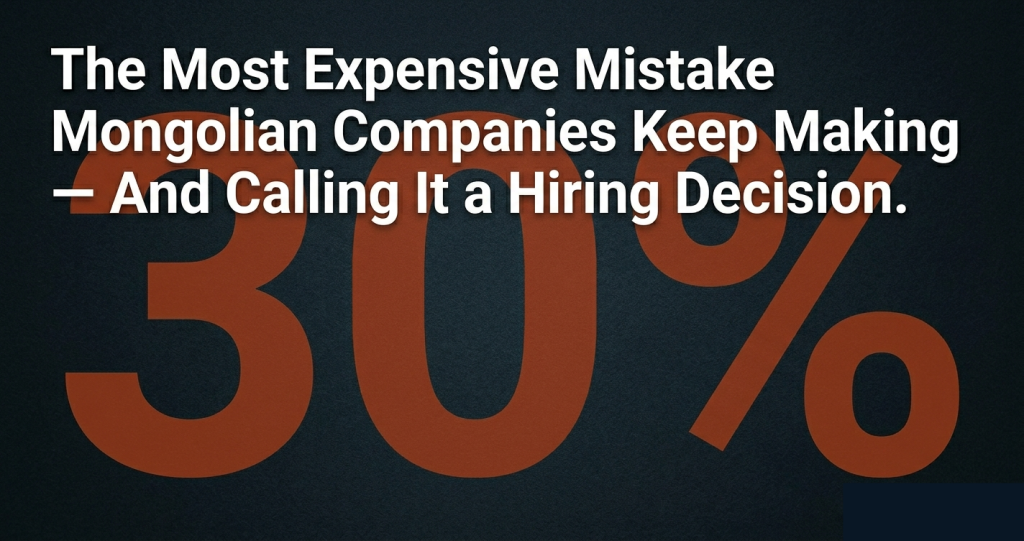
    A bad hire costs up to 30% of that employee’s first-year salary. In a market where senior management earns 4.37 million MNT per month, that number gets large very fast. Organizations are absorbing this cost constantly, and almost none of them are measuring it.


    Here is a number that most companies do not know about their own operations: the precise cost of the last person they hired who did not work out. Not the salary paid during the tenure. Not just the recruitment fee. The full number, including the management time absorbed, the productivity lost by the team around them, the clients or projects disrupted, the morale damage, the cost of starting the search again, and the salary of the replacement hire, layered on top of all of it.

    Almost no Mongolian organization tracks this figure. Almost every Mongolian organization is paying it.

    The global research on bad hires is unambiguous: a poor hiring decision costs between 30% and 150% of the employee’s annual salary, depending on seniority and how long the situation persists before action is taken. For a mid-level manager in Mongolia earning 3 million MNT per month, a failed hire that lasts eight months before being resolved carries a total organizational cost, visible and invisible, of anywhere between 10 and 36 million MNT. For a C-suite appointment that does not work out after a year, the number is multiples of that. These are not edge cases. They are the ordinary, recurring consequence of a hiring process that most Mongolian companies still treat as less important than the decisions the hire will be making.


    What a Bad Hire Actually Costs – Beyond the Obvious

    The direct costs of a failed hire are the ones organizations notice: recruitment spend, salary paid, and, where applicable, severance. These are real, and in a market where executive search fees for senior roles can run 15 to 20% of annual compensation, they are significant. A CFO placed at a 100 million MNT annual package carries a search fee alone of 15 to 20 million MNT. If that hire fails within twelve months, the organization pays that fee again on the replacement search.

    But the indirect costs are where the real damage accumulates and where Mongolian organizations consistently underestimate their exposure.

    42 days average time a position sits open globally after a vacancy occurs during which productivity loss begins immediately (SHRM, 2024)

    Lost productivity is the first and largest invisible cost. A new hire reaches full productivity on average within six to eight months. During that period, the organization is paying full salary for partial output. If the hire is wrong, if the skills, the cultural fit, or the judgment are not what the interview process suggested, that productivity deficit extends indefinitely, while the cost of addressing it grows with every week of delay. In Mongolia’s competitive sectors, where teams are lean and individual contribution is high-leverage, a single underperforming hire in a senior role can slow a department’s entire output for a quarter or more.

    Team morale is the second cost, and the hardest to quantify. When a hire is visibly wrong, when a team can see that a manager lacks competence, that a senior professional is not pulling their weight, that a leader is creating friction rather than removing it, the people around that hire absorb the consequences daily. They pick up the slack. They work around the dysfunction. They start, quietly, to reassess whether an organization that makes decisions like this is one they want to stay in. In a market where, globally, 51% of employees are actively watching or seeking new jobs, the ripple effect of a bad hire on the people already in place is not a soft risk. It is a hard one.

    A Mongolian logistics company hired a regional operations director through an informal referral in 2023. Within four months, three of his direct reports had handed in resignations, citing management style. The company replaced the director eight months into his tenure. Total estimated cost, including the three replacement hires and the projects delayed during the transition approximately 85 million MNT. The original search had cost nothing; the hire came through a contact. The lesson was more expensive than any search fee would have been.


    Why It Keeps Happening

    Mongolia’s bad hire problem is not primarily a competency problem. It is a process problem. Specifically, it is the result of three consistent failures that appear, with remarkable regularity, in how Mongolian organizations approach senior and mid-senior appointments.

    The first is speed, pressure overriding rigor. When a role becomes vacant, the organization feels the operational gap immediately, and the impulse is to fill it as quickly as possible. Timelines compress. Reference checks become cursory. The structured evaluation that would identify a misalignment between the candidate’s actual capabilities and the role’s real demands gets skipped or shortened. The hire is made. The problem that was visible in a proper assessment process emerges six months later at considerably greater cost.

    The second is over-reliance on the interview performance. Mongolia’s hiring culture places significant weight on the interview as the primary evaluation mechanism. A candidate who presents well, who is articulate, who knows the right things to say about strategy and leadership, who has the right institutional affiliations, can move through a Mongolian hiring process with very little scrutiny of whether they have actually done what they are claiming to have done. Structured reference conversations, practical assessments, and competency-based evaluation frameworks are still not standard practice across most Mongolian organizations. The interview room rewards performance, not necessarily performance in the role.

    The third is the most culturally specific, the connection override. A referral from within the network of a board member or a senior executive carries an informal authority that often bypasses evaluation entirely. The hire is made because of who vouches for them, not what an independent assessment reveals. In a small professional community like Ulaanbaatar’s, this mechanism is understandable. It is also statistically the source of a disproportionate share of the bad hires that are most damaging, because the relationship layer that enabled the hire also makes it harder to address when the hire fails.


    What Structured Hiring Actually Prevents

    The case for structured executive search is frequently made on the grounds of candidate quality, finding a better person for the role. That case is true but incomplete. The more precise argument is that structured search prevents specific, calculable categories of organizational cost that informal hiring consistently produces.

    A properly run search process for a senior role includes a thorough role definition before any candidate is evaluated, a step that, in informal hiring, rarely happens. Organizations that skip this step often discover, three months into a hire, that the role they described to the candidate was not actually the role they needed filled. The resulting misalignment is not the candidate’s fault. It is a design failure that a structured process would have caught.

    It includes independent reference conversations that go beyond the references the candidate provides, conversations with people who have managed, worked alongside, or been managed by the candidate, conducted by someone with no stake in validating the hire. It includes competency-based evaluation against criteria defined before any name is attached to the process. And it includes a candidate pool that extends beyond the organization’s existing network, which is the only mechanism that guarantees the best available person is being considered, rather than the most available known person.

    30% minimum cost of a failed hire as a percentage of first-year salary rising to 150% for senior roles (SHRM/Wellhub, 2025)

    XacBank’s adoption of psychometric and cognitive assessments as part of its interview process is one of the more sophisticated hiring practices visible among Mongolian financial institutions, which reflects an understanding that interview performance is not a sufficient proxy for role performance. Organizations that have invested in more rigorous evaluation are not just finding better candidates. They are avoiding the cost of the wrong ones.


    The Calculation Every Mongolian CEO Should Run

    Before the next senior hire, consider running the actual numbers. Take the monthly salary of the role. Multiply by twelve. Take 30% of that figure as the floor cost of a failed hire, recognizing that for senior roles and extended bad-hire situations, the real number is considerably higher. Add the search fee for the replacement hire. Add a rough estimate of the management time and productivity loss your team will absorb if the hire is wrong. Compare that total to the cost of a properly structured search process that reduces the probability of that outcome.

    In almost every case, the math is not close. The cost of getting it wrong dwarfs the cost of getting it right. The question is not whether Mongolian organizations can afford structured, rigorous hiring. It is whether they can afford to keep doing without it.

    Lambda. Global’s executive search practice is built on precisely this premise. In a market of 1.2 million active workers with a projected shortfall of 240,000 by 2035, the organizations that will have the strongest leadership teams in five years are the ones making the best hiring decisions right now, not the fastest ones.


    SOURCES & REFERENCES

    1.  Wellhub – Cost Per Hire: Averages, Deciding Factors, and How to Calculate (2025)

    Bad hire costs up to 30% of first-year salary; hidden costs include lost productivity, morale impact, and repeat recruitment spend.

    https://wellhub.com/en-us/blog/talent-acquisition-and-retention/cost-of-hire

    2.  Spark Hire – The Real Cost of Employee Turnover (January 2025)

    42-day average to fill open position (SHRM 2024); 6-8 months to full productivity; culture and morale impact of turnover.

    https://www.sparkhire.com/learn/screen-candidates/the-cost-of-employee-turnover

    3.  High5Test – US Employee Turnover Statistics 2024–2025

    51% of employees are watching or seeking new jobs; engagement and culture top reasons for leaving (37%); turnover cost frameworks.

    4.  9CV9 Blog – How to Find and Hire Employees in Mongolia in 2025

    Rise in employee turnover in mining and IT; XacBank psychometric assessment practice; long-term aspiration screening approaches.

    5.  9CV9 Blog – State of Recruitment and Hiring in Mongolia 2025

    83,700 new hires projected for 2025; senior management avg 4.37M MNT/month; 1.2M active workforce; 240,000 shortfall by 2035.

    6.  Rivermate – Recruitment in Mongolia (February 2026)

    Poor hiring decisions linked to turnover and productivity loss; salary variation by industry, experience, and location in Mongolia.

    https://www.rivermate.com/guides/mongolia/recruitment