Category: Mongolian Companies

  • The Office Should Feel Good to Be In.

    The Office Should Feel Good to Be In.

    One in three employees globally is experiencing persistent burnout. Mental health issues cost the global economy $1 trillion annually in lost productivity. And yet most Mongolian organizations are still treating office comfort and employee wellbeing as decoration, something nice to mention in a job posting, but never quite making it onto the budget. That is changing. Slowly. And the organizations moving fastest are pulling ahead in ways that are showing up in their talent numbers.

    Walk into the offices of most Mongolian companies, and you will find the same scene: rows of desks, fluorescent overhead lighting, a small kitchen with a coffee machine, and walls that have not been repainted since the building was fitted out. The chairs are functional. The temperature is whatever the building management decides it is. There are no plants, no quiet rooms, no spaces designed for anything other than sitting at a desk and staring at a screen.

    This is not a design criticism. It is a talent and productivity observation. The research connecting physical workplace environment to employee performance, engagement, and retention is now extensive enough that ignoring it is no longer a neutral decision. It is a choice one that shows up in output, in attrition, and increasingly in whether the best candidates accept an offer or keep walking.

    Mongolia’s professional workforce is young, educated, and increasingly aware of what good workplaces look like, not because of abstract aspirations but because they can see them. International companies operating in Ulaanbaatar, the growing fintech sector, and the returnee professionals arriving from Singapore, Seoul, and Sydney all carry a reference point for what a well-designed, thoughtfully managed workplace feels and functions like. That reference point is now part of how Mongolian professionals evaluate where they want to spend their working hours.


    What the Research Actually Shows

    The connection between physical and psychological workplace comfort and productivity is not soft science. The data is specific and the magnitudes are significant.

    16%   productivity increase when employees have control over their workspace environment – Oxford University, 2023

    Natural light is one of the most impactful and least expensive workplace interventions available. Employees who work near natural light report 84% less eye strain, headaches, and blurred vision symptoms that directly reduce focus and output. In Ulaanbaatar’s notoriously harsh winters, where the city experiences some of the world’s worst air quality and limited daylight hours between November and February, the quality of indoor lighting is not a luxury. It is a functional necessity for the months during which most of Mongolia’s professional workforce spends the majority of its waking hours indoors.

    Temperature and air quality have equally documented effects. A Cornell University study found that employees make 44% more errors and are less than half as productive when office temperatures are too cold, a finding with direct relevance to Ulaanbaatar’s office stock, much of which was built during the Soviet era and continues to rely on centralized heating systems that provide little individual control. In winter, Mongolia’s offices are frequently either overheated to compensation levels or inadequately warmed at the edges of older buildings. Neither condition is conducive to sustained concentration.

    Noise is the third variable. Open-plan offices are now the default configuration in most of Ulaanbaatar’s modern commercial buildings, creating specific acoustic challenges that most organizations do not actively manage. Research from the Global Wellness Institute consistently identifies noise as the number one environmental complaint from office workers globally. An employee who is interrupted every three to five minutes by ambient conversation, phone calls, or the general hum of a shared workspace is not just mildly distracted. They are operating in a condition where deep, sustained work, the kind that produces the most valuable output, is structurally difficult to sustain.


    Wellbeing Is Not a Perk It Is a Retention Tool

    The WHO estimates that mental health issues cost the global economy $1 trillion annually in lost productivity. Burnout is defined as chronic, unrelenting workplace stress. Now, it affects one in three employees globally, with WebMD’s 2025 research showing a 25% increase in employee-reported burnout between 2022 and 2024. In Mongolia’s professional context, burnout is a particularly underexamined risk. The country’s cultural norms around resilience and self-sufficiency create organizational environments where acknowledging stress is often perceived as weakness, which means the problem accumulates invisibly until it manifests as resignation.

    $1T   annual global productivity cost of mental health issues in the workplace – World Health Organization, 2025

    The organizations in Mongolia making visible progress on wellbeing are doing so not through wellness programs or team-building events, though these have their place, but through the fundamentals of organizational design. Clear workload expectations. Regular, honest check-ins between managers and their teams. Protected time for focused work without meeting interruptions. Physical spaces that give employees some degree of environmental control, such as a quiet room for calls, an informal collaboration area, and lighting that adjusts with the season.

    These are not expensive interventions. A quiet room can be any meeting room designated for focused work between certain hours. Adjustable desk lamps cost less than a single day of lost productivity from a burned-out developer. A deliberate no-meeting morning block three days a week requires no budget at all, only organizational willingness to protect it.


    What Lambda.Global observes in the best Mongolian workplaces:

    ✦  Natural light prioritized in desk placement – not reserved for senior offices

    ✦  Quiet zones designated and respected, not just theoretically available

    ✦  Temperature and air quality actively managed, especially November through February

    ✦  Wellbeing check-ins normalized brief, regular, not performative

    ✦  Physical space signals that the organization values the people inside it


    The Talent Market Connection

    At Lambda.Global, workplace environment and wellbeing now come up regularly in candidate conversations at the mid-senior and executive level, not as a primary requirement, but as a genuine evaluation criterion. Professionals who have worked in well-designed environments, whether internationally or at Mongolia’s most thoughtful domestic employers, carry that experience as a reference point. When they are evaluating a new role, they are implicitly asking: Does this organization take seriously the conditions under which its people work?

    The organizations that can answer that question with specific, visible evidence, a well-designed office, a genuine wellbeing policy, and a management culture that does not treat burnout as a personal failing are the ones generating stronger offer acceptance rates and longer average tenures among mid-senior hires. The connection is not complicated: people stay in environments where they feel well, and they leave environments where they do not. In a market where replacing a senior hire costs between 30 and 150% of annual salary, the ROI on office comfort is not difficult to calculate.

    Mongolia’s commercial real estate market is maturing, and newer office stock in Ulaanbaatar’s central business district is increasingly built to international specifications, with better natural light penetration, improved HVAC systems, and more flexible floor plates. The physical infrastructure for better workplaces is becoming more available. The question is whether the organizations occupying that space are thinking intentionally about how to use it, or simply filling it with desks in the same configuration they have always used.


    What a Thoughtfully Designed Mongolian Office Looks Like

    It does not need to be expensive. It needs to be intentional. The physical environment communicates something about what an organization believes about the people who work there, and employees read that communication accurately, whether or not it is explicitly stated.

    An office with good light, manageable noise, comfortable temperature, and spaces for both collaboration and focus tells its occupants: we thought about you when we designed this. An office that has none of these things tells them something else, something that eventually shows up in how long they stay and how much they bring.

    Lambda.Global works with organizations across Mongolia’s professional sectors, and the pattern we see in the talent market is consistent with the research: the employers attracting and retaining the best people are the ones treating workplace comfort not as a luxury but as a basic condition of doing the work well. In a talent market this competitive, basic conditions matter more than they ever have.


    SOURCES & REFERENCES

    1.  Wellbeing People – 5 Workplace Wellbeing Trends for 2025

    DEI integration into wellbeing; data-driven engagement measurement; McKinsey diverse workforce outperformance finding (2024). https://wellbeingpeople.com/workplace-wellbeing/5-workplace-wellbeing-trends-for-2025/2024/

    2.  Global Wellness Institute – Workplace Wellbeing Initiative Trends for 2025

    Social connection at work; physical workspace design for collaboration; AI and wellbeing balance; McKinsey Health Institute data.

    3.  WebMD Health Services – 2025 Workplace Wellness Trends

    1 in 3 employees experiencing persistent burnout; 25% burnout increase 2022-2024; onsite workers higher burnout than flexible arrangements.

    4.  WHO – Mental Health in the Workplace (2025)

    Mental health issues cost global economy $1 trillion annually in lost productivity; workplace mental health as essential component.

    https://www.who.int/teams/mental-health-and-substance-use/promotion-prevention/mental-health-in-the-workplace

    5.  NNRoad – Work Culture 2025 in Mongolia

    Hybrid work adoption, performance outcomes over presenteeism; digital HR tools; employee wellbeing in the Mongolian workplace context.

    https://nnroad.com/blog/work-culture-2025-in-mongolia-7-practical-steps

    6.  Frontiers in Built Environment – Workplace Performance and Office Design (2026)

    Open-plan office acoustic and ergonomic design; flexible zones and circulation; noise as primary environmental complaint; focus vs collaboration balance.

  • 38.2%. That Is Mongolias Productivity Score. It Does Not Have to Stay That Way

    38.2%. That Is Mongolias Productivity Score. It Does Not Have to Stay That Way

    Mongolia ranks as the second least productive nation globally at 38.2% workforce productivity. With a booming economy, a young workforce, and record hiring demand, that number should not exist. The gap between Mongolia’s economic potential and its workplace reality is not a mystery; it has specific, addressable causes. And fixing it starts with an honest conversation.

    Mongolia’s economy grew nearly 6% in 2023. Foreign direct investment is flowing in. The mining sector is booming. The fintech industry is maturing. Eighty-three thousand new jobs are being created in 2025 alone. By almost every headline economic indicator, Mongolia is a growth story.

    And yet Mongolia ranks second in the world for low workforce productivity, at just 38.2%, sitting between Iran and Cambodia on a global benchmark that measures how effectively labor inputs are converted into economic output. That ranking is not a rounding error. It is a structural reality that quietly undermines every other positive number in Mongolia’s economic story, and one that very few organizations are addressing directly.

    Understanding why productivity is low in Mongolian workplaces requires moving past the easy explanations. It is not simply that Mongolian workers are less capable or less motivated than their peers elsewhere. The evidence does not support that. What the evidence does support is a set of specific organizational, managerial, and cultural patterns that systematically suppress output and that can be changed.


    The Engagement Problem

    Start with the global context, because it frames Mongolia’s situation accurately. Gallup’s 2026 State of the Global Workplace report found that only 21% of employees globally are actively engaged at work. Disengaged employees cost organizations an estimated 18% of their salary in lost productivity. Collectively, low engagement is draining approximately 9% of global GDP every year.

    21%   of employees globally are actively engaged at work – the rest are present but not fully contributing (Gallup, 2026)

    Mongolia’s engagement picture is complicated by specific local dynamics. The country’s workforce is young, over 60% of the population is under 35, and that youth concentration brings with it high expectations around career development, feedback, and workplace culture. As explored in earlier Lambda.Global pieces on Gen Z in Mongolia’s workforce, the youngest professional cohort, are significantly more likely to disengage quietly, which researchers call ‘quiet quitting’ when they feel their growth is not being supported. Gallup found that six in ten employees globally are doing the minimum required and nothing more. In Mongolia’s organizations, where formal performance management is still maturing and feedback loops are often weak, that proportion is likely at least as high.


    The Meeting Trap

    One of the most consistent productivity killers in Mongolian organizations is also one of the least discussed: meetings. The average knowledge worker globally spends 103 hours per year in unnecessary meetings, 209 hours on duplicated work, and 352 hours in what researchers call ‘work about work,’ talking about, organizing, and reporting on work rather than doing it. Sixty-seven percent of workers consider more than half the meetings they attend to be pointless.

    A department head at a major Mongolian financial institution described her team’s reality this way: ‘We have a morning meeting to plan the day, a midday check-in to review progress, and an afternoon debrief to close out. On a busy day, that is three hours of meetings for a team of eight, and I am not sure any of us can name a specific decision that came out of them last week.’

    Mongolia’s organizational culture places a high value on collective alignment and visible coordination values that are genuinely useful in building cohesive teams. The problem arises when those values translate into meeting frequency that is driven by culture rather than necessity. The organizations in Mongolia making the most visible progress on productivity are the ones that have started treating meeting time as a cost rather than a default, asking before any gathering is scheduled, what specifically cannot be accomplished with a message, a document, or a brief asynchronous update.


    The Performative Work Problem

    Globally, the average employee spends a third of their working hours on performative work activity that looks like productivity but does not produce meaningful output. Checking emails, attending unnecessary meetings, preparing status updates that nobody reads, and organizing files that nobody will access. Fifty percent of employees feel they must seem productive even when they are not doing anything genuinely useful.

    In Mongolia’s office culture, particularly in organizations where physical presence is equated with diligence and where senior leaders visibly monitor who arrives early and leaves late, the pressure to perform busyness rather than deliver results is particularly acute. This dynamic is not unique to Mongolia, but it interacts badly with a management culture that still tends to evaluate people on visible effort rather than measurable outcomes.

    The shift from presence-based to output-based performance management is one of the most impactful changes a Mongolian organization can make for productivity and one of the hardest, because it requires managers to be clear about what they actually expect, rather than relying on proximity as a proxy for performance.


    What Actually Drives Productivity and What Mongolia’s Best Organizations Are Doing

    The research on workplace productivity is consistent across markets: the variables that matter most are engagement, clear goals, quality management, and the right tools. Not long hours. Not physical presence. Not surveillance. The organizations in Mongolia that have made the most visible productivity gains in recent years share recognizable patterns.

    They have moved toward outcome-based performance frameworks, defining what success looks like for each role in measurable terms and evaluating people against those terms rather than against hours logged or desks occupied. Khan Bank’s investment in performance management infrastructure, including structured KPI frameworks for its branch and head office teams, reflects an understanding that productivity is measured at the output level, not the input level.

    They have reduced meeting volume deliberately, not by banning meetings, but by requiring agendas, enforcing time limits, and creating a cultural norm where attendance is earned by relevance rather than granted by seniority. The time savings this creates are not trivial. An organization that reduces unnecessary meeting time by just thirty minutes per person per day across a team of fifty gains back 250 hours of productive capacity every week.

    23%   higher profitability in highly engaged teams versus disengaged ones – Gallup meta-analysis, 2025

    They have invested in the tools that eliminate duplicate work. Mongolia’s technology infrastructure is now capable of supporting the collaboration platforms, project management tools, shared documentation systems, and asynchronous communication channels that the world’s most productive organizations rely on. The barrier to adoption is not cost or connectivity. It is organizational willingness to change established habits, and managerial commitment to training teams to use new tools effectively rather than adding them alongside existing ones.


    The Lambda.Global Perspective

    At Lambda.Global, workplace productivity is not a separate conversation from talent strategy; it is the same conversation. The organizations that struggle most with productivity are almost always the ones that also struggle most with retention, engagement, and leadership development. The connection is direct: disengaged employees are unproductive employees, and the primary driver of disengagement is poor management.

    The hiring decisions that Lambda.Global support at the executive, director, and mid-senior level has a direct and measurable impact on the productivity of the teams that those leaders will manage. A strong CFO does not just manage numbers. They build a finance function that operates efficiently, develops its people, and produces output that the organization can rely on. A strong technology director does not just maintain systems. They create the conditions under which their team can do its best work, and in doing so, they address the productivity gap at its root.

    Mongolia’s 38.2% productivity ranking is not a fixed number. It is the current result of organizational and managerial decisions that can be made differently. The companies that close that gap over the next five years will not do it by working longer hours. They will do it by hiring better leaders, managing more intentionally, and building workplaces where the people showing up every day are genuinely motivated to do more than the minimum.


    SOURCES & REFERENCES

    1.  MoneyZine – Key Productivity in the Workplace Statistics for 2024

    Mongolia ranked 2nd least productive nation globally at 38.2%; global employees productive ~60% of the time; 304 weekly emails per worker.

    https://moneyzine.com/careers/key-productivity-in-the-workplace-statistics-for-2024

    2.  Gallup – State of the Global Workplace 2026

    21% employee engagement globally; manager engagement dropped 9 points since 2022; disengagement drains 9% of global GDP annually.

    https://www.gallup.com/workplace/349484/state-of-the-global-workplace.aspx

    3.  SMB Guide – 40+ Employee Productivity Statistics for 2025

    6 in 10 globally quiet quitting; 1/3 of shift spent on performative work; 50% feel pressure to seem productive; 74% say guidance improves performance.

    https://www.smbguide.com/employee-productivity-statistics/

    4.  TimeDoctor – Workplace Productivity Statistics (2025 update)

    103 hours/year in unnecessary meetings; 209 hours on duplicated work; 352 hours ‘work about work’; 18% salary lost to disengagement.

    https://www.timedoctor.com/blog/workplace-productivity-statistics

    5.  Clockify – Workplace Productivity Statistics 2025

    67% of workers find over half of meetings pointless; 91% say meeting count unchanged or higher; 23% profitability gain from engaged teams (Gallup).

    https://clockify.me/productivity-statistics

    6.  World Bank – Mongolia Jobs Diagnostic (July 2024)

    Mongolia labor productivity levels below structural peers; capital concentration in mining; slow diversification limiting productivity growth.

    https://www.worldbank.org/en/country/mongolia/publication/mongolia-jobs-diagnostic

    7.  Trading Economics – Mongolia Employment Rate (2025)

    Mongolia employment rate 59.2% Q3 2025; labor force participation and wage trend context.

    https://tradingecon

  • Here’s A Quick Look at Mongolia’s Work Landscape Right Now

    Here’s A Quick Look at Mongolia’s Work Landscape Right Now

    This is not an essay or a guide. I want to provide just a handful of things the numbers are saying that most people have not heard yet.

    1. 53% of the workforce is in the wrong job

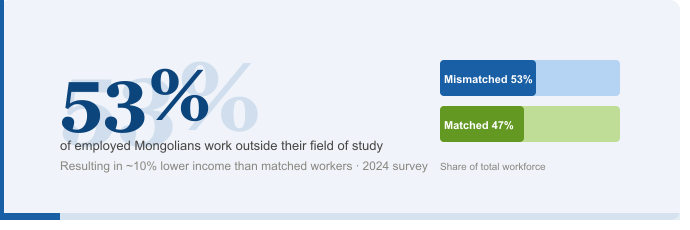
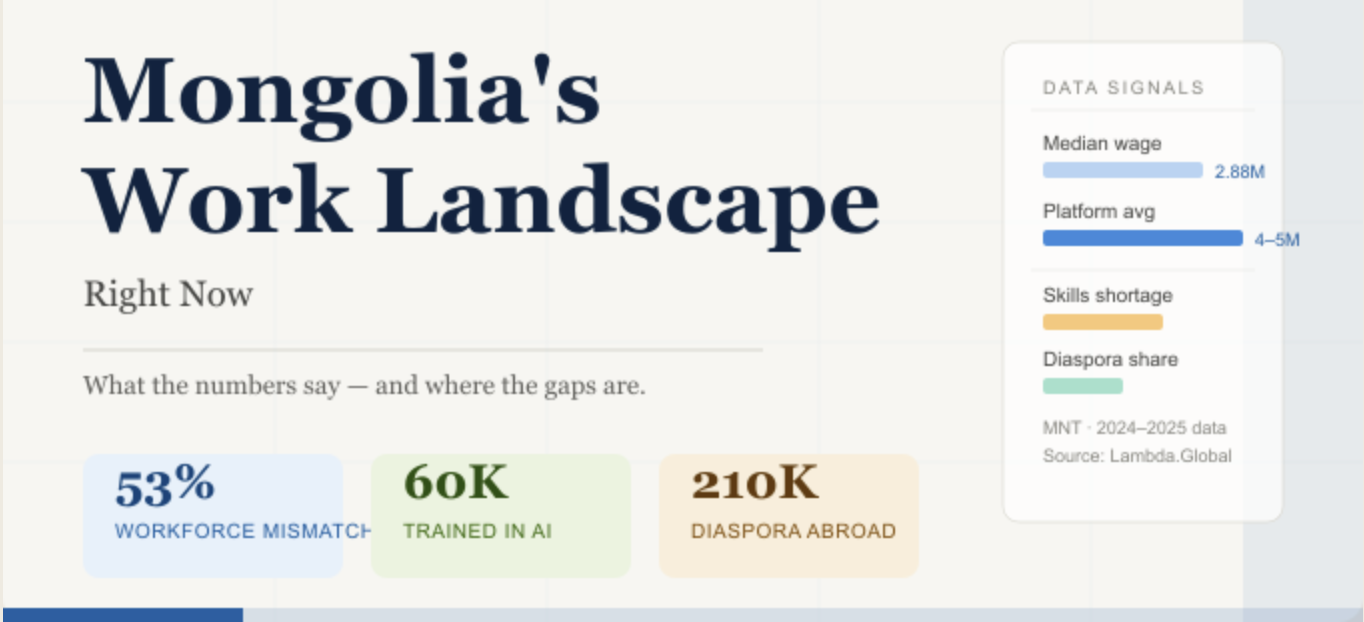
    A survey conducted in 2024 found that 53% of all employed individuals are working in fields that have nothing to do with what they studied for in Mongolia. As a consequence, their incomes are about 10% lower than people whose jobs match their qualifications.

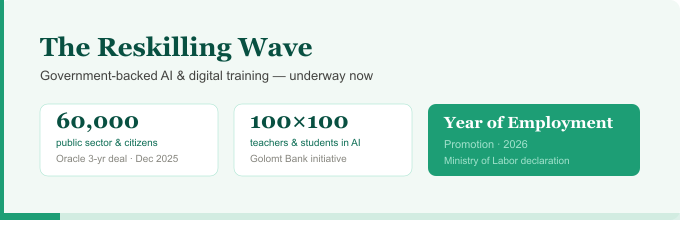
    It is unfortunately a structural drag because when more than half a workforce is misaligned, productivity stays stagnant regardless of how hard individuals work. In order to address this specific issue, the Ministry of Family, Labor and Social Protection declared 2026 the “Year of Employment Promotion”.

    2. The government is not waiting, it is building

    In December 2025, the Ministry of Digital Development signed a three-year agreement with Oracle. The overall plan is to train over 60,000 public sector employees and citizens in artificial intelligence, database systems, data management, data security and information technology in order to free access at a nationwide level.

    In addition to that, Golomt Bank supported the launch of an “AI for Women 100×100” initiative. One hundred women teachers. One hundred women students. Organized AI training sessions from secondary schools throughout the country.

    The Prime Minister himself has advocated for a national “reskilling wave” initiative, recognizing the reality that artificial intelligence and digitalization are not something in the future. They are here to change the job landscape, eliminating some while creating others. This is no longer about experimental programs but the start of something big.

    3. The diaspora is younger and more educated than most people think

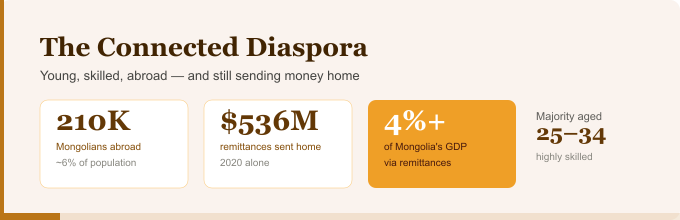
    Over 210,000 Mongolians live abroad which is about six percent of the entire population. Most are concentrated in the 25 to 34 age bracket and many are highly skilled professionals with experience and high labor productivity. In 2020 alone, Mongolians abroad sent back USD 536.2 million in remittances, equal to more than four percent of the country’s GDP.

    These are not people who left and forgot, but the ones who left and stayed connected. The question is whether the home market knows how to reach them.

    4. Even traditional sectors are feeling the skills squeeze

    The cashmere industry, a sector Mongolia has built its reputation on, is short of workers. An ILO survey conducted in 2025 with nearly 600 respondents found labor shortages of 10 to 20% across the sector. The shocking news is that the jobs were there, but the applicants just did not match. The same pattern repeats in fintech, logistics and professional services. It is not one industry in trouble anymore. It is a whole economy where the supply of skills and the demand for skills are not meeting.

    5. Nobody has connected all these dots in one place

    Let’s take it all by looking at it simply. The Ministry of Labor publishes forecasts, the World Bank publishes surveys, Coursera publishes global skills reports, Oracle and Golomt Bank run training programs and IOM tracks the diaspora. It is clear that the data exists, but in a scattered form across dozens of sources. As a result, most working individuals never end up seeing these.

    This is the gap Lambda.Global is filling. Not by becoming a training provider or a government agency, but by making the market visible. Lambda tracks what employers are actually requesting, which skills are gaining demand and where compensation is really landing. It turns these scattered information into something a person or a company can use.

    In 2025, Lambda’s own salary data shows the median wage in Mongolia reached 2.88 million MNT. However, the average compensation sits higher between 4 and 5 million MNT on the Lambda platform itself. That gap tells its own story about how the market is not flat. It is deeply segmented and knowing which segment you are in changes everything.

    6. The future ahead

    The government is training tens of thousands at present. Firms are updating their job profiles to ensure that candidates possess AI and cross-discipline skills. Diasporas are becoming more educated and larger in size. The discrepancy between knowledge and economy remains wide open.

    Lambda.Global does not close that gap by itself. In fact, no platform can. But it gives people a clear view of the gap so they can decide for themselves where to step next. It is the one advantage that most professionals and most companies in Mongolia are not using yet.

    References

    1. Ministry of Labor and Social Protection / MONTSAME, Additional Jobs Centers to Be Established Nationwide
    2. Ministry of Family, Labor and Social Protection, Year of Employment Promotion
    3. Oracle Academy Blog, Ministry of Digital Development launches three-year AI and big data skills program with Oracle 
    4. Golomt Bank, Golomt Bank supports the “National AI campaign”
    5. Mongolian National Chamber of Commerce, Supporting and Collaborating with the Prime Minister’s Policy
    6. IOM, New Era for Diaspora Engagement in Mongolia
    7. IOM Mongolia, IOM in Mongolia – USD 536.2 million in remittances in 2020, 4.07% of GDP.
    8. ILO, Survey finds job quality key to attracting youth to Mongolia’s cashmere sector
    9. Lambda.Global, Salary Trends and Compensation Insights in Mongolia
  • Your Best Candidate Just Said No. Here Is Why It Keeps Happening.

    Your Best Candidate Just Said No. Here Is Why It Keeps Happening.

    One in six job offers is declined in 2025, even at the final stage, after weeks of interviews. In Mongolia’s tight talent market, where the best candidates are fielding multiple offers simultaneously, a declined offer is not just a setback. It is an expensive signal that something in the process needs fixing. Lambda.Global sees this pattern regularly, and the causes are almost always preventable.


    There is a particular kind of frustration that hiring managers in Mongolia know well. Weeks of interviews. A strong shortlist was narrowed to one. An offer extended with genuine enthusiasm. And then, a few days later, a polite message that they have decided to go another direction. The role goes back to the beginning. The team absorbs the gap. The manager wonders what went wrong.

    What went wrong, in most cases, was not the candidate. It was the process specifically, the assumptions embedded in how the offer was constructed and communicated. At Lambda.Global, declined offers are one of the most consistent and preventable failures we help organizations address. The data is clear on why candidates say no. The frustrating reality is that most of the reasons are within the employer’s control.


    The Numbers Behind the Problem

    17.5%   of candidates decline offers even after reaching the final interview stage – Ashby Talent Trends, 2024

    Nearly one in six offers declined globally. For organizations running searches in Mongolia’s competitive talent environment, where the candidate pool for senior and specialist roles is already narrow, a declined offer at the final stage does not just mean starting over. It means the organization has spent the search budget, absorbed the management time, and raised the candidate’s expectations only to end up back at week one with a smaller pool of candidates who now know the role is harder to fill than it looked.

    The reasons candidates decline are consistent across markets and well-documented. Slow process is the leading cause, 62% of candidates globally have pulled out of a hiring process because it took too long, and 70% expect to hear back within one week of their final interview. Compensation misalignment is the second most common reason, not always because the number is too low, but because it arrives as a surprise rather than a managed conversation. And poor candidate experience during the process itself drives more than one third of all declines, slow communication, unclear expectations, and the impersonal handling that signals to a candidate that the organization does not particularly value their time.


    What Lambda.Global Sees in Mongolia Specifically

    Mongolia’s version of the declined offer problem has a few characteristics that are specific to this market and worth naming directly.

    In the last six months, Lambda.Global managed searches across fintech, banking, and executive roles where the final-stage candidate declined the offer. In every case, a post-decline conversation revealed the same pattern: the candidate had received a competing offer faster, communicated more clearly, or both. The salary difference was rarely the deciding factor. The process was.

    The first Mongolian-specific pattern is the counteroffer problem. Mongolia’s professional community is small and interconnected. When a strong candidate begins exploring the market even discreetly, their current employer often finds out. By the time an external offer arrives, many candidates have already received a retention package from their existing organization. The employer who moves slowly loses not to a better offer from a competitor, but to the organization that was already paying the candidate and simply needed to demonstrate it valued them.

    The second pattern is the information gap during the process. Many Mongolian hiring processes are conducted with significant opacity; candidates are told they are progressing but are not told what the timeline looks like, who else is being considered, or when a decision will be made. In a market where the best candidates are simultaneously talking to multiple organizations, that opacity is a competitive disadvantage. The organization that communicates proactively and specifically throughout the process signals organizational competence. The one that goes quiet for two weeks after the final interview signals the opposite.

    The third pattern is the single-number offer. Lambda.Global consistently advises against presenting a compensation offer as a fixed number with no context, no flexibility discussion, and no understanding of what the candidate actually values. In Mongolia’s market, where total compensation increasingly includes elements beyond base salary performance bonuses, professional development budgets, flexibility arrangements, and, in some cases, international exposure opportunities, the organization that understands what a specific candidate values and structures the offer accordingly will consistently outperform the one that extends a standard package and waits for a response.


    What Lambda.Global Does Differently

    The most effective intervention in the offer decline problem is not at the offer stage. It is at the beginning of the search. Lambda.Global’s process is built around understanding, from the first candidate conversation, what would make a role genuinely compelling for each specific individual, not what the generic market wants, but what this candidate, with their specific situation, would find difficult to turn down.

    That intelligence shapes how the role is positioned throughout the process, how the offer is structured when it arrives, and how the conversation is managed in the critical window between verbal and written acceptance. The difference between a candidate who accepts and one who declines is frequently not the offer itself it is whether they felt, throughout the process, that the organization understood them as a professional rather than as a headcount to be filled.

    62%   of candidates have withdrawn from a process because it took too long – LinkedIn Global Talent Trends 2024

    Speed is the variable most within an organization’s control and the one most consistently underestimated. Lambda.Global tracks time-to-offer across every search we run, and the data is consistent: searches where the organization moves from final interview to offer within five business days have significantly higher acceptance rates than those where the process extends beyond two weeks. The candidate’s enthusiasm peaks at the final interview. Every day of silence after that is a day the competing offer gains ground.


    Three Things to Fix Before the Next Search

    Define the offer before the search begins. Lambda.Global asks every client organization to confirm salary range, flexibility parameters, and non-salary benefits before the first candidate conversation. This is not bureaucracy; it is the only way to ensure that when the right candidate is found, the organization can move within days rather than weeks. Organizations that need internal approval processes to construct an offer after the final interview are the ones losing candidates to employers who already have the answer ready.

    Communicate at every stage, even when there is nothing to report. A brief message telling a finalist that the decision is still in progress and they will hear by a specific date costs nothing and preserves the candidate’s confidence in the process. Silence costs offers. Lambda.Global manages this communication on behalf of our clients throughout every search because we know that the candidate experience during the process predicts the acceptance decision as reliably as the offer itself.

    Treat the offer conversation as a negotiation, not an announcement. The organizations that extend offers as if they are doing the candidate a favor lose the candidates who have options. The ones that approach the offer as a collaborative conversation, what would make this work for you, what matters most in what we are putting together, close significantly more offers. In Mongolia’s tight talent market, the best candidates always have options. The offer conversation is where that reality is either acknowledged or ignored.

    A declined offer in Mongolia’s market is not the end of a search. But it is a signal worth reading carefully. Lambda.Global’s role is not just to find the right candidates; it is to help organizations build the process, the speed, and the communication discipline that converts the right candidate into an accepted offer. In a market where the best professionals are rarely looking and always being approached, the gap between finding someone and landing them is where searches are won or lost.


    SOURCES & REFERENCES

    1.  Talent Place – How to Handle a Candidate Rejecting a Job Offer (2025)

    1 in 6 offers declined in 2025; 17.5% final-stage declines (Ashby); poor candidate experience drives 1/3 of declines; chatbot impersonality cited by 47%.

    https://talentplace.com/blog/for-recruiters/candidates-rejecting-a-job-offer/

    2.  TalentAlly – Top Reasons Candidates Decline Offers (December 2025)

    70% of candidates expect response within 1 week of final interview; 62% have withdrawn due to slow process (LinkedIn 2024 Global Talent Trends).

    https://talentally.com/resources/top-reasons-candidates-decline-job-offers

    3.  Ashby – Offer Acceptance Rates Talent Trends Report (2024)

    Analysis of 230K applications; 2023 highest OAR at 81%; candidate-driven declines dominant; technical roles highest rescind rate.

    https://www.ashbyhq.com/talent-trends-report/reports/2023-trends-report-offer-acceptance-rates

    4.  MokaHR – Why Candidates Accept or Reject Job Offers in 2025

    77% would leave for higher salary; 12.5% pay increase motivates change; retirement plans and financial security key offer factors.

    https://www.mokahr.io/myblog/offer-acceptance-trends-2025

    5.  Wellhub – Cost Per Hire and Offer Decline Management (2025)

    Failed hire costs 30–150% of first-year salary; declining offer after acceptance handling; employer brand impact of poor process.

    https://wellhub.com/en-us/blog/talent-acquisition-and-retention/decline-job-offer-after-accepting

    6.  9CV9 Blog – State of Recruitment and Hiring in Mongolia 2025

    1.2M active workforce; 83,700 new positions in 2025; competitive candidate market; counteroffer trends in Mongolian professional sector.

    https://blog.9cv9.com/the-state-of-recruitment-and-hiring-in-mongolia-in-2025/

  • The World Is Going Back to the Office. Mongolia Should Think Twice Before Joining It.

    The World Is Going Back to the Office. Mongolia Should Think Twice Before Joining It.

    Eighty-three percent of global CEOs expect a full return to the office by 2027. Most of them are not competing for talent in a market of 1.2 million workers facing a 240,000-person shortfall. Mongolia is. The global return-to-office trend is real, and following it without question may be one of the more consequential mistakes Mongolian employers make in the next five years.


    There is a return-to-office wave rolling through the corporate world right now, and it is being led from the top. Major multinationals have quietly reversed pandemic-era flexibility policies. Hybrid creep, the gradual addition of mandatory office days without formal announcement, has been documented across sectors globally. By Q1 2026, 77% of new job postings worldwide were fully on-site, up from the flexible-work peak of recent years. The direction of travel is clear, offices are back, and organizational leaders are the ones driving the return.

    Mongolia’s employers are watching this trend and, in many cases, following it. Full attendance expectations have quietly reasserted themselves in banking, in government adjacent organizations, and across a range of sectors where senior leadership equates physical presence with productivity and commitment. The logic feels globally validated. If Amazon and Goldman Sachs are calling people back, why not a Mongolian logistics company or a mid-sized financial services firm?

    Here is why: because Amazon and Goldman Sachs are not competing for talent in a market where one in eleven professionals has already left the country, where a 240,000-worker shortfall is projected within a decade, and where the competition for skilled professionals is severe enough that a single flexible work policy can be the deciding factor in whether a candidate accepts an offer or walks across the street to accept one from someone else.


    What Flexibility Is Actually Worth in Mongolia’s Market

    Remote and hybrid work is not primarily a lifestyle preference. In Mongolia’s specific talent context, it is a retention and recruitment tool with measurable economic value, and most Mongolian employers are significantly underestimating it.

    67%   of professionals globally rank remote work options as the #1 job selection factor above salary (Second Talent, 2026)

    Consider what flexibility offers to the Mongolian professional pool that is most at risk of leaving. A finance manager commuting forty-five minutes each way across Ulaanbaatar’s traffic saves ninety minutes of their day when working from home, time that research shows is overwhelmingly reinvested into work, not leisure. A software developer who can work two days remotely is not just more productive by most measures, they are significantly less likely to take a call from a recruiter offering a fully remote position with an international tech firm paying in dollars. In a market where that call is a real and recurring risk, flexibility is not a perk. It is a retention mechanism.

    The return-to-office argument relies on assumptions that are difficult to sustain in Mongolia’s specific context. The productivity argument that people work better in the office is contested by nearly every major study of remote work outcomes. Stanford’s research shows a 13% productivity increase among remote workers. Eighty-one percent of managers globally report maintained or improved team productivity in hybrid arrangements. The culture argument that physical presence builds organizational cohesion has more merit, but it is an argument for thoughtful hybrid design, not blanket office mandates.

    A technology director at one of Ulaanbaatar’s growing fintech companies put it plainly in a recent conversation: ‘We tried bringing everyone back five days a week. Within three months, two of our best developers had accepted offers from companies that didn’t. We couldn’t match the salary. We could have matched the flexibility. We chose not to.’


    Mongolia’s Specific Flexibility Opportunity

    Mongolia sits in an interesting position relative to the global remote work conversation. Ulaanbaatar now has reliable high-speed internet infrastructure capable of supporting distributed teams effectively, a baseline that many emerging markets have not yet reached. The country’s young, digitally literate professional class is comfortable with collaboration tools, asynchronous communication, and the self-management that remote work requires. And Mongolia’s time zone is UTC+8, aligned with East Asia, which places it in a working-hours overlap with South Korea, Japan, Singapore, and China, making it practically viable for international remote collaboration in a way that many other markets are not.

    These are genuine structural advantages for building flexible work models. And yet the policy conversation inside most Mongolian organizations has not caught up with the infrastructure reality. Many companies are operating flexible work arrangements informally, tolerating occasional remote days without building the systems, expectations, or management capability that make hybrid work genuinely effective. The result is the worst of both worlds: the organizational cost of distributed work without the strategic benefit of using flexibility as a talent advantage.

    4x more applicants apply for remote roles than equivalent in-office positions expanding the effective candidate pool immediately (LinkedIn Talent Solutions)

    The talent pool expansion argument is particularly relevant for Mongolian organizations that struggle to fill specialist roles. An IT security expert, a compliance specialist with IFRS experience, or a bilingual communications director is hard to find in Ulaanbaatar. They are considerably easier to find if the role can accommodate two or three remote days per week, because that policy immediately opens the position to qualified Mongolians currently working abroad, to professionals based outside the capital, and to candidates who are fielding multiple offers and will select the one that fits their life most practically.


    The Return-to-Office Tension Is Real And Manageable

    None of this is an argument against offices. Offices matter. Face-to-face interaction builds the kind of trust and organizational cohesion that distributed teams struggle to replicate. Onboarding new hires remotely is genuinely harder than doing it in person. Complex problem-solving and creative collaboration have a documented in-person advantage. The Mongolian organizations navigating this most successfully are not the ones that went fully remote or the ones that mandated full attendance; they are the ones that built deliberate hybrid models with a clear rationale behind each element.

    What does a deliberate hybrid model look like in practice for a Mongolian organization? It starts with role-level analysis rather than blanket policy. A customer service team that interacts with clients in person every day has different flexibility requirements than a data analytics team whose entire output is digital. Applying the same attendance policy to both is a design failure, not a management decision.

    It continues with outcome-based performance management, the infrastructure that makes flexible work actually function. Managers who evaluate their teams on hours logged in the building will not successfully run a hybrid team. Managers who evaluate on clearly defined deliverables, regular check-ins, and visible output can manage effectively regardless of where the work happens. Building that management capability is not a remote-work problem. It is a management development problem that happens to become visible when offices are no longer enforcing presence as a proxy for productivity.


    What Mongolia’s Best Employers Are Getting Right

    The Mongolian organizations that have turned flexibility into a competitive talent advantage share a few specific practices that distinguish them from those treating remote work as an administrative inconvenience.

    They communicate their flexibility policy clearly and early in the hiring process in job postings, not just after an offer is extended. In a market where 67% of professionals rank flexibility above salary in job selection, burying the policy in an onboarding document is a recruiting failure. The organizations winning the best candidates are the ones who lead with it.

    They invest in the technology infrastructure that makes distributed work reliable. The average global spend on remote work technology is $1,800 per employee annually, a figure that sounds large until it is compared to the cost of a single failed hire or a voluntary departure in a tight talent market. Mongolian companies that have equipped their teams with proper collaboration tools, secure remote access, and reliable communication infrastructure are not spending money on flexibility. They are buying retention.

    And critically, they train their managers to lead distributed teams, not just tolerate them. The single most common failure mode in hybrid work is a manager who technically allows remote days but informally penalizes people who use them, through less visibility, fewer development opportunities, and quiet exclusion from decisions that happen in the office. That pattern is visible in exit interview data globally, and it is visible in Mongolia’s market too. Organizations that address it directly, through explicit management training and clear cultural signals from the top, retain their flexible-work talent. The ones that do not are paying the cost of a hybrid in name only.


    The Bigger Picture

    The global return-to-office trend is real, and it is not irrational. For large organizations in deep talent pools with strong employer brands and competitive compensation, office mandates are manageable. People will comply, or they will leave and be replaced by a large and replenishable market.

    Mongolia is not that market. Mongolia is a 1.2 million worker economy with a projected shortfall of 240,000 by 2035, a professional class that has demonstrated a clear willingness to relocate abroad when the domestic proposition is not compelling enough, and a Gen Z workforce that places flexibility among its top three non-negotiable job criteria.

    In that context, following the global return-to-office trend without asking whether it applies to Mongolia’s specific situation is not conservative management. It is an expensive assumption dressed as conventional wisdom.

    The organizations that will have the deepest talent pools in Mongolia in 2030 are the ones making different assumptions right now, designing work models around the talent market they are actually competing in, not the one that happens to be trending in markets ten times their size. Lambda. Global’s work with employers across Mongolia’s fastest-growing sectors consistently shows the same pattern: the companies offering genuine, well-designed flexibility are the ones generating the strongest candidate pipelines, the highest offer acceptance rates, and the most defensible retention numbers. The flexibility conversation is not over. For Mongolia, it is just getting started.


    SOURCES & REFERENCES

    1.  Second Talent – Top 100+Remote Work & Hiring Statistics 2026

    67% of professionals rank remote work #1 job factor above salary; 87% would change jobs for full remote; 42% fully remote by 2030 projected.

    https://www.secondtalent.com/resources/remote-work-hiring-statistics/

    2.  Robert Half – Remote Work Statistics and Trends Q1 2026

    77% of Q1 2026 job postings are fully on-site; 55% of job seekers rank hybrid as top choice; 16% prefer in-office roles fully.

    https://www.roberthalf.com/us/en/insights/research/remote-work-statistics-and-trends

    3.  Vena Solutions – Remote Work Statistics and Trends 2026

    83% of global CEOs anticipate full return-to-office by 2027; 80% of remote-eligible employees working hybrid or fully remote early 2025.

    https://www.venasolutions.com/blog/remote-work-statistics

    4.  The Interview Guys – State of Remote Work 2025 (October 2025)

    61% of workers are more productive at home; 10% would quit immediately over RTO mandate; Stanford 13% productivity increase for remote workers.

    https://blog.theinterviewguys.com/state-of-remote-work-2025/

    5.  NNRoad – Work Culture 2025 in Mongolia

    Hybrid and remote persistent in Mongolia 2025; reliable Ulaanbaatar internet supports distributed teams; rural connectivity is uneven.

    https://nnroad.com/blog/work-culture-2025-in-mongolia-7-practical-steps

    6.  JobsPikr – Remote Work Trends 2025: A Talent Strategy Guide

    Remote roles receive 4x applicants vs in-office; $1,800 avg annual per-employee remote tech spend; LinkedIn 4x applicant volume data.

    https://www.jobspikr.com/blog/remote-work-trends-2025

    7.  9CV9 Blog – State of Recruitment and Hiring in Mongolia 2025

    1.2M active workforce; 240,000 projected shortfall by 2035; 83,700 new positions needed 2025; competitive talent landscape overview.

    https://blog.9cv9.com/the-state-of-recruitment-and-hiring-in-mongolia-in-2025

  • Gen Z Is Already Running The Job Market.

    Gen Z Is Already Running The Job Market.

    Over 60% of Mongolia’s population is under 35. The youngest professionals in the country’s workforce are not a niche segment to be accommodated; they are the workforce. And they are operating by a completely different set of rules than the organizations trying to hire them.


    There is a conversation happening in HR offices and management meetings across Ulaanbaatar that usually goes something like this a manager describes a young employee who left after eight months without much warning, who asked uncomfortable questions about the company’s values during onboarding, who seemed disengaged in team meetings but was apparently very active on their phone, and who when asked why they were leaving gave an answer about “not feeling like they were growing”. The manager is frustrated. The manager is also asking the wrong question.

    The question being asked is “What is wrong with this generation?” The question that would actually help is “what has this generation understood about work that we have not yet built our organizations to reflect?” 

    Mongolia’s Gen Z, broadly, those born between 1997 and 2012, now aged 14 to 29, is not a future workforce. It is the current one. With over 60% of Mongolia’s population under 35 and a labor market that added 83,700 new positions in 2025 alone, the youngest professional cohort is not a segment to be managed carefully at the margins. It is the talent pool that Mongolia’s economy runs on. Understanding what it actually wants is not a generational indulgence. It is a hiring strategy.


    What the Global Data Says and Why It Applies Here

    Gen Z’s tenure in their first role averages just 1.1 years globally compared to 2.8 years for Gen X. That number is frequently cited as evidence of disloyalty or impatience. It is more accurately described as evidence of a generation that has learned, very quickly, that growth happens by moving rather than waiting. They have watched their older siblings and parents stay loyal to organizations for years and receive, in return, stagnant salaries and restructuring notices. They drew a rational conclusion.

    59% of Gen Z workers say learning and growth opportunities are their top factor when choosing a job above salary (Gallup)

    In Mongolia, this dynamic has a particular edge. The country’s labor market is competitive and growing, with genuine options available to qualified young professionals across banking, fintech, IT, and logistics. A 25-year-old software developer in Ulaanbaatar who is not being developed by their current employer knows, with considerable accuracy, that AND Global, LendMN, or one of the growing number of international firms with Mongolian operations would hire them next week. The leverage that young professionals hold in a tight talent market is real, and most Mongolian companies are still pricing their retention strategies as if it were 2015.

    Globally, 44% of Gen Z workers say they would turn down an employer whose values do not align with their own. This is not performative. It reflects a generation that grew up watching institutional failures, financial crises, pandemic mismanagement, environmental degradation, and concluded that organizations should be held to the same standards of honesty they expect from individuals. When a Mongolian company’s stated values are ‘integrity and innovation’ but its actual practice is opaque decision-making and zero professional development, Gen Z notices the gap. And then they leave it.


    The Three Things Mongolia’s Youngest Professionals Actually Want

    Strip away the generational stereotyping, and the global Gen Z research converges on three things that matter most to this cohort, all of which have direct implications for how Mongolian organizations hire, onboard, and retain young talent.

    The first is visible growth, quickly. Gen Z does not want to spend eighteen months proving they are ready for responsibility before being given any. They want to learn by doing, and they want a manager who can show them concretely, not theoretically, what the next twelve months of their development looks like. The organizations in Mongolia that have the strongest Gen Z retention rates are the ones with structured onboarding that goes beyond process compliance and into genuine skill-building in the first ninety days. Ard Financial Group, which has invested significantly in fintech product development with young Mongolian teams, has built a reputation as a place where junior professionals get real scope early. That reputation has become a recruiting asset.

    The second is psychological safety and honest communication. Globally, 92% of recent graduates say they want workplaces that acknowledge and support mental health conversations, a figure that would have been unimaginable in professional settings a decade ago. In Mongolia, where workplace culture has traditionally been hierarchical and where showing vulnerability has not been rewarded, this expectation creates genuine friction. Managers who have spent their careers in environments where personal difficulties were kept entirely private are now leading teams where young employees expect to be seen as whole people, not just productive units. This is not a request for therapy at work. It is a request for a manager who notices when something is off and creates enough safety for someone to say so.

    The third is transparency about pay, about decisions, about direction. Eighty-one percent of Gen Z workers cite transparency and honesty as a workplace priority. In Mongolia’s professional culture, where salary is rarely discussed openly and organizational decisions are frequently made without explanation, this expectation lands hard. A Gen Z employee who is not told why a decision was made will not assume good reasons. They will assume there were none or that the reasons were ones they would object to if they knew them. Organizations that have shifted toward more open communication about strategy, compensation ranges, and the reasoning behind structural decisions are finding that their youngest employees are more engaged, not less.


    The Mongolian Twist

    Global Gen Z data is useful context, but Mongolia’s version of this generation has its own specific characteristics that organizations hiring here need to understand.

    Mongolian Gen Z professionals grew up in a country undergoing rapid and visible transformation. They have watched Ulaanbaatar change physically and economically within their own lifetimes. They are more internationally connected than any previous Mongolian cohort, with social media giving them direct exposure to global professional norms and salary benchmarks that their parents had no access to. They know, often with surprising precision, what their equivalent role pays in Seoul or Singapore. That knowledge shapes their expectations in Ulaanbaatar.

    One recruiter at a major Mongolian bank described interviewing a 24-year-old candidate who arrived having already mapped the bank’s Glassdoor-equivalent ratings, compared its graduate program to three competitors, and prepared a question about the bank’s ESG commitments. ‘Ten years ago,’ she said, ‘that level of preparation was unusual for a senior hire. Now it is standard for entry level.’

    Mongolia’s Gen Z is also, statistically, predominantly female at the educated professional tier, continuing the pattern of female educational overperformance that runs through the entire Mongolian workforce. This matters for how organizations design early-career programs. Companies that default to informal mentorship networks, after-hours socializing, or sports-based team culture as their primary tools for Gen Z engagement are building programs that work better for some of their young employees than others. The organizations doing this well are the ones thinking about inclusion from the design stage, not as an afterthought.


    What This Means for Hiring Right Now

    Three practical adjustments that Mongolian organizations can make immediately, none of which require a budget or a policy overhaul.

    Tell candidates, during the interview process, exactly what their first six months of development will look like. Not vaguely specifically. Which skills, which projects, and which people will they learn from? Gen Z evaluates job offers like investment decisions. They want to see the return, not just the salary. Organizations that can articulate the growth architecture of a role will consistently outcompete those that can only describe the job description.

    Close the feedback loop faster. Gen Z’s average tenure of 1.1 years is not inevitable; it is partly a function of organizations that wait six months for a formal review cycle before telling a young employee how they are doing. Monthly, specific, two-way feedback conversations, not performance appraisals, just honest check-ins, dramatically change how connected young employees feel to their work and their manager.

    And stop treating salary transparency as a risk. A Gen Z candidate who cannot find out what a role pays before their third interview will assume the number is one they would reject, and they may well be right. Publishing salary ranges in job postings, or sharing them at first contact, removes a source of distrust that costs organizations candidates they cannot afford to lose in a market this tight.

    Mongolia’s youngest professionals are not a problem to be managed. They are the most educated, most internationally aware, and most options-conscious cohort the country’s labor market has ever produced. The organizations that treat that as a threat will keep losing them. The ones that treat it as a signal that the workforce has evolved, and hiring strategy needs to evolve with it, are the ones that will build the teams they actually need for the next decade.

    At Lambda. Global, the shift in what early and mid-career Mongolian professionals are looking for is one of the clearest trends shaping how we advise organizations on hiring strategy. The brief has changed. The job market has changed. The only question is whether the organizations competing in it have.


    SOURCES & REFERENCES

    1.  High5Test – Gen Z Workforce Statistics 2025-2026

    Gen Z avg tenure 1.1 years; 52% freelancing; 77% prioritize DEI; 59% prioritize learning & growth above salary; 30% of the global workforce by 2030.

    https://high5test.com/gen-z-workforce-statistics/

    2.  WEF – The Rising Pressures for Gen Z in the Global Job Market (November 2025)

    Entry-level postings down 29% since Jan 2024; 55% of Gen Z use AI at work; 41% of organizations expect workforce reduction before 2030.

    https://www.weforum.org/stories/2025/11/gen-z-labour-market-ai-economy

    3.  CAKE.com – Gen Z Workforce Statistics (October 2025)

    81% of Gen Z prioritize transparency and honesty at work; 44% would reject employers with misaligned values; 60% want managers to show care.

    https://cake.com/blog/gen-z-workforce-statistics/

    4.  The Interview Guys – State of Gen Z in the Workplace 2025 (January 2026)

    92% of graduates want mental health support at work; 74% would leave for a low salary; 45% hold non-traditional full-time roles.

    https://blog.theinterviewguys.com/the-state-of-gen-z-in-the-workplace-2025/

    5.  9CV9 Blog – State of Recruitment and Hiring in Mongolia 2025

    83,700 new positions in 2025; over 60% of population under 35; IT sector salaries 3.6M MNT avg; youth engagement challenges noted.

    https://blog.9cv9.com/the-state-of-recruitment-and-hiring-in-mongolia-in-2025/

    6.  World Bank – Mongolia Jobs Diagnostic (July 2024)

    Youth unemployment high in urban areas; education-labor market mismatch; and low labor force participation among youth and women.

  • The Most Expensive Mistake Mongolian Companies Keep Making And Calling It a Hiring Decision.

    The Most Expensive Mistake Mongolian Companies Keep Making And Calling It a Hiring Decision.

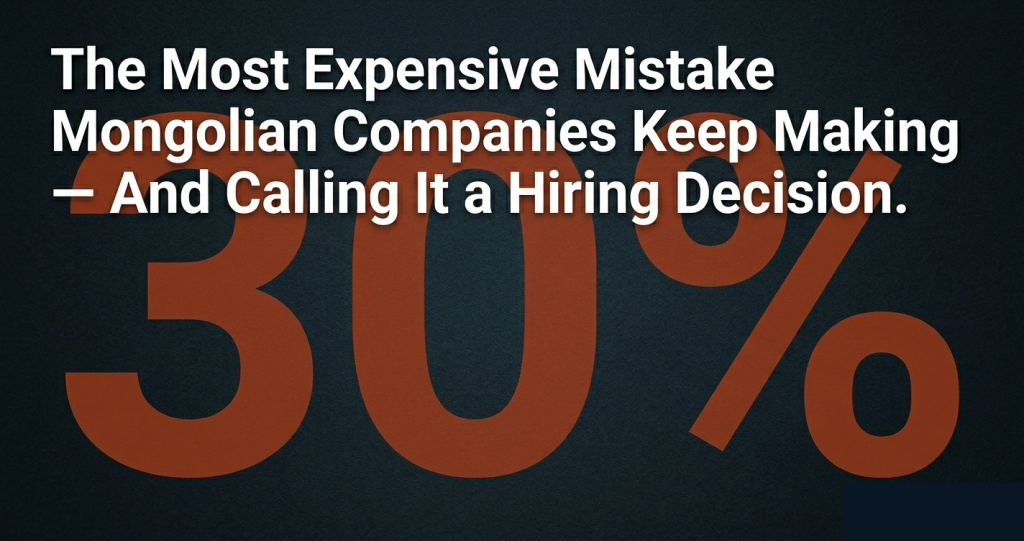
    A bad hire costs up to 30% of that employee’s first-year salary. In a market where senior management earns 4.37 million MNT per month, that number gets large very fast. Organizations are absorbing this cost constantly, and almost none of them are measuring it.


    Here is a number that most companies do not know about their own operations: the precise cost of the last person they hired who did not work out. Not the salary paid during the tenure. Not just the recruitment fee. The full number, including the management time absorbed, the productivity lost by the team around them, the clients or projects disrupted, the morale damage, the cost of starting the search again, and the salary of the replacement hire, layered on top of all of it.

    Almost no Mongolian organization tracks this figure. Almost every Mongolian organization is paying it.

    The global research on bad hires is unambiguous: a poor hiring decision costs between 30% and 150% of the employee’s annual salary, depending on seniority and how long the situation persists before action is taken. For a mid-level manager in Mongolia earning 3 million MNT per month, a failed hire that lasts eight months before being resolved carries a total organizational cost, visible and invisible, of anywhere between 10 and 36 million MNT. For a C-suite appointment that does not work out after a year, the number is multiples of that. These are not edge cases. They are the ordinary, recurring consequence of a hiring process that most Mongolian companies still treat as less important than the decisions the hire will be making.


    What a Bad Hire Actually Costs – Beyond the Obvious

    The direct costs of a failed hire are the ones organizations notice: recruitment spend, salary paid, and, where applicable, severance. These are real, and in a market where executive search fees for senior roles can run 15 to 20% of annual compensation, they are significant. A CFO placed at a 100 million MNT annual package carries a search fee alone of 15 to 20 million MNT. If that hire fails within twelve months, the organization pays that fee again on the replacement search.

    But the indirect costs are where the real damage accumulates and where Mongolian organizations consistently underestimate their exposure.

    42 days average time a position sits open globally after a vacancy occurs during which productivity loss begins immediately (SHRM, 2024)

    Lost productivity is the first and largest invisible cost. A new hire reaches full productivity on average within six to eight months. During that period, the organization is paying full salary for partial output. If the hire is wrong, if the skills, the cultural fit, or the judgment are not what the interview process suggested, that productivity deficit extends indefinitely, while the cost of addressing it grows with every week of delay. In Mongolia’s competitive sectors, where teams are lean and individual contribution is high-leverage, a single underperforming hire in a senior role can slow a department’s entire output for a quarter or more.

    Team morale is the second cost, and the hardest to quantify. When a hire is visibly wrong, when a team can see that a manager lacks competence, that a senior professional is not pulling their weight, that a leader is creating friction rather than removing it, the people around that hire absorb the consequences daily. They pick up the slack. They work around the dysfunction. They start, quietly, to reassess whether an organization that makes decisions like this is one they want to stay in. In a market where, globally, 51% of employees are actively watching or seeking new jobs, the ripple effect of a bad hire on the people already in place is not a soft risk. It is a hard one.

    A Mongolian logistics company hired a regional operations director through an informal referral in 2023. Within four months, three of his direct reports had handed in resignations, citing management style. The company replaced the director eight months into his tenure. Total estimated cost, including the three replacement hires and the projects delayed during the transition approximately 85 million MNT. The original search had cost nothing; the hire came through a contact. The lesson was more expensive than any search fee would have been.


    Why It Keeps Happening

    Mongolia’s bad hire problem is not primarily a competency problem. It is a process problem. Specifically, it is the result of three consistent failures that appear, with remarkable regularity, in how Mongolian organizations approach senior and mid-senior appointments.

    The first is speed, pressure overriding rigor. When a role becomes vacant, the organization feels the operational gap immediately, and the impulse is to fill it as quickly as possible. Timelines compress. Reference checks become cursory. The structured evaluation that would identify a misalignment between the candidate’s actual capabilities and the role’s real demands gets skipped or shortened. The hire is made. The problem that was visible in a proper assessment process emerges six months later at considerably greater cost.

    The second is over-reliance on the interview performance. Mongolia’s hiring culture places significant weight on the interview as the primary evaluation mechanism. A candidate who presents well, who is articulate, who knows the right things to say about strategy and leadership, who has the right institutional affiliations, can move through a Mongolian hiring process with very little scrutiny of whether they have actually done what they are claiming to have done. Structured reference conversations, practical assessments, and competency-based evaluation frameworks are still not standard practice across most Mongolian organizations. The interview room rewards performance, not necessarily performance in the role.

    The third is the most culturally specific, the connection override. A referral from within the network of a board member or a senior executive carries an informal authority that often bypasses evaluation entirely. The hire is made because of who vouches for them, not what an independent assessment reveals. In a small professional community like Ulaanbaatar’s, this mechanism is understandable. It is also statistically the source of a disproportionate share of the bad hires that are most damaging, because the relationship layer that enabled the hire also makes it harder to address when the hire fails.


    What Structured Hiring Actually Prevents

    The case for structured executive search is frequently made on the grounds of candidate quality, finding a better person for the role. That case is true but incomplete. The more precise argument is that structured search prevents specific, calculable categories of organizational cost that informal hiring consistently produces.

    A properly run search process for a senior role includes a thorough role definition before any candidate is evaluated, a step that, in informal hiring, rarely happens. Organizations that skip this step often discover, three months into a hire, that the role they described to the candidate was not actually the role they needed filled. The resulting misalignment is not the candidate’s fault. It is a design failure that a structured process would have caught.

    It includes independent reference conversations that go beyond the references the candidate provides, conversations with people who have managed, worked alongside, or been managed by the candidate, conducted by someone with no stake in validating the hire. It includes competency-based evaluation against criteria defined before any name is attached to the process. And it includes a candidate pool that extends beyond the organization’s existing network, which is the only mechanism that guarantees the best available person is being considered, rather than the most available known person.

    30% minimum cost of a failed hire as a percentage of first-year salary rising to 150% for senior roles (SHRM/Wellhub, 2025)

    XacBank’s adoption of psychometric and cognitive assessments as part of its interview process is one of the more sophisticated hiring practices visible among Mongolian financial institutions, which reflects an understanding that interview performance is not a sufficient proxy for role performance. Organizations that have invested in more rigorous evaluation are not just finding better candidates. They are avoiding the cost of the wrong ones.


    The Calculation Every Mongolian CEO Should Run

    Before the next senior hire, consider running the actual numbers. Take the monthly salary of the role. Multiply by twelve. Take 30% of that figure as the floor cost of a failed hire, recognizing that for senior roles and extended bad-hire situations, the real number is considerably higher. Add the search fee for the replacement hire. Add a rough estimate of the management time and productivity loss your team will absorb if the hire is wrong. Compare that total to the cost of a properly structured search process that reduces the probability of that outcome.

    In almost every case, the math is not close. The cost of getting it wrong dwarfs the cost of getting it right. The question is not whether Mongolian organizations can afford structured, rigorous hiring. It is whether they can afford to keep doing without it.

    Lambda. Global’s executive search practice is built on precisely this premise. In a market of 1.2 million active workers with a projected shortfall of 240,000 by 2035, the organizations that will have the strongest leadership teams in five years are the ones making the best hiring decisions right now, not the fastest ones.


    SOURCES & REFERENCES

    1.  Wellhub – Cost Per Hire: Averages, Deciding Factors, and How to Calculate (2025)

    Bad hire costs up to 30% of first-year salary; hidden costs include lost productivity, morale impact, and repeat recruitment spend.

    https://wellhub.com/en-us/blog/talent-acquisition-and-retention/cost-of-hire

    2.  Spark Hire – The Real Cost of Employee Turnover (January 2025)

    42-day average to fill open position (SHRM 2024); 6-8 months to full productivity; culture and morale impact of turnover.

    https://www.sparkhire.com/learn/screen-candidates/the-cost-of-employee-turnover

    3.  High5Test – US Employee Turnover Statistics 2024–2025

    51% of employees are watching or seeking new jobs; engagement and culture top reasons for leaving (37%); turnover cost frameworks.

    4.  9CV9 Blog – How to Find and Hire Employees in Mongolia in 2025

    Rise in employee turnover in mining and IT; XacBank psychometric assessment practice; long-term aspiration screening approaches.

    5.  9CV9 Blog – State of Recruitment and Hiring in Mongolia 2025

    83,700 new hires projected for 2025; senior management avg 4.37M MNT/month; 1.2M active workforce; 240,000 shortfall by 2035.

    6.  Rivermate – Recruitment in Mongolia (February 2026)

    Poor hiring decisions linked to turnover and productivity loss; salary variation by industry, experience, and location in Mongolia.

    https://www.rivermate.com/guides/mongolia/recruitment