Tag: executive-roles-mongolia

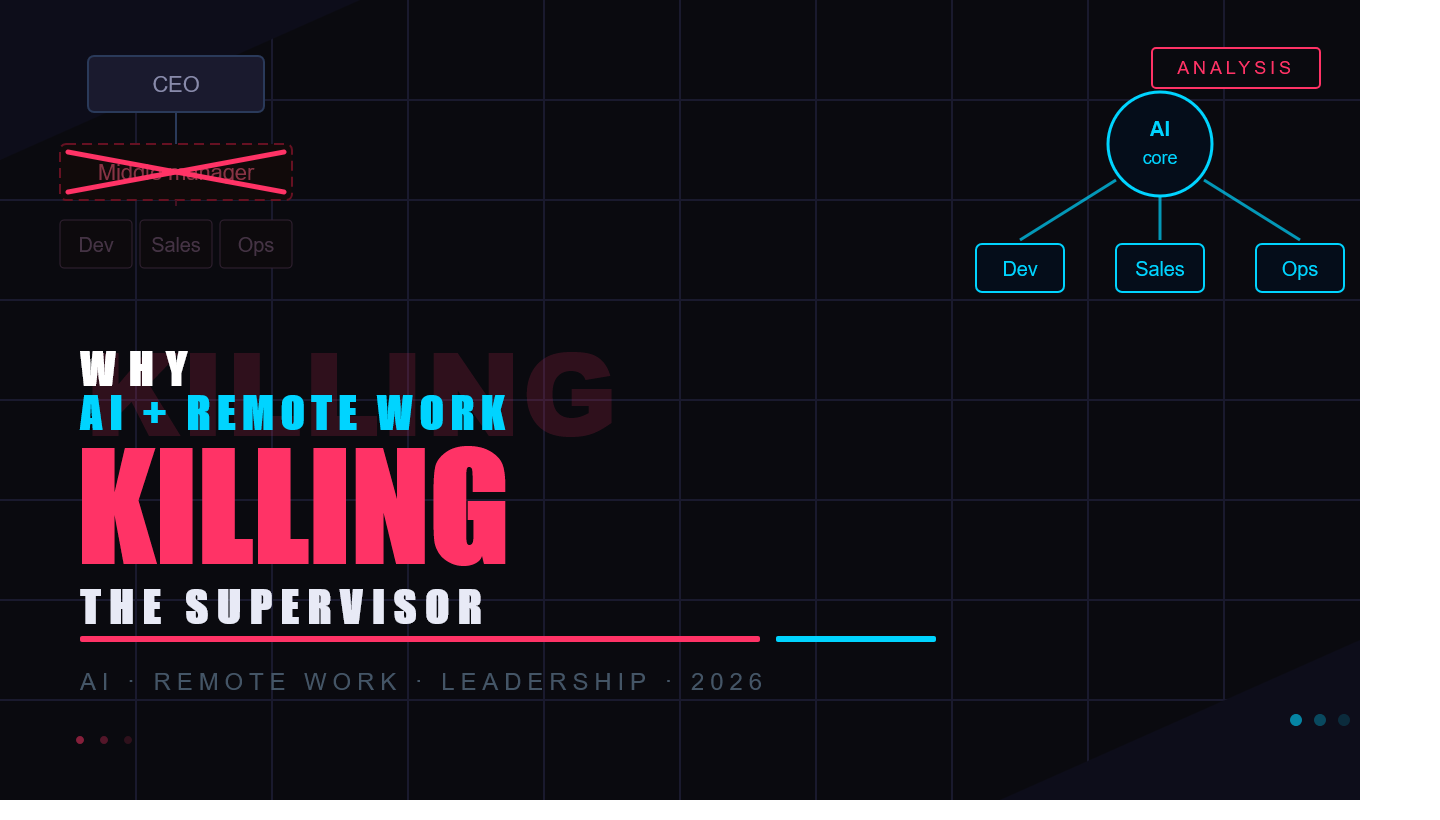
  • AI and Remote work are threat to The middle managers

    AI and Remote work are threat to The middle managers

    The Attack on the Middle Layer: A Big Change

    In the past the “Middle Manager” was very important to a company. For over a hundred years their job was clear: they helped the top bosses and the workers on the line understand each other. They took ideas and turned them into small tasks watched how hard people worked and made sure everything ran smoothly. This system was great for the industrial era, when information moved slowly and people needed to be watched all the time.

    Now in 2026 the “middle layer” is in big trouble. From Ulaanbaatar to London the traditional supervisor. The one who just watches over a team or asks for reports. Is struggling to survive. The reasons for this are not temporary they are the two drivers of the modern economy: Artificial Intelligence and Remote Work.

    Artificial Intelligence: The End of “Management by Numbers”

    In the past a middle manager spent most of their time collecting data making spreadsheets and reporting to their bosses. Now in 2026 this job is no longer needed because of Artificial Intelligence.

    Real Time Information: New project management software, powered by Artificial Intelligence gives bosses up to date information. When a CEO can see how a project is going how sales are doing or how productive a team is, with just one click, the human manager who used to give them this information is no longer needed.

    Autonomous Decision Making: Artificial Intelligence is not a tool for reporting it is also a decision maker. Whether it is optimizing supply chains predicting market changes or allocating resources algorithms can make data driven choices faster and more accurately than a supervisor. The part of management that was about numbers. Once the main job of the middle layer. Is being automated.

    The result is that the “Middle Layer” is disappearing. Companies no longer need a layer to filter information. They need systems that give data directly to the people who do the work and the people who lead.

    Remote Work: From Watching to Trusting

    The second blow to the supervisor came with the shift to remote and hybrid work models. The supervisors power came from being able to see that an employee was at their desk from 9 to 5. This was management by watching.

    In a world watching is not possible and it is not helpful. You cannot control someone who works from a time zone or a home office without hurting their morale and productivity. This shift has forced a cultural change: from watching to trusting.

    The best workers today. The kind of talent that Lambda Global supports. Do not like being controlled. They need goals and the freedom to achieve them. If a company still uses managers who do not trust their workers it is wasting a lot of time and money. Those managers are not adding value they are just causing problems.

    The “End” of the Bureaucrat

    As companies get flatter we are seeing a divide between two types of leaders. One is becoming less important while the other is becoming more valuable.

    The Bureaucrat: These are the managers who were good at administration. They were good at attending meetings watching workers and doing paperwork. Without a physical office to control and with Artificial Intelligence doing their reports they have no job left.

    The Expert Leader: These are the leaders who have technical or domain knowledge. They do not just supervise they contribute. They are the mentors who can solve problems the strategists who can close big deals and the coaches who can improve the skills of their team.

    At Lambda Global we believe the future belongs to the Expert Leader. In a company there is no room for someone who just manages. Everyone must add value.

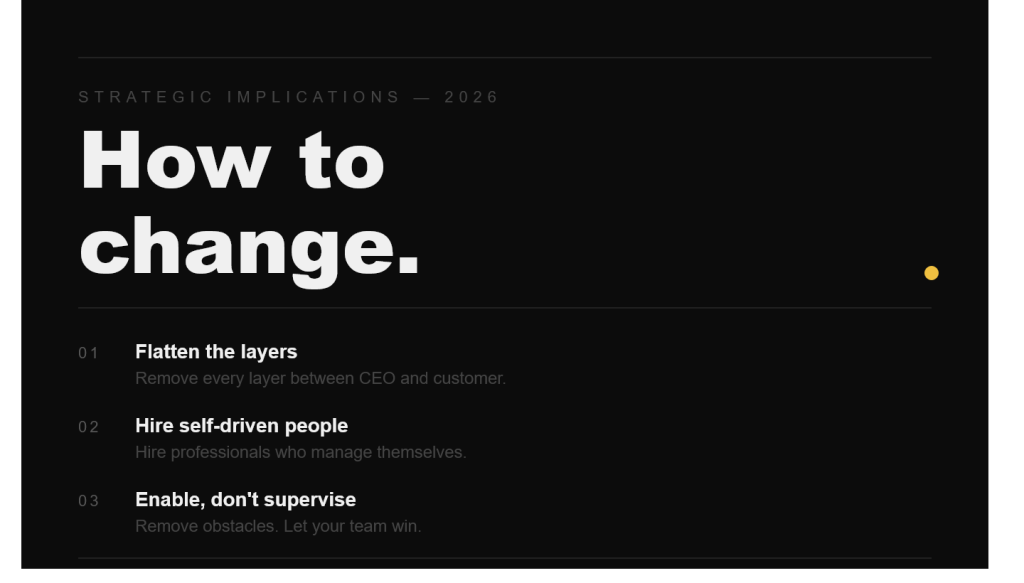
    Strategic Implications: How to Change
    For a boss in 2026 the question is no longer “How many people work for me?” This is a way of thinking. The modern question is: “How well can my team work without me?”

    Changing to this way of leading requires three big steps:

    1. Remove unnecessary layers of management that slow down decision-making. Every layer between the customer and the CEO is a problem.
    2. Hire workers who are self-driven. Of hiring supervisors to watch people hire professionals who can manage themselves.
    3. Change the job of managers from “supervising” to “enabling”. Their job is to remove obstacles that prevent their team from winning.

    The New Era: Leadership as System Design

    The “end” of the supervisor is not a disaster for companies it is an opportunity. It allows organizations to be leaner, faster and more human. When you remove the layer of watching and manual reporting you create a culture of high trust and high performance.

    Companies today do not need “bosses”. They need architects who can design systems and mentors who can nurture great talent. The companies that thrive in this era will be those that embrace the flat structure use Artificial Intelligence to handle logistics and empower their teams to lead themselves.

    Clarity Over Control

    The change from a hierarchy of control to a network of autonomy is the challenge for Mongolian businesses and global companies alike, in 2026. The supervisor as we knew them is gone. In their place we must build a standard of leadership based on expertise, trust and results.

    Giving your team the space to work autonomously is not a nice thing to do it is necessary. The future is flat the future is autonomous. The future is led by experts. It is time to stop watching and start making an impact.
  • Hiring in Mongolia Is Broken. Here’s What’s Actually Causing It.

    Hiring in Mongolia Is Broken. Here’s What’s Actually Causing It.

    Low unemployment and a growing economy, yet companies cannot fill their most critical roles. The problem runs deeper than most employers want to admit.

    Mongolia’s economy has grown considerably over the past decade, largely driven by its mining sector and the steady expansion of financial and professional services in Ulaanbaatar. Unemployment sits near historic lows. The number of formally registered companies has risen steadily. And yet, if you talk to hiring managers across industries, the
    picture they describe doesn’t feel like a tight labor market. It feels like a broken one.

    Senior roles sit open for six to twelve months. Qualified candidates apply and hear nothing back. Salary expectations between employers and candidates differ so widely that negotiations often collapse before they begin. And a disproportionate share of hiring decisions are made not through formal processes, but through personal networks quietly.

    Ask anyone who has hired or been hired in Mongolia’s professional market, and they will describe some version of this. What most conversations skip is why it works this way and what it would take to change.

    The network works. Until it doesn’t.

    Mongolia’s professional class in Ulaanbaatar is small enough that most hiring managers already know who they’re looking for before a search begins. In that context, relationship based hiring isn’t simply a habit, it’s an information strategy. A referral arrives pre-vetted, with the recommender’s reputation on the line if the hire goes wrong. In a market without reliable salary data or standardized credentials, a referral carries more signal than a resume.

    The cost is who gets excluded. Graduates from regional universities, returning professionals, and candidates who simply haven’t had time to build the right connections get filtered out before anyone reviews their qualifications. The market doesn’t exclude them because they’re unqualified. It excludes them because they’re unfamiliar, and in a
    relationship-driven system, the two get treated the same way. Companies fishing the same small pool compete over the same people, bid salaries up reactively, and convince themselves the market is the problem. It feels tight partly because they’ve made it tight.

    The network works. It just works better for some people than others. In a market this small, that is not a minor inefficiency. It is the defining feature.

    The formal process nobody believes in

    Most mid-size and large Mongolian companies post jobs formally. But the process rarely works the way it’s supposed to, and both sides have learned to expect little from it.

    From the employer side, too many applications, too little relevance, and a hiring process where effort rarely matches outcome. Many HR managers admit they post roles publicly out of procedure or policy, while already knowing who they intend to hire.

    From the candidate side, the experience is just as discouraging. Applications go unanswered. Interviews run multiple rounds and then go silent. Roles turn out to have been filled through referral weeks before the listing went live. For candidates who haven’t been through this before, it’s confusing. For those who have, it becomes a reason to stop trying altogether.

    Both sides are responding rationally to an unreliable system. And both responses make it more unreliable. When employers don’t invest in the formal process, it produces poor results. When candidates lose confidence in it, application quality drops. The cycle is self reinforcing, and it won’t break until someone decides to go first.

    Nobody knows what anything pays

    Mongolia has no standardized public compensation data for most professional roles. Salary decisions come down to internal precedent, peer comparisons, or whatever a candidate names in the room. Similar roles pay very differently across companies, with no logical relationship to seniority or scope. Candidates with insider access negotiate far better
    outcomes than equally qualified peers who don’t, not because they’re more valuable, but because they have information others lack.

    Above all of this sits the mining sector premium. For instance, Oyu Tolgoi, Erdenet, and Erdenes Tavan Tolgoi pay at levels most non-resource companies structurally cannot match, not because those companies are poorly managed, but because resource extraction
    generates margins that banking, technology, and professional services don’t.

    A senior operations or engineering professional in the resource sector earns substantially more than an equivalent role anywhere else in Ulaanbaatar. Companies outside the resource orbit are outbid before negotiations even begin. Most of them know it, and most haven’t found a
    meaningful answer to it.

    Professionals who discover they were underpaid don’t accept it quietly. They leave and in a small market, that story travels.

    The professionals who leave, and why

    Mongolia’s labor emigration is more skilled than public conversation acknowledges. South Korea’s Employment Permit System draws Mongolian workers in significant numbers each year, and the cohort increasingly includes people with technical qualifications and university degrees, not only those seeking unskilled work. Japan and Germany have formalized bilateral agreements opening structured pathways for Mongolian professionals in engineering, healthcare, and logistics.

    The economics are straightforward. Foreign wages are multiples of comparable domestic roles. Career progression is more clearly structured. Remittances have become a meaningful contributor to Mongolian household income nationally, which looks positive on paper, but signals something uncomfortable. For a growing share of Mongolia’s most capable workers, staying home is the financially irrational choice. The country isn’t losing its least productive people to emigration. It is losing some of its most capable, precisely because they have the qualifications and adaptability to go.

    What the better companies are doing

    A minority of Mongolian organizations navigate this environment noticeably better than their peers, and they are not all paying the most. They hire earlier, building relationships with universities, including regional ones outside Ulaanbaatar, and bring in graduates through structured development programs. The result is professionals who stay because they were developed by the organization, not simply bought from a competitor.

    They also make their processes legible, clear timelines, consistent communication, and honest feedback. In a market where most hiring experiences are frustrating, this alone builds a reputation that attracts stronger candidates. And the most effective organizations treat talent as a leadership issue, not an HR function, because how executives talk about growth and promotion determines whether ambitious people see a future there at all.

    The honest conclusion

    Some of Mongolia’s hiring dysfunction is structural, including the mining premium, the absence of compensation data, and years of underinvestment in workforce development. No single employer fixes those alone.

    But a significant share is self-inflicted. Employers who hire only through networks, run processes they don’t believe in, and treat development as a cost are sustaining the very shortage they complain about most.

    The companies best positioned five years from now are building their talent pipeline today. The market is fixable. It just requires employers to stop waiting for someone else to fix it first.