Category: Thought Leadership

  • Digital Nomadism is Dead Long Live the Global Mobility Elite: The Case of Mongolia

    Digital Nomadism is Dead Long Live the Global Mobility Elite: The Case of Mongolia

    Digital Nomadism is Dead Long Live the Global Mobility Elite

    Back in the 2020s everyone wanted to be a Digital Nomad. They would talk about professionals working on their laptops on a beach in Bali wearing sunglasses. This was about freedom. By 2026 that conversation became a joke. Digital Nomads couldn’t get work done anywhere. They couldn’t help their companies.

    The new era is the age of Global Mobility. This is about working in an planned way. It’s not about how you want your life to be. It’s about becoming part of a high-level workgroup in the labor market. These workers are not nomads. They are leaders who’re good at Global Mobility.

    So why didn’t the Digital Nomad concept work?

    Some research in 2025 showed that 62% of workers went back to an office. They couldn’t work well with their colleagues. Advance their careers. The problem with Digital Nomads was that they thought work was a part-time thing. They got frustrated with time zones and didn’t understand different cultures.

    Global Mobility is different. Work is a part of a global network. Whether the manager, engineer or creative director works from Ulaanbaatar, Berlin, Tokyo or even Mars they’re all working on the projects. We call this Systemic Mobility.

    Systemic Mobility is based on three concepts:

    * Cultural Intelligence. Research by the World Bank shows that 80% of a leaders success with teams from countries depends on understanding different cultures. A global mobility expert works like a decoder. They know that an engineers silence at a meeting means they’re probably thinking, not that they agree.

    * Follow-the-Sun architecture. The expert works at 9, 5 or whatever. They design work so that when its night in Ulaanbaatar work continues in Europe. When its night in Europe work goes to the Americas. This allows for work to happen all the time.

    * Asynchronous Diplomat. In 2026 people were tired of using Zoom all the time. Top specialists in Global Mobility communicate with videos and long texts. They don’t need real-time conversations. They just need results.

    Ulaanbaatar: The new center of the global network

    Mongolia is in a position. It links Central Asia with the rest of the world. The time zone is perfect for working with markets. A study showed that high-level specialists working in Mongolia for companies increased by 45% in just 18 months. These are not nomads. These are leaders who’re good at Global Mobility.

    What kind of worker are you?

    In 2026 there are two types of specialists.

    * Digital Nomad: The main goal is comfort and travel.

    * Global Mobility: The main goal is to make an impact and be efficient.

    FeatureDigital Nomad (Legacy)Global Mobility Elite (Future)
    Primary GoalPersonal comfort & travelGlobal impact & systemic efficiency
    CommunicationSynchronous (Real-time/Zoom)Asynchronous (Systematized)
    Value MetricHours worked (Input)Value added (Output)
    MindsetEscaping the systemMastering the network
    Location“Wherever has the best Wi-Fi”Strategic positioning for global reach

    Your communication style is also different. Digital Nomads communicate in time. Global Mobility workers use communication. The value attached to employees is also different. Digital Nomads are paid for their hours. Global Mobility workers are paid for the value they add.

    Lambda Global Manifesto: Capability over Coordinates

    Our message to companies is simple. You don’t need an office in a perfect location. You need workers. Global Mobility is not something that employees need. It’s something that companies need to succeed. It’s not unusual for a young professional in Ulaanbaatar to work with a team from India, Germany and Brazil at the time.

    Lambda Global helps businesses find talent. We don’t just fill positions. We bring a Global Brain to your company. We do this in a way.

    FeatureTraditional RecruitmentLambda Global (Global Brain)
    Talent ReachGeographically restricted (Local)Unlocking the Global Talent Pool
    Evaluation CriteriaTechnical Skill-set onlyAssessing “Mobility Mindset” and CQ
    Primary ObjectiveFilling a vacancyDelivering Strategic “Brainpower”
    Operational ScopeLocal market limitationsBorderless workforce integration

    The era of the Digital Nomad is over. We’re entering the era of the leader. Where you are located doesn’t matter. What matters is your connections, leadership and value. This is your passport to success, in the labor market. Will you stay a Digital Nomad? Will you become a member of the Global Mobility elite?

  • The State of the Male Workforce in Mongolia

    The State of the Male Workforce in Mongolia

    I remember there were a podcast called “Where are the Mongolian men?” hosted by three men. Three hosts worked in a corporate sector. They have claimed that everywhere they go, in the office, restaurants, networking events, different clubs and training, there were always women outnumbering the men. Hence, they have started a podcast to discuss this issue. 

    According to the study the state is one of the major employers in Mongolia, especially in the rural provinces. One out of five people in Mongolia are employed by the state. Head of the government agencies are dominated by men. 
    There are around 120 state owned enterprises, if the subsidiary and local government owned enterprises will be added this number will rocket to 450. Men are dominantly working in these state-owned enterprises. It is not a secret that recruiting process of ministries, government agencies and state-owned enterprises are very different than the private enterprises. Private enterprises have largely merit based recruiting system. Candidates have to pass the interview and exam to get into the big company, whereas in the state-owned enterprise connection is more important than the candidates’ education and skills. This connection-based system allows a number of incompetent workforces to easily get a job.
    Majority of Mongolian men are heavily interested in politics. Therefore, most of them see state enterprises as a ladder to the political leadership role. It is public knowledge that the heads of the state-owned enterprises are appointed by a political party. 
    The rest, who are not aspiring to the political leadership role, stays in the organization even if they dislike the job. The main reason is they are aware that, if they lose this job, they will face hard time to get another one as they have poor skills and qualifications. 

    For both government agencies and corporate sector, in the office environment men are either at the top or the bottom. Middle positions are dominated by women. That’s why women seem to be everywhere in the corporate world. 
    Educated and skilled Mongolian men are predominantly working in construction, mining and energy sectors in the home country. Rest is the business owners. If we look into the number of medical professionals of Mongolia, men comprise only around 20%, which is a huge gap. 

    Men, who have no connection to government agencies and state-owned enterprises among others, choose to go abroad and work there. Working abroad allows men to earn a decent salary to build their life. Today approximately 55,000 Mongolians are residing in South Korea, from which 37,000 are contracted workers. It is the number one destination for Mongolians. Consequently, South Korea is the largest country with bilateral social security agreement with Mongolia, where Mongolians are granted an option to be covered by Mongolian social insurance. It is not clear when will the outflow to South Korea cease, as the system sending the contractor workers is well established that even the legal regulations are in favor of it. 

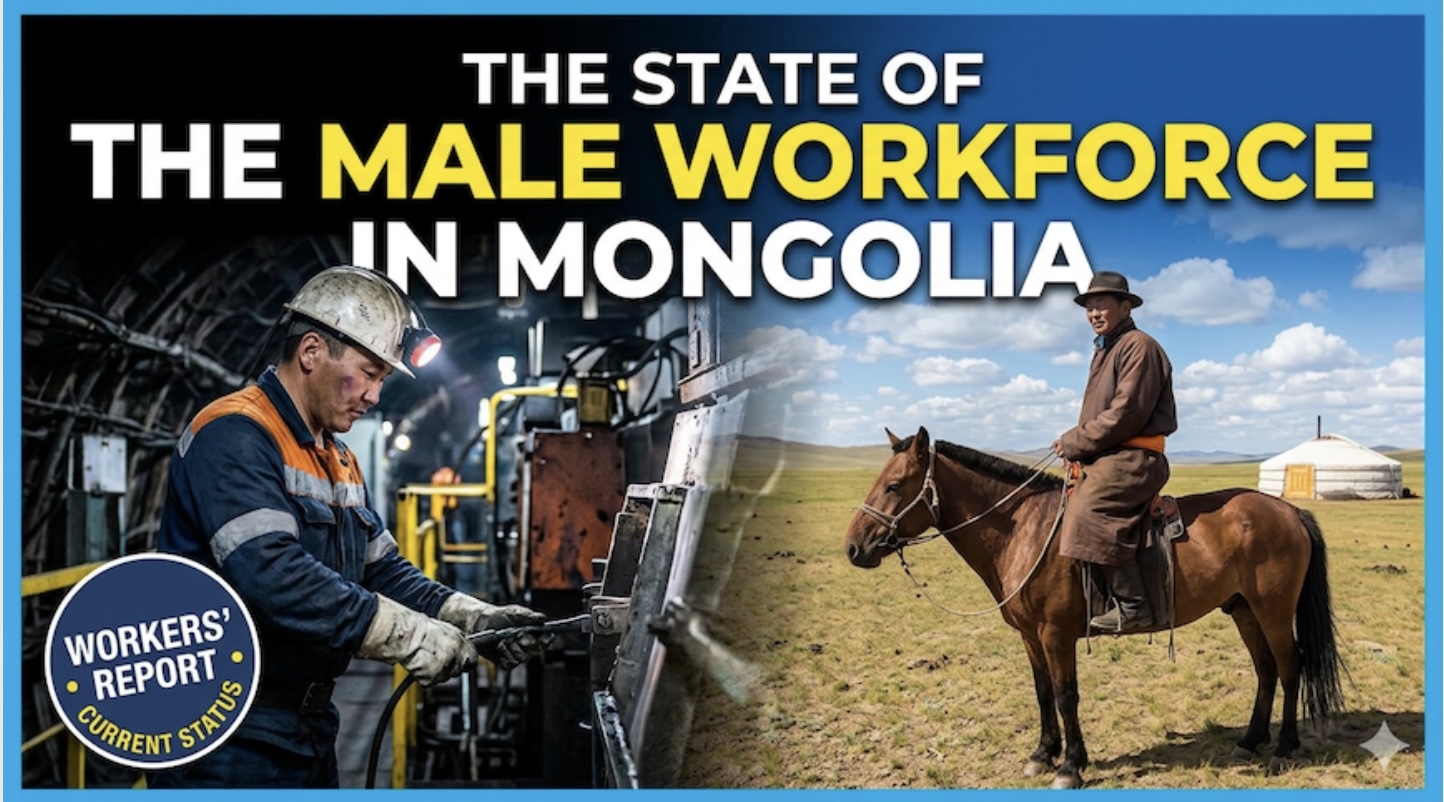
    Another group of men are the men who are continuing the Mongolian heritage, undertaking a herding work. They regarded as a workforce in the agricultural sector. Herding is a hard work. Consequently, most herder families keep the boys to help with herding, while sending the girls to go to the university. It created a so-called reverse gender gap in education. 

    This is the overall picture of male workforce of Mongolia. They are either directors or a contract worker, they are a business owner or a herder. There are small number of doctors, software engineers and other specialists. Thus, there is need to support the male professionals and increase the number of highly skilled workforce.

    Tips to support existing male professionals:

    – Involve in professional training to upgrade their qualifications
    – Involve in other self-development training 
    – Provide clear career path
    – Provide incentives aside the salary, such as transportation and communication allowances
    – Provide attractive packages such as a health insurance.

    References:

    1. Agreement between Mongolia and the Republic of Korea on Social Security, the Ministry of Family, Labour and Social Protection, 2006
    2. Employment of Mongolians in South Korea and Changes of Foreign Labor Policy of South Korea,2024
    3. Gender bias in medicine: which countries have the most female doctors, the World Health Organization, 2023
    4. Mongolia’s Workforce in the Public Sector is 18.4%, Inside Mongolia, 2026
    5. Reports of State-owned enterprises, Agency for State Property Policy and Coordination,2023. 

  • Most of Mongolia’s Best Candidates Are Invisible. Lambda Is Changing That.

    Most of Mongolia’s Best Candidates Are Invisible. Lambda Is Changing That.

    Anywhere from 70% to 80% of professional roles are never advertised before they are filled. This figure could actually be higher in Mongolia. It is no secret. It is a common practice. And if you are a hiring manager, then it may be slowly draining away potential applicants you may never come across.

    The best professionals in Mongolia are usually off the radar. Not because of any skill deficiencies, but rather because they do not belong to the correct chat groups or networking events in the city of Ulaanbaatar. They are out there somewhere, and yet the market never sees them.

    The comfort of the small circle, and why it is not enough

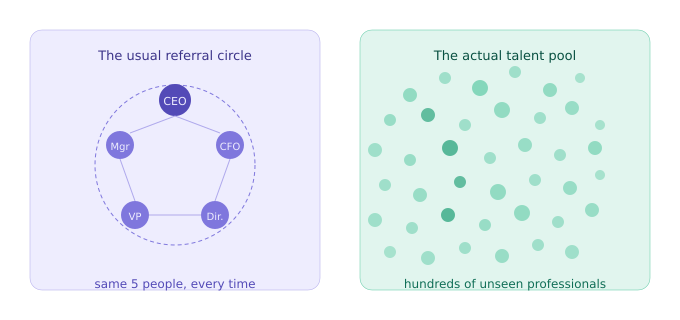
    In a simple term, Mongolia’s professional network is compact. When a leadership or specialist role opens, it’s usually the same scenario for many places. They call a few people they trust and ask who they know. Those people are often already employed, known, or being chased by someone else. The pool looks busy but it is certainly shallow.

    It makes total sense that this approach is prevalent and it’s not because of laziness. It came from logic. In a market where salaries are opaque and credentials can be inflated, a referral feels safe. The person vouching has a reputation in the game. That is the real value.

    Unfortunately, the same small group of candidates gets approached again and again. Their salary expectations inflate and the thousands of capable people who are not in that circle stay invisible, including people in Darkhan or Erdenet city, Mongolians quietly returning from years abroad, and professionals who simply never learned how or never had the time to network in the right rooms.

    The market is bigger than it feels

    But the facts paint a completely different picture. For example, Mongolia boasts 2.8 million Internet users. And that is only the number of people registered on LinkedIn. This number exceeds half a million profiles belonging to residents of the country. That figure does not even take into consideration the individuals whose information needs updating, as well as those people who have never used social networking sites like LinkedIn at all.

    The old way worked when the economy was simpler and everyone knew everyone. But Mongolia’s private sector is changing. Fintech, logistics, professional services, and technology are growing. They need skills that did not exist in the local market a decade ago. You cannot fill a niche compliance role or a data leadership position by asking your old classmate if he knows someone. You need to see a bigger picture.

    What Lambda.Global is doing about it

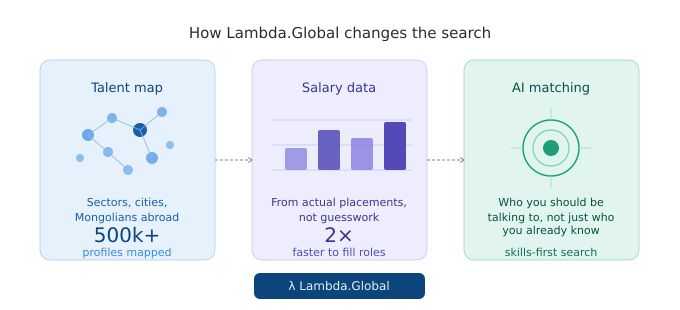
    Lambda.Global was not built to be a job board. A job board lists vacancies. It does not solve the problem of who gets seen. Lambda works the other way around. It all begins with the talent pool, but with the help of data, it connects the right individuals to the right opportunities, no matter whether these two never would have met under normal circumstances. This results in three things being done differently.

    Lambda.Global keeps a running map of professionals across sectors, locations, and experience levels, including Mongolians abroad who are open to working here but have no obvious way to wave their hand and say “I exist”. That alone changes a hiring conversation before it even begins.

    Then there’s the money question. In a market where salary talks often collapse because nobody knows what’s real, Lambda pulls compensation data from actual placements, not from surveys that have been sitting in a drawer for two years. Therefore, both sides can show up with numbers they can defend, not numbers they pulled from nowhere. A lot of good matches die simply because someone guessed wrong. Lambda makes guessing less necessary.

    And when it’s time to find the person, the platform uses AI not to judge who is best, but to pull forward candidates who actually fit. It means the search stops being about who you already know and starts being about who you should be talking to. Lambda’s own placement data backs this up. Roles that are posted with clear pay ranges and an open search scope fill about twice as fast as the ones that still run on the old model.

    Another part worth paying attention to is who finally gets considered. People who would never have landed on a referral shortlist start showing up in final interviews. That’s not a minor improvement. It’s a different hiring market entirely.

    Let’s take an example where a Mongolian manufacturing firm needed a lead role. The role had been empty for several months. The CEO had exhausted every contact he had, but someone on his team suggested Lambda. Within a few weeks, the platform surfaced a candidate the CEO had never heard of. The candidate was not in any chat group and he was not on anyone’s referral list. He took the job. This is not technology saving the day. It is seeing what was already there. The talent did not appear because Lambda created it. It appeared because Lambda made it visible.

    Moreover, Lambda.Global is not trying to kill referrals. Referrals will always matter and they should. What Lambda is doing is putting data and transparency alongside personal relationships, so the referral is not the only door. So a company can still trust its network while also growing it.

    Lambda.Global gives companies a map of the talent that is actually out there, not just the talent that happens to be in the same group. Mongolia’s hiring problem is not a shortage of capable people. It is a habit of looking in the same small places and pretending that is the whole market. Breaking that habit does not require a revolution. It requires a decision that can be made tomorrow morning.

    References

    • Internet penetration: Mongolia has approx. 2.8 million internet users (DataReportal, Digital 2025 Mongolia).
    • LinkedIn profiles in Mongolia: over 550,000 active professionals
    • Lambda.Global internal placement data (2025–2026)
    • World Bank, Skills demand in Mongolia: Main Findings of the Skills Module of the Barometer Survey (2022)
  • They Came Back to Mongolia for the Salary. They Stayed for Something Else.

    They Came Back to Mongolia for the Salary. They Stayed for Something Else.

    Bilguun left for Singapore in 2014. He was 24 when he left and he had a finance degree from a university in Ulaanbaatar city that nobody outside Mongolia had heard of. For seven years he climbed in a foreign land. He began working with a local bank, followed by a startup, and ended up doing business across three countries. By 2023, he was earning what those back home that he grew up with would only earn in ten years.

    In a surprising turn of events, he moved back to Mongolia last November. Not for family, not because he got pushed out. He moved back because a Mongolian company offered him something that surprised even him. Not a fancy title, not a company car, not a salary that matched Singapore dollar for dollar. None of that was on the table when he got the offer. What they offered was a real authority where he could rebuild a broken finance function however he saw fit. The CEO told him “You’ll have my ear and my backing. The rest is yours.” He took the job before they even finished negotiating the bonus salary.

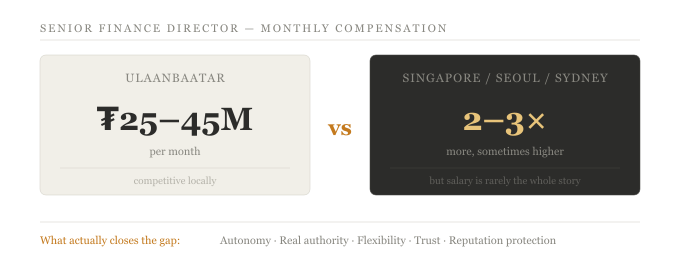
    I am telling this story because it says something about Mongolia’s job market that most compensation surveys miss. We still have a gap between what executives earn in Mongolia and what their equivalent roles pay in Singapore, Australia, or Korea. Let’s say a senior finance director in UB will bring home 25 to 45 million tugriks a month. Their counterpart in a foreign country makes two or three times that, sometimes more. Money is always part of the conversation. But it’s rarely the whole conversation.

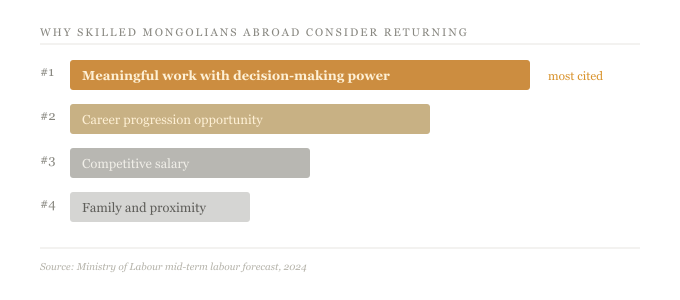
    The Ministry of Labour’s own mid-term labour forecast from 2024 showed something interesting. Within highly skilled Mongolians abroad, the top reason for considering a return to Mongolia was not a competitive salary, but a meaningful work with decision-making power. According to the info, salary came third on the list after career progression. When I first read that, it felt counterintuitive to me. But then I thought about Bilguun and it started making sense.

    What changes when someone reaches the senior level

    Early-career employees need money. They have student loans, young families, rent, etc. But by the time someone is being recruited for a director-level role or above, the arithmetic changes. What keeps them up at night is not the difference between a 20 million and a 25 million tugrik package. It’s the fear of being positioned in a role where they have the title but not the tools. They may spend six months fighting approvals, waiting for decisions that never come, and end up watching their credibility fade because nobody empowered them to actually lead.

    In a small professional market like this city, that reputation damage is permanent. Word gets around. A story about a senior hire who gets hired with fanfare and leaves quietly six months later because they couldn’t get anything done will keep following them. So experienced professionals ask harder questions in interviews. They are required to know who controls budget, who hires their team, whether the board actually wants change or just wants to announce it for the day. Companies that cannot answer those questions clearly lose the candidate.

    What the data quietly shows

    According to a skills survey carried out by the World Bank in 2022, Mongolian employers consider soft skills such as reliability and communication to be more crucial than technical skills. However, the same applies when senior professionals are picking their employers, based on factors like vision and leadership.

    And then there’s the flexibility piece. More than 70 percent of Gen Z and Millennial professionals globally say they value flexibility over a small salary bump. In Mongolia, that number is harder to pin down with precision, but anyone who spends time talking to candidates in the 30-45 age bracket will hear a version of it. They don’t want to be chained to a desk in Central Tower for appearance’s sake. They want to work where the work happens and be judged by output, not attendance. That mindset shift is already here. The companies ignoring it are quietly losing access to the very people they say they need most.

    Where Lambda.Global fits into this

    At Lambda.Global, we see this play out in near real time. The platform surfaces not just who is looking, but what they’re actually looking for. Roles that clearly articulate decision-making authority and offer genuine flexibility fill noticeably faster than roles that offer a slightly higher salary but give vague answers about their “scope”. It’s a huge difference between a role sitting open for three months versus being filled in three weeks.

    The other thing the data makes plain is how much talent is simply invisible to traditional network-based hiring. A Mongolian professional who has spent eight years in Seoul or Sydney doesn’t show up at the usual Ulaanbaatar city networking drinks. They’re not in the group chats that produce the same shortlists. Lambda.Global helps companies get past their own limited Rolodex and actually see the wider pool that surrounds them. Not as a database of CVs, but as a map of who is reachable and what it would take to bring them home.

    A different kind of negotiation

    If you’re a company trying to hire senior talent right now, some changes are needed to be made. Not because the old one is wrong. But because candidates have already changed. Before putting a number on the table, the company should know what a person can actually do in the role. Not what they’ve done in the past. But what they’ll be allowed to do with you. If that cannot be described that with confidence, the negotiation hasn’t even started yet.

    And if you’re a professional sitting abroad or sitting at home thinking about a move, please start asking those questions early. The companies worth your time will have answers. The rest will fumble and change the subject. That alone tells you everything.

    Mongolia’s talent market in 2026 isn’t suffering from a lack of capable people. It’s suffering from a mismatch between what is being offered and what senior professionals actually want. The gap is not about money first. It’s about trust, autonomy, and respect. The organizations that understand this are not only hiring faster. They’re building teams that stay.

    A big salary might open the door. But clarity about the job is what gets someone to walk through it.

    References

    1. Ministry of Labour and Social Protection / Research Institute of Labour and Social Protection, Labor Market of Mongolia: Mid-Term Demand and Supply Forecasting Study Report (2024) – diaspora return motivations.
    2. World Bank, Skills demand in Mongolia: Main Findings of the Skills Module of the Barometer Survey (2022) – employer rankings of soft vs. technical skills.
    3. Lambda.Global internal hiring platform insights (2025–2026) – observed time-to-fill patterns for roles with vs. without clearly defined authority and flexibility.
    4. General background, Youth Employment Forum highlights, Unread / ADB / Ministry of Labour and Social Protection (2025) – generational preference for flexibility.
  • What Is the Executive Talent Gap? And Why Is It a Growing Issue in Mongolian Companies

    What Is the Executive Talent Gap? And Why Is It a Growing Issue in Mongolian Companies

    Let’s say a top-tier mining contractor in Mongolia spent close to five months trying to hire a Head of Operations. The role was critical. The salary was already above what most local companies would offer.

    Candidates came and went. Some were not quite ready. Some were already tied into better roles. A few lost interest halfway through the process. In the end, the company hired someone based in Australia. The final package landed at nearly double the original budget once relocation and allowances were factored in.

    No one involved would call this unusual by today’s standard. This is what executive hiring is starting to look like. And it moves slowly. In a market where even mid-level roles can take a month or two to fill, senior positions easily stretch to five or six months—sometimes longer. The search itself becomes more expensive than the salary increase companies were trying to avoid in the first place.

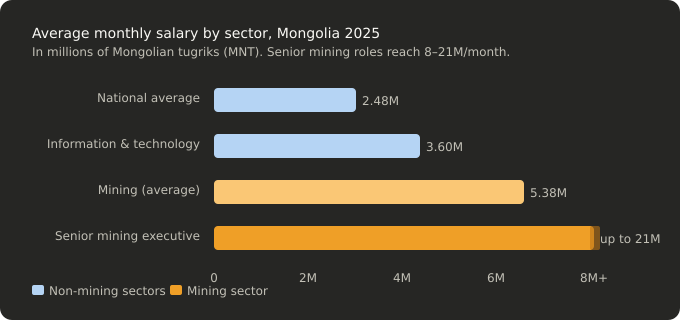
    Mongolia is not short on people. It is short on people who have already seen enough to lead without hesitation. Everything might look fine if you only check the headline numbers. The national average monthly salary reached roughly 2.48 million tugriks last year. Executive base pay climbed another 8–12 percent over the same period. On paper, the market is getting stronger.

    The reality is more awkward. The same handful of candidates keep circling through the same senior roles at different companies. The pool hasn’t grown. The price has. And at some point, salary stops being the main question.

    Early in a career, people chase the number. That’s normal. At the executive level, the questions change. People start asking what they’re walking into. Who actually makes decisions. Whether the team is stable. Whether the business knows where it’s going. Those answers matter more than an extra one or two million tugriks. And when the answers are unclear, the offer begins to fall apart.

    So, companies push harder on the one lever they can control: pay. It feels like action. It rarely fixes the real issue.

    The unevenness of economic growth can be seen from many sources. Mongolia’s economy expanded by 6.9 percent in 2025 according to the World Bank. It was driven largely by mining and agriculture industries. Thanks to that growth, wages were pushed upward, especially in resource-linked industries. But higher wages are not the same as deeper capability.

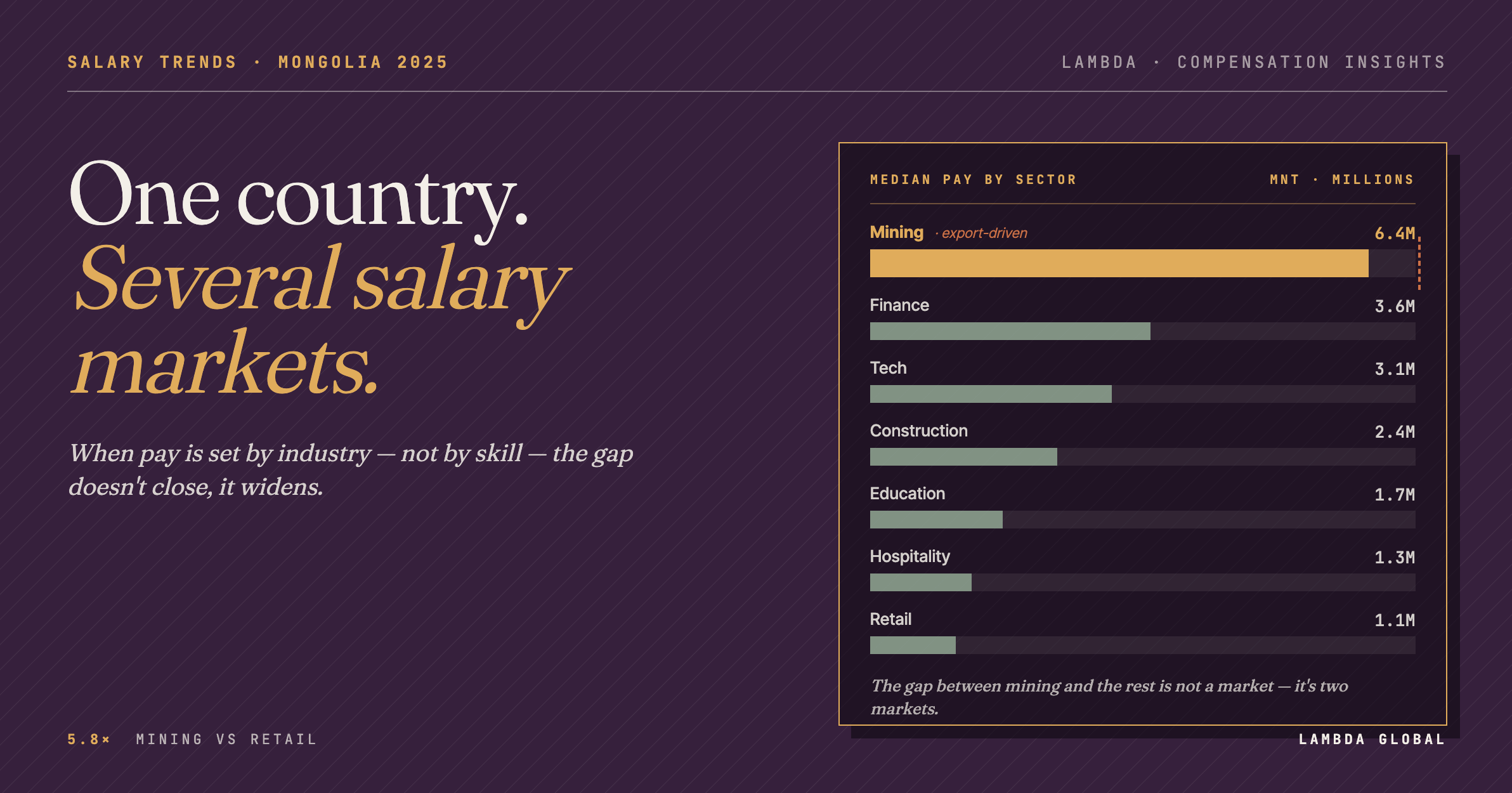
    Look at the spread. By late 2025, the average monthly salary in mining was about 5.38 million tugriks. In comparison, the information and technology sector had the average hovering around 3.6 million. At the top end, senior mining professionals can earn between 100 million and 250 million tugriks annually—numbers that simply don’t exist in most other industries. Mining companies aren’t being reckless; they have the margins. The problem is that this premium distorts expectations across the entire market. Banks, fintechs, professional service firms—they all end up competing against a benchmark they often cannot match, while trying to attract the same caliber of leader.

    The result is a market that looks competitive but feels unstable. Compensation rises faster than the organizational maturity needed to make these roles stick.

    The diaspora is not the problem. It is the signal.

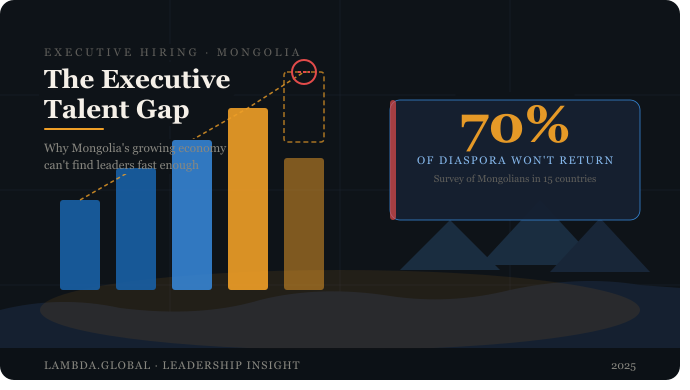
    There is no shortage of Mongolian professionals working abroad. Engineers in Korea, finance professionals in Singapore, consultants in Australia. Estimates put the Mongolian diaspora at well over 200,000 people worldwide—around 6 percent of the country’s entire population. According to a recent survey of Mongolians living across 15 countries, more than 70 percent of them hold a bachelor’s, master’s, or doctoral degree. Yet eight out of ten said they had no intention of returning to their homeland.

    That is often misunderstood as a salary problem. It rarely is. People do return—but only for roles that feel worth returning to. That means clear mandates, real authority, and organizations that operate with a certain seriousness. When those conditions are absent, the global market stays more attractive, even if the pay gap narrows. The shortage of diaspora talent in senior roles isn’t the root cause. It’s a reflection.

    At the executive level, hiring in Mongolia still leans heavily on familiarity. The professional network in Ulaanbaatar is small. Most searches begin with a shortlist that already looks nearly identical across firms. For a while, that works. Then it starts to show its limits. The same people are approached over and over. They become harder to reach, more selective, and predictably more expensive. Hiring timelines stretch. Expectations on both sides drift apart. Offers get pushed higher not because the role demands it, but just to keep the conversation alive.

    It feels like a tight market. In many ways, it is artificially tight—because the search stays too narrow for too long.

    That’s where Lambda.Global starts to matter. Not as a shortcut, but as a way to make the market more visible. Real compensation benchmarks that show what similar roles actually pay—not just the inflated figure a desperate company slapped on at the last minute. Access to professionals who don’t surface in the usual Ulaanbaatar network, including Mongolians abroad who might be open to the right conversation. It doesn’t magically fix hiring. It removes a layer of guesswork that companies have operated with for years.

    The cost of waiting until it’s urgent

    Most companies only think seriously about leadership when something breaks. A key person leaves. A role opens. Suddenly it’s urgent. By then, choices are limited and expensive. The companies that navigate this better do something less dramatic. They spot people early, give them room to grow, and treat leadership development as part of running the business—not a panic button for when a gap appears. It’s quiet work. It doesn’t look impressive from the outside. But when a role opens, they aren’t scrambling.

    The gap will not close on its own

    Mongolia’s economy is still moving towards a positive direction. The World Bank projects 5.0 percent growth for Mongolian economy in 2026. Therefore, demand for experienced leadership will only increase in the future. Supply will take much longer. That gap isn’t going to fix itself.

    Sooner or later, companies will need to stop treating hiring as a response or leverage, and start treating it as recruiting a talent you build over time. That means clearer development paths, leaders who take people seriously, and better data. Compensation visibility, a wider view of the talent pool, and genuine access to diaspora professionals aren’t “nice to have” anymore. They’re part of how modern hiring gets done.

    Right now, most organizations are still reacting. The few that stop reacting first will be in a very different position five years from now.

    Conclusion

    Mongolia isn’t losing because it lacks talent. It’s losing because it hasn’t fully connected that talent to the right opportunities. Rising salaries have made the gap more visible. They haven’t closed it. The companies that will shape the next phase of Mongolia’s economy aren’t the ones offering the highest pay. They’re the ones building leaders before they urgently need them—and using the right tools to see the full market before making their most critical decisions.

    Everyone else will keep searching.

    References

    1. Rivermate, Recruitment in Mongolia (2025) – typical hiring timelines for professional roles.
    2. National Statistics Office of Mongolia / WageCentre – national average monthly salary, 2025.
    3. Higher Careers, Executive Compensation Trends in Mongolia 2025 – executive base salary movement.
    4. World Bank, Mongolia’s Economy Stays Resilient but Faces Rising Uncertainty (April 2026) – GDP figures and 2026 projection.
    5. CEIC Data, Mongolia Average Monthly Wage: Mining & Quarrying – Q4 2025 data.
    6. AmCham Mongolia, Salary Survey 2024 – IT sector average salary.
    7. Higher Careers, Career Paths for Senior Managers in Mongolia’s Key Industries – senior mining manager compensation range.
    8. National Statistics Office & United Nations Migration Agency – diaspora population estimate (via E-Mongolia, April 2025).
    9. UB Post, Should we continue letting talented minds flow outward? (May 2025) – diaspora education levels and return intention survey.
    10. MONTSAME, Mongolia’s Workforce Demand in 2025 to Reach 83.7 Thousand (Jan 2025).
    11. 9cv9 Blog, The State of Recruitment and Hiring in Mongolia in 2025 (April 2025) – recruitment landscape and talent shortage overview.
  • AI and Remote work are threat to The middle managers

    AI and Remote work are threat to The middle managers

    The Attack on the Middle Layer: A Big Change

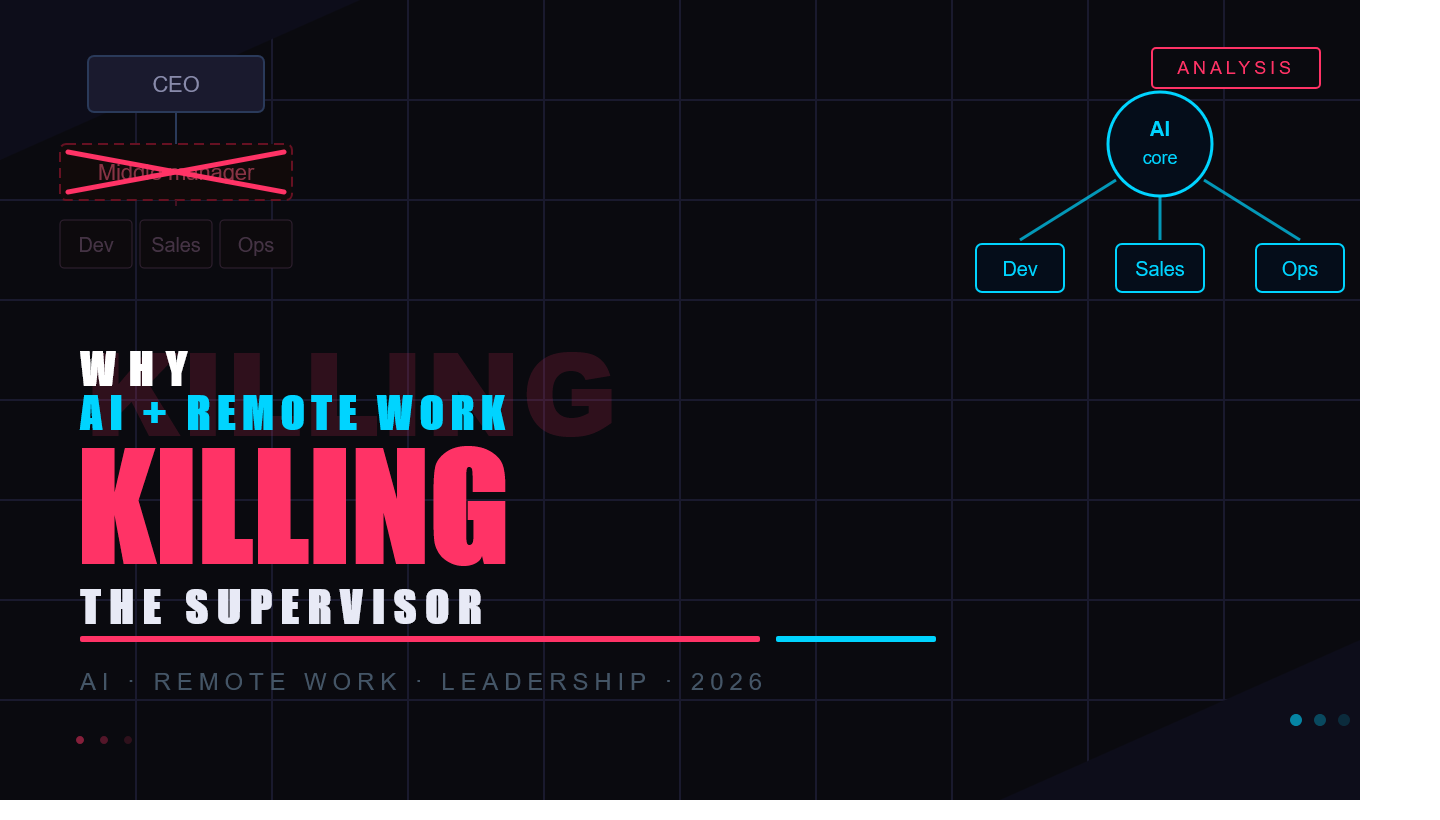
    In the past the “Middle Manager” was very important to a company. For over a hundred years their job was clear: they helped the top bosses and the workers on the line understand each other. They took ideas and turned them into small tasks watched how hard people worked and made sure everything ran smoothly. This system was great for the industrial era, when information moved slowly and people needed to be watched all the time.

    Now in 2026 the “middle layer” is in big trouble. From Ulaanbaatar to London the traditional supervisor. The one who just watches over a team or asks for reports. Is struggling to survive. The reasons for this are not temporary they are the two drivers of the modern economy: Artificial Intelligence and Remote Work.

    Artificial Intelligence: The End of “Management by Numbers”

    In the past a middle manager spent most of their time collecting data making spreadsheets and reporting to their bosses. Now in 2026 this job is no longer needed because of Artificial Intelligence.

    Real Time Information: New project management software, powered by Artificial Intelligence gives bosses up to date information. When a CEO can see how a project is going how sales are doing or how productive a team is, with just one click, the human manager who used to give them this information is no longer needed.

    Autonomous Decision Making: Artificial Intelligence is not a tool for reporting it is also a decision maker. Whether it is optimizing supply chains predicting market changes or allocating resources algorithms can make data driven choices faster and more accurately than a supervisor. The part of management that was about numbers. Once the main job of the middle layer. Is being automated.

    The result is that the “Middle Layer” is disappearing. Companies no longer need a layer to filter information. They need systems that give data directly to the people who do the work and the people who lead.

    Remote Work: From Watching to Trusting

    The second blow to the supervisor came with the shift to remote and hybrid work models. The supervisors power came from being able to see that an employee was at their desk from 9 to 5. This was management by watching.

    In a world watching is not possible and it is not helpful. You cannot control someone who works from a time zone or a home office without hurting their morale and productivity. This shift has forced a cultural change: from watching to trusting.

    The best workers today. The kind of talent that Lambda Global supports. Do not like being controlled. They need goals and the freedom to achieve them. If a company still uses managers who do not trust their workers it is wasting a lot of time and money. Those managers are not adding value they are just causing problems.

    The “End” of the Bureaucrat

    As companies get flatter we are seeing a divide between two types of leaders. One is becoming less important while the other is becoming more valuable.

    The Bureaucrat: These are the managers who were good at administration. They were good at attending meetings watching workers and doing paperwork. Without a physical office to control and with Artificial Intelligence doing their reports they have no job left.

    The Expert Leader: These are the leaders who have technical or domain knowledge. They do not just supervise they contribute. They are the mentors who can solve problems the strategists who can close big deals and the coaches who can improve the skills of their team.

    At Lambda Global we believe the future belongs to the Expert Leader. In a company there is no room for someone who just manages. Everyone must add value.

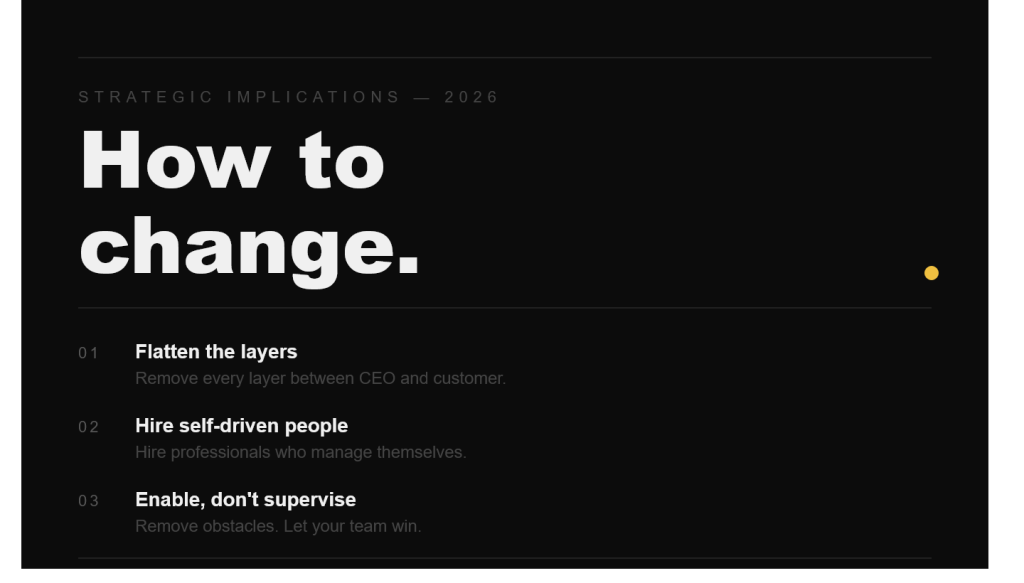
    Strategic Implications: How to Change

    For a boss in 2026 the question is no longer “How many people work for me?” This is a way of thinking. The modern question is: “How well can my team work without me?”

    Changing to this way of leading requires three big steps:

    1. Remove unnecessary layers of management that slow down decision-making. Every layer between the customer and the CEO is a problem.
    2. Hire workers who are self-driven. Of hiring supervisors to watch people hire professionals who can manage themselves.
    3. Change the job of managers from “supervising” to “enabling”. Their job is to remove obstacles that prevent their team from winning.

    The New Era: Leadership as System Design

    The “end” of the supervisor is not a disaster for companies it is an opportunity. It allows organizations to be leaner, faster and more human. When you remove the layer of watching and manual reporting you create a culture of high trust and high performance.

    Companies today do not need “bosses”. They need architects who can design systems and mentors who can nurture great talent. The companies that thrive in this era will be those that embrace the flat structure use Artificial Intelligence to handle logistics and empower their teams to lead themselves.

    Clarity Over Control

    The change from a hierarchy of control to a network of autonomy is the challenge for Mongolian businesses and global companies alike, in 2026. The supervisor as we knew them is gone. In their place we must build a standard of leadership based on expertise, trust and results.

    Giving your team the space to work autonomously is not a nice thing to do it is necessary. The future is flat the future is autonomous. The future is led by experts. It is time to stop watching and start making an impact.

  • How to prepare for a job interview in Mongolia

    How to prepare for a job interview in Mongolia

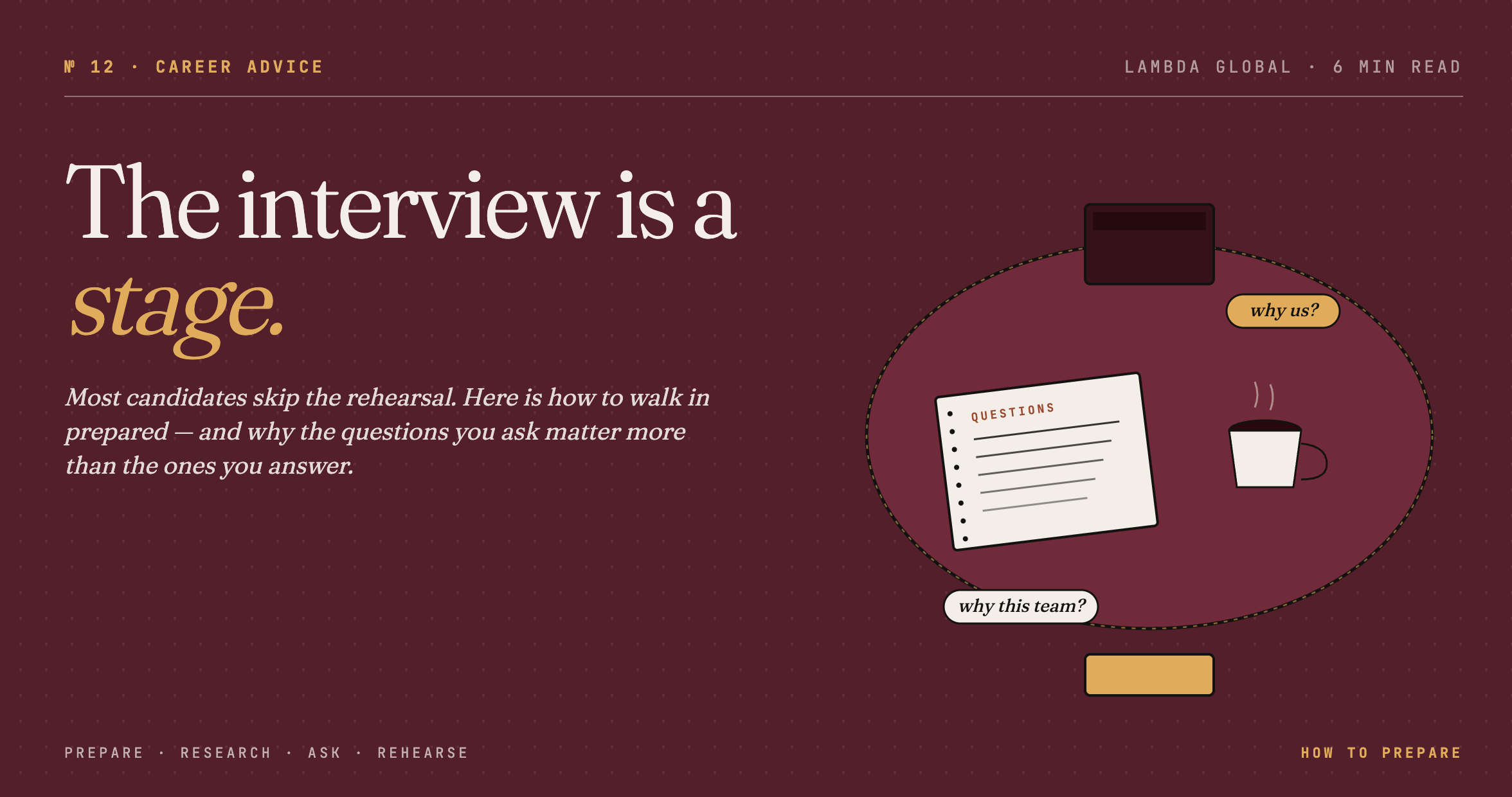
    Job interview is a stage for you to show off yourself and get the job you want. Unfortunately, many candidates fail to use this opportunity.

    Simple google search on interview preparation will tell you to do the following:
    – To do your research about the organization, its projects, products and recent news.
    – To analyze the role: fully understand the job description, prepare questions for clarity, provide an example of similar experiences,
    – To prepare your questions about the team or department, organization’s goals and values.

    All these seems to be an obvious feature to prepare. However, when conducting an interview with a potential candidate, I was surprised to see how many actually skip these steps. Most candidates skim through the vacancy ad without further research. It was obvious from the basic questions candidates ask. Some candidates even went on to request the interview team, to tell them about the organization and the project. Interview time is very limited. Potential employers would like to get as much information about you as possible and make a decision if you are suitable for the job. Nobody has time to inform you about the basics. Hence, it is better to do your homework, do the research, at least go to the organization’s website and social media.


    This, however, doesn’t mean you can’t ask any questions. In fact, you should ask questions. Asking a question, somehow refrained in Mongolian culture. From childhood we were raised to hold our opinions against adults, to be respectful and polite to them. Because of our culture, during the seminars and meetings, especially where most of the participants are strangers to each other, people ask minimal questions. Similar trend is evident at the interview. Towards the end of the interview, when the interview team asks “if there are any questions you would like to ask?”, most candidates respond “no”. Those who ask questions to clarify the job description or the organization’s long-term goal shows understanding and genuine interest in that position. Consequently, those stands out.
    During the preparation, if no question pops up to your mind, imagine that you are actually hired and working in that position. You start your job, you’re doing the tasks described in the job description, step by step. Imagine daily tasks and then long term, one year, two years… Questions will start emerge. Some questions might seem obvious or insignificant to you, but it will show how detailed you have thought about the position. In the end, there is no stupid question.

    There are many other ways to prepare for a job interview. One example would be watching a TV show, a useful one. The other day I have watched TV show on Central TV Mongolia – “the Interview” it’s called. I highly recommend this show to the new job seekers, especially those who don’t have any experience with an interview. In this show, actual organizations conduct an interview with potential candidates. The episode I have watched was with the MCS Coca Cola. You can learn various things from this show, including:
    – have a glimpse to the management team, including the CEO of the organization,
    – the questions they ask,
    – technical exams they take,
    – how to present yourself, including the outfit,
    – analyze the answers that candidates give, and think about the responses you would give,
    – analyze the body languages both the interview team’s and candidates’ side, when does they feel relaxed, when not.
    – impression that candidates left and which ones are selected at the end.


    Another great way to prepare yourself for a job interview is using an AI. The Lambda Global has Skills application to help the job seekers to enhance their relevant skills. From Skills you can go to the Career advice section, where it has an AI interview question generator. You should simply register as a talent to the Lambda Global. Then, upload your CV and click on the job position you would like to apply. You can select the language of the interview. Based on your CV and the job description AI will generate the potential questions with the possible answers. These questions will help you identify the matching skills that you have failed to recognize. Especially if you have rich experience in various organizations. AI is great at capturing even the little details you have mentioned in your CV. It not only provides questions, but also an opinion if your skills, at least the ones you have mentioned in your CV, matches the job description. It is the most important question that employers try to answer during the interview.

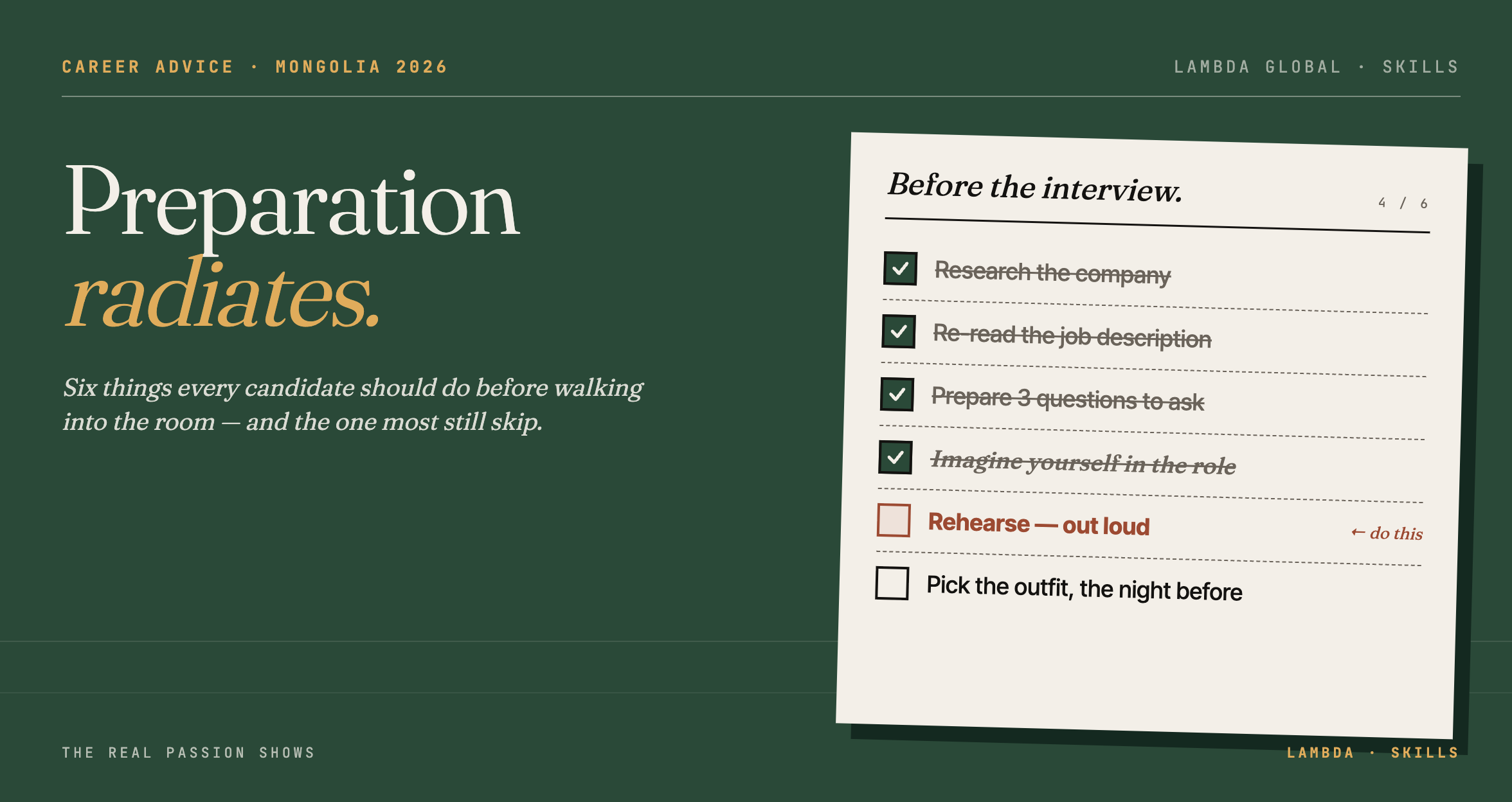
    The last, but perhaps the most important preparation would be a question to ask from yourself. Why do I want this position? Why do I want to work in this organization? The real passion radiates. Poor preparation is a sign of low interest in that job. Therefore, prepare yourselves well for the job you really want.

  • Salary Trends and Compensation Insights in Mongolia

    Salary Trends and Compensation Insights in Mongolia

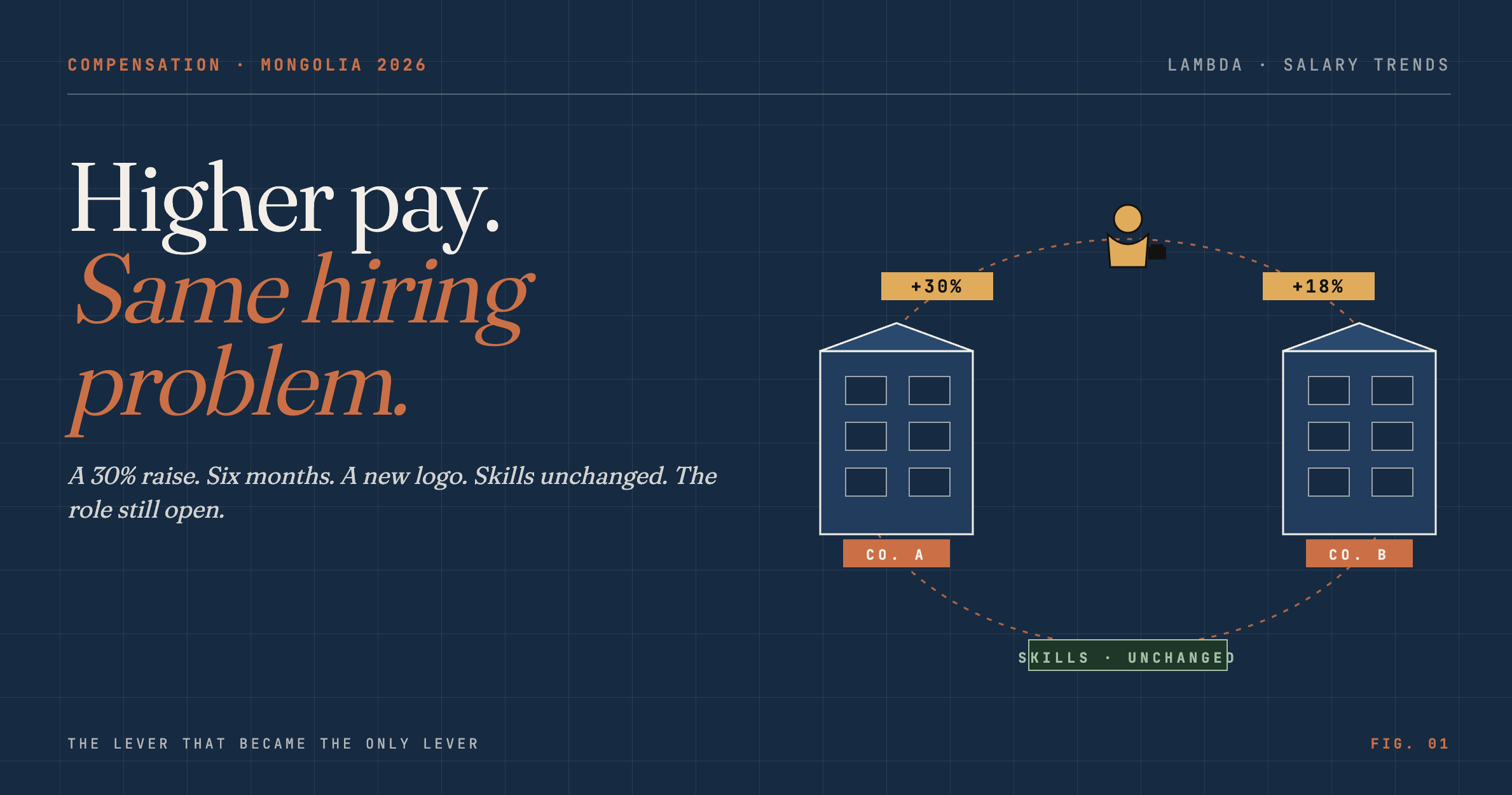
    I would like to prefix this article by telling a story about a mid-level employee in  Ulaanbaatar city who switches jobs for a 30 percent salary increase. Six months later, he moves  again for slightly more. His income rises, but his role barely changes, his skills stagnate, and the  company he left is still trying to fill the same position. This cycle is becoming increasingly  common in Mongolia’s job market, where rising salaries are not solving hiring problems but  quietly making them worse. At first glance, this makes little sense. Higher salaries should attract  better talent and fill any open roles in a matter of few days. But the current reality of our situation  tells a different story.  

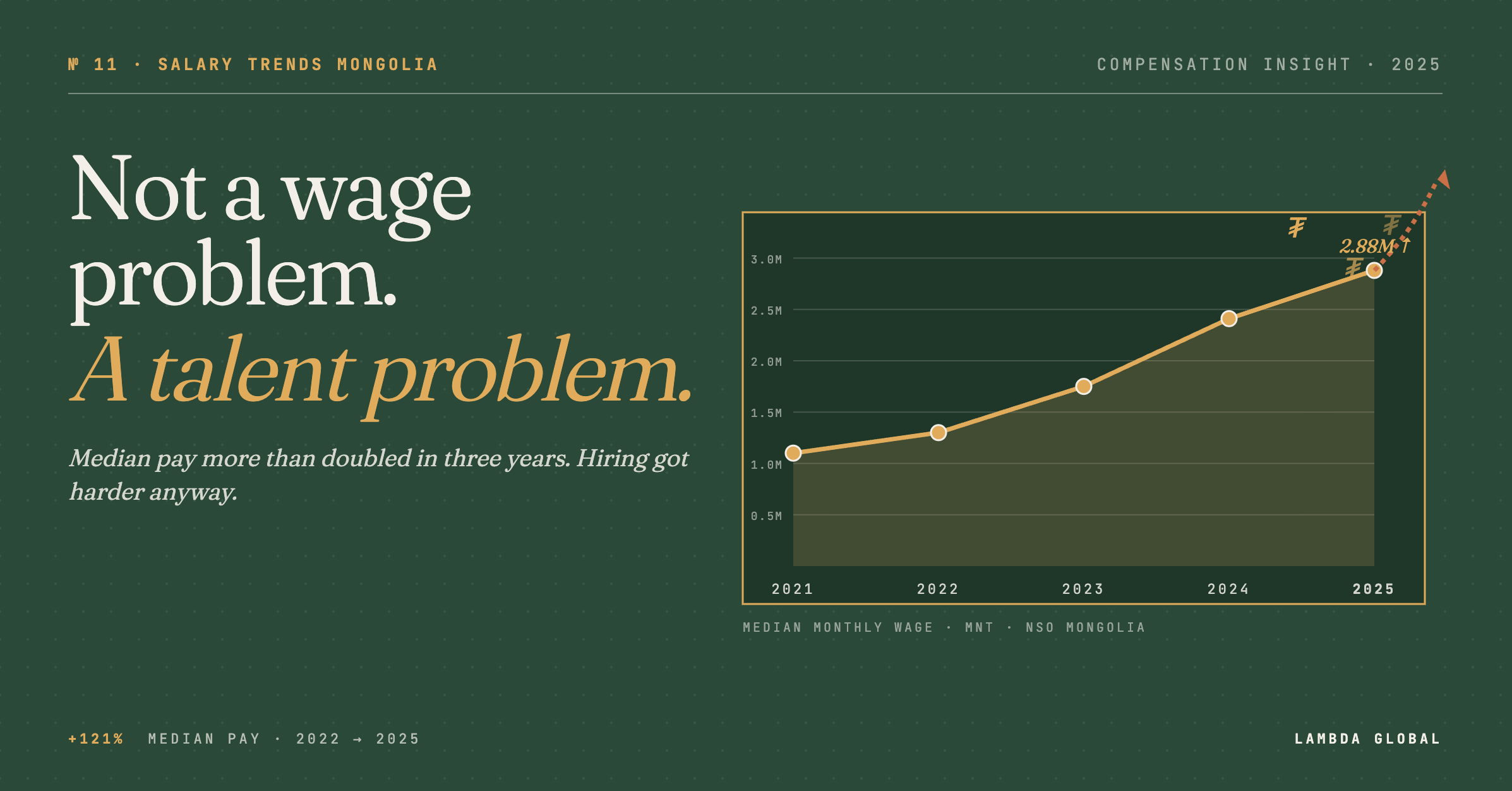
    Sure, compensation is increasing which is a good thing. But it is not solving the deeper  issues in the labor market. Looking into a data from the National Statistics Office of Mongolia, it  clearly demonstrates an upward trend in wages. The median monthly salary has been steadily rising  in recent years, intensifying from around 1.30 million MNT before 2022 to 1.75 million MNT in  2023. In 2024, it shot up to 2.41 million MNT. By 2025, the median wage reached approximately  2.88 million MNT, with a sharp jump beginning in early 2024. The realistic salary reports are recently published by a private and independent source;  Lambda.Global – a rising talent platform with realtime database collected from actual professionals deployed to the private companies and corporate in Mongolia in last couple of years. The median salary here is at least 20-30% more on Lambda’s Annual Salary Report than the one published in NSO Mongolia. It is understandable that state report include government workers including teachers, nurses, and city service workers and so on..

    However, the same data also reveals a persistent gap between average and median wages.  This gap isn’t only a statistical detail. It can be seen as a sign of income inequality. A higher average  wage in comparison to the median means a smaller group of high salary earners is pulling the  average up, while most employees earn significantly less to make up for the median. In other  words, salary growth is real, but it is uneven. This unevenness becomes even more obvious when  looking across industries. Mongolia does not have one salary market. It has several, and they are  disconnected from each other. Due to exports and foreign investment, the mining industry offers  significantly higher salaries than most other sectors in Mongolia. Whereas, hospitality, retail, and many service jobs remain far behind. Understandably, the latter sectors realistically will not keep  up with heavily invested industries like mining. But the result of it all is a fragmented economy  where compensation depends mostly on industry rather than skill alone.  

    This trend is closely tied to the broader picture. According to the World Bank, Mongolia’s  recent economic recovery has been largely driven by coal exports and mining revenues. Thanks to  the mining sector and other huge players in the economy growth of Mongolia, household income  and government spending advanced in 2023. However, rising wages and expenditure are also likely  to increase inflation. This ends up creating a cycle where higher pay comes from growth but also  leads to higher prices for everything.  

    But the core issue is not that salaries are increasing. The issue is how and why they are  increasing. Many companies in Mongolia are competing for talent by raising salaries rather than  building long term talent pipelines. Employees who join for higher pay often do not stay long term. They move again when another company offers slightly more. From the employee’s perspective, this is obviously a rational decision. If companies are not offering growth, training, or  clear career paths, salary becomes the only lever that matters. From the company’s perspective,  this leads to constant rotation and rising salaries.  

    This pattern can already be observable in today’s market. On hiring platforms like  Zangia.mn, many mid-level roles are bundled with similar salary ranges between 3.0 and 3.5  million MNT. However, on the newest platform – Lambda.Global, the average compensation tend to be much higher between 4.0 to 5 million MNT as these offers are more focused on top talents or highly skilled specialists. Simultaneously, many job postings do not clearly communicate total compensation or benefits for being hired to their companies.

    Salary is emphasized at the top of all other things,  while training, development, or long-term incentives are either unclear or absent within their  offers. As a result, companies have a narrow competition based almost entirely on who can pay  the most amount of money. The consequence of this approach is that these companies end up  overpaying for positions without improving productivity. Employees gain higher salaries in the  short term, but without structured development, their long-term career growth becomes  questionable.  

    This imbalance is also geographic. Jobs with higher salaries are largely concentrated in  Ulaanbaatar city, the capital of every Mongolian’s heart. Opportunities in other regions and  provinces are still limited, leading more people to move to the city. The challenges in the capital  go beyond employment. As highlighted by the World Bank, living conditions in ger districts  negatively affect productivity, health, and long-term earning potential. Employees facing poor  housing and environmental conditions are more likely to be late to work, earn less, and exit the  workforce earlier. This turns urban inequality into a labor market issue.  

    All of these factors point to the same conclusion. Mongolia’s salary growth is not being  driven by a coordinated improvement in the labor market. It is being pushed by specific sectors,  especially mining, and amplified by short term hiring strategies. The problem is not that companies  are paying too much. It is that they are solely relying on salary as the primary solution to strategic  and structural challenges. A more sustainable approach will require a shift in how companies think  about talent. Compensation still matters, but it cannot be the only focus. Essential long-term  investments are in training, internal mobility, and leadership development. Employees need to see  their future within an organization, not just a paycheck for the upcoming few years.  

    The current method of increasing wages is already reaching its limit. Rising salaries have  not eliminated hiring difficulties. Retention of employees remains a challenge to many companies.  And the gap between high paying sectors and the rest of the economy continues to widen as we  move on with our lives. The next phase of Mongolia’s labor market will depend on whether  companies can move beyond reactive salary increases. Those that continue to compete only on pay  will face increasing costs without solving their talent problems. Those that invest in developing  people, building skills, and creating clear career paths will have a more stable and competitive  workforce. 

    Mongolia’s economy remains positive, supported by its resources sector and growing  economy. The opportunity is clear. The challenge is execution. To turn higher salaries into lasting  growth, companies should think long-term instead of just focusing on quick wins for the day. Those  that continue to rely on salary alone will face rising costs without solving their hiring challenges.  Those that invest in people will define the next phase of Mongolia’s workforce. Mongolia is not  facing a wage problem. It is facing a talent development problem. 

    Sources:  

    https://lambda.global/salary

    https://lambda.global/salary-report-2025

    https://www.nso.mn/en

    https://www.worldbank.org/ext/en/home

  • Prepare the Bucket Before the Milk: Mongolia’s Closing Window on Young Talent

    Prepare the Bucket Before the Milk: Mongolia’s Closing Window on Young Talent

    What is your long-term top talent recruitment strategy? Are you building an organization with a big goal, where young people eager to join and stay. If the answer is yes, you’re  on the right track.  

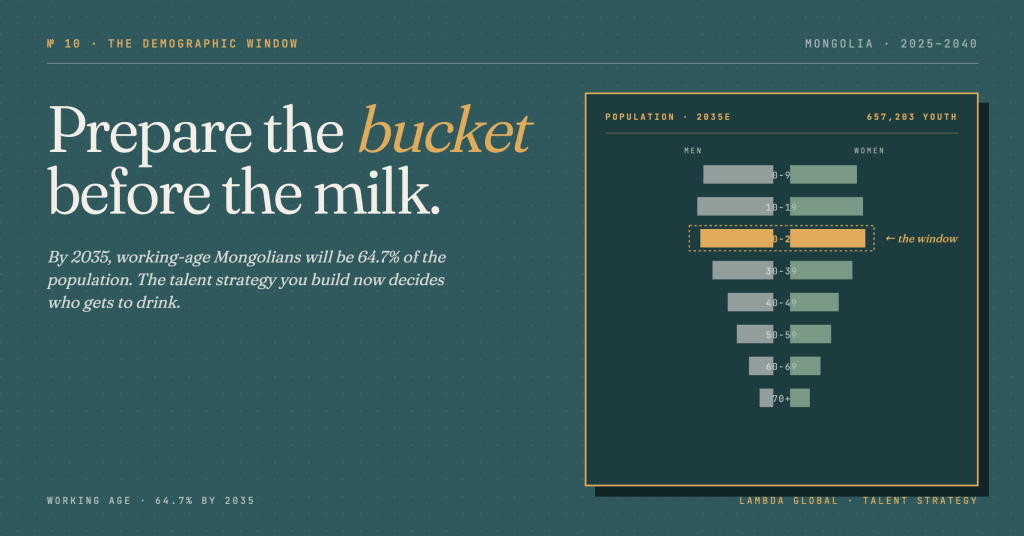
    Statistics telling us that by the year of 2035, working age people will comprise 64,7% of  the total population of Mongolia. Youth born after the 2017 will start joining the labor market. Many Asian countries, notably South Korea and Japan are dreaming of such  population.  

    Let’s look at the “demographic window1” numbers closely. According to the Mongolian  population census, in 2025 there were 452,890 youth aged 20-29. This number is  estimated to grow to 657,203 by the year of 2035.  

    You might think, what is the significance of that, we have high number of youth today, but  we are still having a difficulty to find the right candidate with sufficient soft skills. Good  news is that new generation is likely to have better soft skills and technological skills compared to the current working age population, as they have more enabling environment  to develop relevant skills both inside and outside the classroom. Private secondary  schools have started to focus more on soft skills aspect. Not only private schools, with  the support of international fundings project-based learning method, where children  improve their soft skills while working on a team project, is being implemented even at  the soum level public schools. 

    Each year 15,000-25,000 secondary school graduates are choosing to study abroad  exposing themselves further to the world class education and opportunities. Many choose  to stay in the respective countries after their graduation. On the other hand, with the rising  global tension and uncertainty, a good many from the current Mongolian diaspora are  choosing to return to be part of a bigger cause in the home country. 

    With stable GDP projection, the labor demand in finance, insurance, professional  scientific and technical services are estimated to grow. These sectors demand employees  with higher education degree. Consequently, it is the time, like our Mongolian idiom says,  “to prepare the bucket before preparing the milk”.  

    To be better prepared for the future, we should analyze today’s labor market condition. Many employers are struggling to keep the young generation in the workplace. The study  on the youth employability landscape in Mongolia sheds light on some of the reasons  behind it: 

    – Employer’s constant request to work overtime  
    – Job-title based salary scale  
    – Female youth face double disadvantage, lower salary than men, questions about family planning during the interview, workplace harassment among others.  

    1 High number of working age people and low number of pensioners in the year of 2020-2040. 

    To attract and keep the highly educated youth in the workplace, we have to tackle these existing human resource practices. We are emphasizing the following two points: 

    Organizational HR policy  

    Bottom-up approach can make a significant impact. Apart from following and ensuring  compliance with the labor law clauses related to female employees, business and  employers’ can have a HR policy that increases their female employer’s retention rate. I  can tell this from my personal experience of benefiting from such policy both financially  and emotionally. I have worked in an international organization operating in Mongolia for  many years. It had policy to provide two months of paid maternal leave after the employer  gives birth. Two months of full salary aside the social insurance allowance was a great financial support for a young family. It was a big stimulus for women to join and remain in  the organization up to six years. 

    Data driven decision  

    We are all aware that data driven decision is indispensable part of our daily work in this  AI era. However, it was questionable, if there are systems for human resources and  executives to make a sound data driven decision. Lambda Global is developing an AI  driven system to enhance the human resources efficiency. It has started an initiative to  be not only an AI driven new generation talent connection, but also a leader in the sector  to shape a transparent and fair labor ecosystem in Mongolia. 

    As mentioned above, one of the major issues youth are facing is a fair salary. Lambda.Global is trying to address this matter by introducing a transparent and reliable salary  information resource. It produces a salary report of each sector based on multiple  information resources, including the real market information.  

    The salary report provides: 

    1. Insight to the average and highest salary  
    2. Top five positions  
    3. Workforce demand 
    4. Where the skills mismatch is lying  
    5. Global trends 
    6. Actionable insights for employer’s and employees.  

    By joining the Lambda Global, organizations can greatly benefit and together create a fair  labor ecosystem, that could address many of the labor market pitfalls.  

    Top talents shape the modern-day economy, country’s development, business  competitiveness and innovation speed. We, Mongolians are rich with rising young  population. Hence, every organization has the opportunity to leverage this potential and  aspire to the greater goal. 

    References: 

    1. Entrepreneurship-focused Socio-Emotional Skills For The Most Vulnerable Youth  In Rural Mongolia project, Save the Children Mongolia, 2025, 

    2. Labor Market Of Mongolia: Mid-Term Demand and Supply Forecasting Study Report, the  Ministry Of Labour and Social Protection, Research Institute Of Labour And Social Protection,  MMCG,2024 3. Mongolia Economic Update, the World Bank, 2026 

    4. Population of Mongolia, National Statistics Office of Mongolia, 2025 

    5. Sector Salary report, Lambda Global,2025 

    6. Skills demand in Mongolia: Main Findings of the Skills Module of the Barometer Survey, the  World Bank, 2022 

    7. Youth Employment Forum highlights, Unread, Asian Development Bank, the Ministry of Labour  and Social Protection, 2025 

    8. Youth Employability Landscape Study of Mongolia, the Lorinet Foundation, 2022.

  • Hiring in Mongolia Is Broken. Here’s What’s Actually Causing It.

    Hiring in Mongolia Is Broken. Here’s What’s Actually Causing It.

    Low unemployment and a growing economy, yet companies cannot fill their most critical roles. The problem runs deeper than most employers want to admit.

    Mongolia’s economy has grown considerably over the past decade, largely driven by its mining sector and the steady expansion of financial and professional services in Ulaanbaatar. Unemployment sits near historic lows. The number of formally registered companies has risen steadily. And yet, if you talk to hiring managers across industries, the
    picture they describe doesn’t feel like a tight labor market. It feels like a broken one.

    Senior roles sit open for six to twelve months. Qualified candidates apply and hear nothing back. Salary expectations between employers and candidates differ so widely that negotiations often collapse before they begin. And a disproportionate share of hiring decisions are made not through formal processes, but through personal networks quietly.

    Ask anyone who has hired or been hired in Mongolia’s professional market, and they will describe some version of this. What most conversations skip is why it works this way and what it would take to change.

    The network works. Until it doesn’t.

    Mongolia’s professional class in Ulaanbaatar is small enough that most hiring managers already know who they’re looking for before a search begins. In that context, relationship based hiring isn’t simply a habit, it’s an information strategy. A referral arrives pre-vetted, with the recommender’s reputation on the line if the hire goes wrong. In a market without reliable salary data or standardized credentials, a referral carries more signal than a resume.

    The cost is who gets excluded. Graduates from regional universities, returning professionals, and candidates who simply haven’t had time to build the right connections get filtered out before anyone reviews their qualifications. The market doesn’t exclude them because they’re unqualified. It excludes them because they’re unfamiliar, and in a
    relationship-driven system, the two get treated the same way. Companies fishing the same small pool compete over the same people, bid salaries up reactively, and convince themselves the market is the problem. It feels tight partly because they’ve made it tight.

    The network works. It just works better for some people than others. In a market this small, that is not a minor inefficiency. It is the defining feature.

    The formal process nobody believes in

    Most mid-size and large Mongolian companies post jobs formally. But the process rarely works the way it’s supposed to, and both sides have learned to expect little from it.

    From the employer side, too many applications, too little relevance, and a hiring process where effort rarely matches outcome. Many HR managers admit they post roles publicly out of procedure or policy, while already knowing who they intend to hire.

    From the candidate side, the experience is just as discouraging. Applications go unanswered. Interviews run multiple rounds and then go silent. Roles turn out to have been filled through referral weeks before the listing went live. For candidates who haven’t been through this before, it’s confusing. For those who have, it becomes a reason to stop trying altogether.

    Both sides are responding rationally to an unreliable system. And both responses make it more unreliable. When employers don’t invest in the formal process, it produces poor results. When candidates lose confidence in it, application quality drops. The cycle is self reinforcing, and it won’t break until someone decides to go first.

    Nobody knows what anything pays

    Mongolia has no standardized public compensation data for most professional roles. Salary decisions come down to internal precedent, peer comparisons, or whatever a candidate names in the room. Similar roles pay very differently across companies, with no logical relationship to seniority or scope. Candidates with insider access negotiate far better
    outcomes than equally qualified peers who don’t, not because they’re more valuable, but because they have information others lack.

    Above all of this sits the mining sector premium. For instance, Oyu Tolgoi, Erdenet, and Erdenes Tavan Tolgoi pay at levels most non-resource companies structurally cannot match, not because those companies are poorly managed, but because resource extraction
    generates margins that banking, technology, and professional services don’t.

    A senior operations or engineering professional in the resource sector earns substantially more than an equivalent role anywhere else in Ulaanbaatar. Companies outside the resource orbit are outbid before negotiations even begin. Most of them know it, and most haven’t found a
    meaningful answer to it.

    Professionals who discover they were underpaid don’t accept it quietly. They leave and in a small market, that story travels.

    The professionals who leave, and why

    Mongolia’s labor emigration is more skilled than public conversation acknowledges. South Korea’s Employment Permit System draws Mongolian workers in significant numbers each year, and the cohort increasingly includes people with technical qualifications and university degrees, not only those seeking unskilled work. Japan and Germany have formalized bilateral agreements opening structured pathways for Mongolian professionals in engineering, healthcare, and logistics.

    The economics are straightforward. Foreign wages are multiples of comparable domestic roles. Career progression is more clearly structured. Remittances have become a meaningful contributor to Mongolian household income nationally, which looks positive on paper, but signals something uncomfortable. For a growing share of Mongolia’s most capable workers, staying home is the financially irrational choice. The country isn’t losing its least productive people to emigration. It is losing some of its most capable, precisely because they have the qualifications and adaptability to go.

    What the better companies are doing

    A minority of Mongolian organizations navigate this environment noticeably better than their peers, and they are not all paying the most. They hire earlier, building relationships with universities, including regional ones outside Ulaanbaatar, and bring in graduates through structured development programs. The result is professionals who stay because they were developed by the organization, not simply bought from a competitor.

    They also make their processes legible, clear timelines, consistent communication, and honest feedback. In a market where most hiring experiences are frustrating, this alone builds a reputation that attracts stronger candidates. And the most effective organizations treat talent as a leadership issue, not an HR function, because how executives talk about growth and promotion determines whether ambitious people see a future there at all.

    The honest conclusion

    Some of Mongolia’s hiring dysfunction is structural, including the mining premium, the absence of compensation data, and years of underinvestment in workforce development. No single employer fixes those alone.

    But a significant share is self-inflicted. Employers who hire only through networks, run processes they don’t believe in, and treat development as a cost are sustaining the very shortage they complain about most.

    The companies best positioned five years from now are building their talent pipeline today. The market is fixable. It just requires employers to stop waiting for someone else to fix it first.