Category: Ai

  • AI Saves Employees 2.2 Hours a Week.

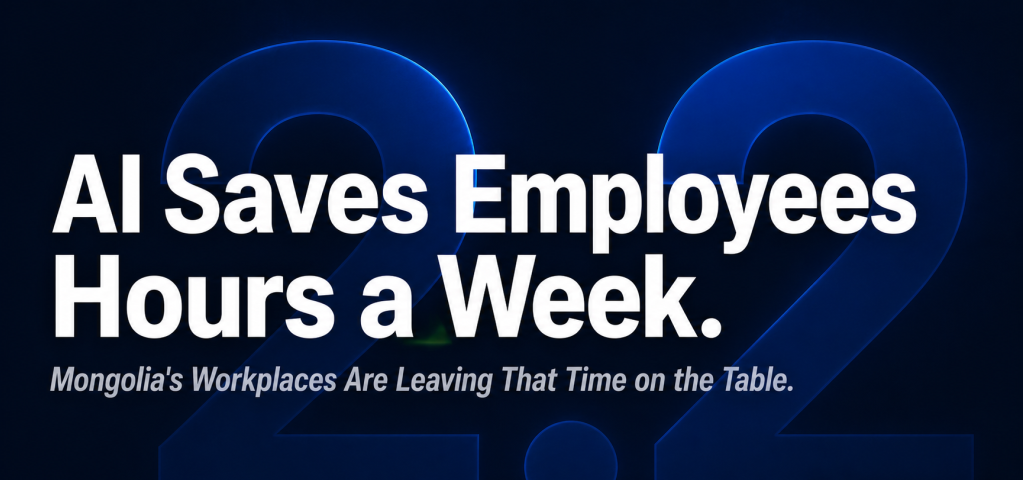
    AI Saves Employees 2.2 Hours a Week.

    91% of employees globally say their organization uses at least one AI tool in 2025. AI saves workers between 40 and 60 minutes every day. And yet most Mongolian organizations have no formal AI policy, no adoption strategy, and no idea which of their employees are using these tools or how. The gap between where AI is and where Mongolian workplaces are managing it is widening fast.


    Here is something worth knowing about your team right now: a meaningful portion of them are using AI tools in their daily work whether or not your organization has sanctioned it. ChatGPT, Claude, Gemini, Copilot, and a growing ecosystem of specialized tools are being used to draft documents, summarize meetings, analyze data, translate content, research market information, and handle the cognitive load of tasks that used to take hours. They are not waiting for organizational approval. They are getting things done.

    This is not a criticism. It is a description of the current state of almost every professional workplace in the world, including Ulaanbaatar’s. The question is not whether AI is entering Mongolia’s offices; it already has. The question is whether organizations are shaping how it enters, or simply discovering it after the fact.

    Mongolia’s professional sector sits at an inflection point with AI that mirrors the global trajectory but carries specific local stakes. A market already stretched by talent scarcity and a projected 240,000 worker shortfall by 2035 cannot afford to ignore a technology that demonstrably extends what each professional can produce. But it also cannot afford the risks that come from AI adoption without governance, inconsistent quality, data security exposure, and the growing divide between employees who use AI effectively and those who do not know where to start.


    What Is Actually Happening Globally

    91%   of employees say their organization uses at least one AI tool in 2025 – up from 80% in late 2023 (Azumo/OpenAI)

    The adoption curve is steep and accelerating. The share of frequent AI users, those using tools daily or multiple times per week, rose from 12% in mid-2024 to 26% by late 2025. AI saves workers an average of 40 to 60 minutes per day, with the St. Louis Federal Reserve’s 2024 research pinning the figure at 2.2 hours per week for generative AI users specifically. Industries with higher AI exposure have seen a 10% productivity boost, 3.9% job growth, and 4.8% wage growth compared to less-exposed sectors.

    The BCG finding is the most practically relevant for Mongolian organizations: frontline employees have hit what BCG calls a ‘silicon ceiling’; only half of them regularly use AI tools, despite the technology being available. The barrier is not access. It is training, managerial support, and organizational culture around AI. The companies pulling ahead are the ones that have moved beyond providing tools and toward building the capability to use them well.

    Gallup’s February 2026 research adds a finding that should reframe how Mongolian leaders think about this: 65% of employees in organizations that have implemented AI say it has improved their productivity and efficiency, regardless of how often they personally use it. The productivity benefit is organizational, not just individual. When some team members use AI effectively, the entire team benefits from better and faster outputs.


    The Mongolia Specific Picture

    Mongolia’s AI adoption in the workplace is real but uneven, following the same pattern visible in most emerging markets with a growing technology-literate professional class. The fintech sector is furthest ahead, not surprisingly. Companies like LendMN, AND Global, and Ard Financial Group are building AI into product development, customer service, and internal operations at a pace that reflects both their technical capability and their competitive pressure to move fast.

    Banking and financial services are following, partly because international regulatory and reporting requirements create specific, high-value AI use cases, such as automated compliance monitoring, IFRS reporting assistance, and AML pattern detection, that justify structured adoption. Khan Bank and TDB have both invested in digital infrastructure that provides the foundation for AI integration, even where specific AI tools are not yet formally deployed.

    The sectors lagging furthest behind are those where the organizational culture is most traditional and where digital literacy among senior leadership is most uneven. Public sector organizations, older state-adjacent institutions, and mid-sized companies without dedicated technology leadership are operating largely without AI governance frameworks, which means their employees may be using AI tools informally while the organization carries the associated risks invisibly.


    The Three Risks Nobody Is Talking About

    The enthusiasm around AI’s productivity benefits is real and justified. The risks are equally real and significantly less discussed in Mongolia’s organizational context.

    The first is data security. When employees use consumer AI tools, including free versions of ChatGPT, Claude, or Gemini, they are inputting data into systems with terms of service that most employees have never read. Client information, internal financial data, personnel details, and strategic plans entered into these tools may be used in ways the organization did not intend and cannot control. Forty-seven percent of workers globally admit to sharing confidential company information with AI tools without explicit permission from their employers. In Mongolia’s banking and financial services sector, where data protection has become a regulatory priority, this is not a theoretical risk. It is an active compliance exposure.

    The second is quality inconsistency. AI tools produce outputs that vary significantly in accuracy, depending on the prompt, the model, and the user’s ability to evaluate what they receive. An employee who uses AI to draft a client proposal without checking the factual claims it makes, or who accepts an AI-generated financial summary without verifying the underlying data, is introducing an error vector that did not exist before. Thirty percent of workers globally fear job loss to AI within three years, but the more immediate organizational risk is not replacement; it is the confident delivery of wrong information by someone who trusted the tool too completely.

    The third is the capability gap between early and late adopters. Within every organization that has not deliberately managed AI adoption, a divide is forming between employees who have figured out how to use these tools effectively and those who have not. The first group is producing more, faster, with less visible effort. The second group is falling behind on output without necessarily understanding why. Left unmanaged, this divide creates resentment, unfair performance comparisons, and the quiet exit of capable people who feel outpaced by colleagues using tools they were never taught to use.


    What a Responsible AI Adoption Strategy Looks Like

    The organizations in Mongolia positioned to benefit most from AI in the next three years are not necessarily the ones with the largest technology budgets. They are the ones moving from informal individual usage to deliberate organizational capability and doing it before the gap between their AI-capable and AI-naive employees becomes a talent and quality problem.

    A responsible adoption strategy starts with an honest inventory: which AI tools are your people already using, for what tasks, and with what data? Most organizations asking this question for the first time discover that adoption is further along than they realized and that the governance framework needs to catch up to reality rather than get ahead of it.

    It continues with clear policy, not blanket prohibition, which is both unenforceable and counterproductive, but specific guidance about which tools are approved for which use cases, what categories of data should never be entered into external AI systems, and how AI-assisted outputs should be reviewed before they reach clients or decision-makers. Organizations that have published clear AI usage policies report higher employee confidence in using the tools appropriately and lower incidence of the informal, unsanctioned usage that creates the most risk.

    It includes training, not a single workshop but ongoing, role-specific capability building that helps employees understand how to prompt effectively, how to evaluate outputs critically, and how to integrate AI into their workflows in ways that actually save time rather than creating new quality control burdens.

    2.2 hrs   saved per week per employee through generative AI usage – St. Louis Federal Reserve, 2024


    The Lambda.Global Perspective

    At Lambda.Global, AI literacy has become an increasingly visible factor in executive and mid-senior candidate evaluation, not as a mandatory technical skill, but as an indicator of professional adaptability. The leaders who are actively learning how AI tools can extend their capability, who are building team cultures where AI usage is normalized and managed rather than ignored or prohibited, are the ones generating the strongest interest from organizations that are serious about the next five years.

    The hiring implication is direct: organizations that build internal AI capability now will be recruiting from a stronger internal pipeline in three years, because their existing professionals will have grown alongside the technology rather than been left behind by it. The ones that wait will be competing for a shrinking pool of externally AI-capable professionals in a market where that capability is already commanding a premium.

    Mongolia’s workplaces are not behind the AI curve because the technology is unavailable or because its professionals are incapable. They are behind because organizational decision-making has not caught up with individual behavior. Closing that gap is not a technology decision. It is a leadership one.


    SOURCES & REFERENCES

    1.  Azumo – AI in the Workplace Statistics 2026

    91% of employees say org uses AI (2025); 54% use ChatGPT/GenAI; ChatGPT saves 1.5–2.5 hrs/week; 800M+ weekly active users globally (July 2025).

    https://azumo.com/artificial-intelligence/ai-insights/ai-in-workplace-statistics

    2.  Gallup – Rising AI Adoption Spurs Workforce Changes (April 2026)

    65% report improved productivity from org AI adoption; 13% use daily; 28% use several times/week; 50% of employed adults use AI at least annually.

    https://www.gallup.com/workplace/704225/rising-adoption-spurs-workforce-changes.aspx

    3.  BCG – AI at Work 2025: Momentum Builds, but Gaps Remain (July 2025)

    ‘Silicon ceiling’ — only 50% of frontline employees regularly use AI; training and managerial support as primary adoption barriers.

    https://www.bcg.com/publications/2025/ai-at-work-momentum-builds-but-gaps-remain

    4.  St. Louis Federal Reserve – Impact of Generative AI on Work Productivity (January 2026)

    2.2 hours saved per week per generative AI user; 5.4% of working hours saved on average; usage stable at 28% Aug–Nov 2024.

    https://www.stlouisfed.org/on-the-economy/2025/feb/impact-generative-ai-work-productivity

    5.  UnboxFuture – AI in the Workplace 2025: Trends, Adoption Gaps (April 2026)

    Frequent AI users rose from 12% (mid-2024) to 26% (late 2025); 10% productivity boost in AI-exposed industries; 40–60 min/day saved.

    https://www.unboxfuture.com/2026/04/ai-in-workplace-2025-trends-adoption.html

    6.  AllAboutAI – 60+ AI Statistics in Workplace: 2026 Trends

    30% of workers fear job loss to AI within 3 years; 47% admit sharing confidential data with AI tools; 39% worried about inadequate AI training.

    https://www.allaboutai.com/resources/ai-statistics/workplace

    7.  NNRoad – Work Culture 2025 in Mongolia

    Digital adoption and cybersecurity in Mongolian workplaces; cloud services and collaboration tool investment; remote work AI integration.

    https://nnroad.com/blog/work-culture-2025-in-mongolia-7-practical-steps

  • AI Won’t Take Your Jobs of Mongolia. Someone Who Uses AI Will

    AI Won’t Take Your Jobs of Mongolia. Someone Who Uses AI Will

    Picture a hiring manager at a mid-sized Mongolian company. She has just posted a vacancy. Within 48 hours, 200 CVs land in her inbox. Except they didn’t come from 200 candidates. Most of them came from maybe 40 people who used AI to tailor each application to the specific job description, making everyone look like a perfect fit.

    This is where AI and hiring intersect in 2026, not in some distant future of robots doing interviews, but in small, practical, daily decisions that are quietly reshaping who gets seen, who gets hired, and who gets left behind. Mongolia is not immune. If anything, the country’s small talent market makes the stakes higher.


    What’s Actually Happening Right Now

    Three shifts are happening simultaneously, and they are moving faster than most HR teams in Ulaanbaatar realize.

    First: Candidates are using AI aggressively. ChatGPT, Claude, and a growing list of specialized tools can rewrite a CV in minutes, draft cover letters that mirror a company’s own language back at them, and coach applicants through interview prep with unsettling accuracy. Globally, the use of AI tools in job applications jumped 68% between 2023 and 2024. The same tools are available to anyone in Mongolia with a smartphone and a Wi-Fi connection. They are being used just unevenly.

    Second: Employers are adopting AI screening tools, but slowly and patchily. Globally, 87% of companies now use some form of AI in hiring. In Mongolia, adoption is real but uneven. Larger multinationals and mining operations with international HR standards are further ahead; local SMEs and state-adjacent organizations are largely still screening manually. The result is a divided hiring landscape where some candidates are filtered by algorithms before a human ever sees their name, while others are still relying on printed CVs sitting in stacks on someone’s desk.

    Third: This is the one most people miss. AI is changing what skills are actually worth hiring for. The shelf life of a technical skill in 2026 is shorter than it has ever been. Data entry, basic financial modeling, and standard report writing are not disappearing overnight, but they are depreciating. The skills becoming more valuable are the ones AI cannot easily replicate including judgment under pressure, the ability to turn data into decisions real organizations will actually act on, and in Mongolia’s relationship driven business culture the kind of trust built through shared experience and proven integrity.


    If You’re the One Hiring

    The immediate practical problem is signal collapse. When AI tools can make any candidate look compelling on paper, the CV becomes a less reliable filter than it already was. This is uncomfortable news for hiring teams that have always leaned on CV screening as the first gate, and in Mongolia, where formal hiring processes are still maturing across many organizations, the first gate is often the only gate.

    The response isn’t to dismiss CVs, it’s to move the real evaluation earlier and make it harder to fake. Structured first-round calls with specific scenario questions. Short practical assignments that reveal how someone actually thinks, not how well they can prompt an AI to describe their thinking. Reference conversations that go beyond “was this person employed here” and into what they were genuinely like under pressure.

    None of this is revolutionary. But in a market like Mongolia’s, where hiring timelines are often rushed, personal relationships substitute for process, and many companies simply do not have the internal HR infrastructure to run rigorous evaluations, the gap between companies that do this well and those that don’t is widening fast.


    If You’re the One Looking for a Job

    Here is the honest version of the AI and jobs conversation that most career advisors avoid: the threat is not that AI replaces your role. The threat is that someone in your field who uses AI competently outcompetes you for it.

    A financial analyst who uses AI to run scenario models in two hours instead of two days does not just do their job faster. They become a different kind of candidate, one who can take on a broader scope, engage at a more strategic level, and make a more compelling case for a senior role earlier in their career. That gap is already visible in how Mongolian fintech companies like LendMN and AND Global are evaluating talent: they are not just asking what you know, they are watching what you can produce with the tools available to you.

    The Mongolian professionals who will be most exposed over the next five years are not those in technical roles who sound vulnerable, such as coders, analysts, and junior accountants. It is the people in mid-level roles whose value proposition has always been “I know how things work here” without continuing to build new capabilities on top of that local knowledge. Institutional memory is valuable. Institutional memory plus the ability to work faster and smarter than a year ago is irreplaceable.


    The Part That’s Specific to Mongolia

    Mongolia’s professional culture has always placed enormous weight on relationships, on who you know, on shared institutional history, on the trust that comes from years of working alongside someone. That is not going away, and AI cannot replicate it. In fact, as AI homogenizes the surface layer of hiring, making CVs look more similar, making first interviews more polished, the differentiation shifts further toward the things that cannot be faked, such as reputation, judgment, and the specific credibility that comes from having done hard things in a small community where everyone notices.

    This is both a comfort and a warning. A comfort, because the core of what makes Mongolian professionals valuable in their own market contextual intelligence, relationship capital, and cultural fluency, is not being automated. A warning, because that advantage only holds if it sits on top of genuine skill development, not instead of it.

    At Lambda.Global, the patterns we see in executive and mid-senior hiring confirm this. The candidates who generate the most interest right now are not the most credentialed or the most connected; they are the ones who combine local credibility with demonstrable adaptability. Employers want proof that someone can learn, not just a resume that proves they once did.


    The conclusion

    AI is not the disruption. The disruption is the uneven adoption of AI across companies, across candidates, across industries. In any market where some players adapt, and others don’t, the gap compounds quickly.

    Mongolia’s hiring market is small enough that those gaps will become visible faster than most people expect. Which side of the gap any given professional or organization ends up on is, for now, still a choice.

  • AI and Remote work are threat to The middle managers

    AI and Remote work are threat to The middle managers

    The Attack on the Middle Layer: A Big Change

    In the past the “Middle Manager” was very important to a company. For over a hundred years their job was clear: they helped the top bosses and the workers on the line understand each other. They took ideas and turned them into small tasks watched how hard people worked and made sure everything ran smoothly. This system was great for the industrial era, when information moved slowly and people needed to be watched all the time.

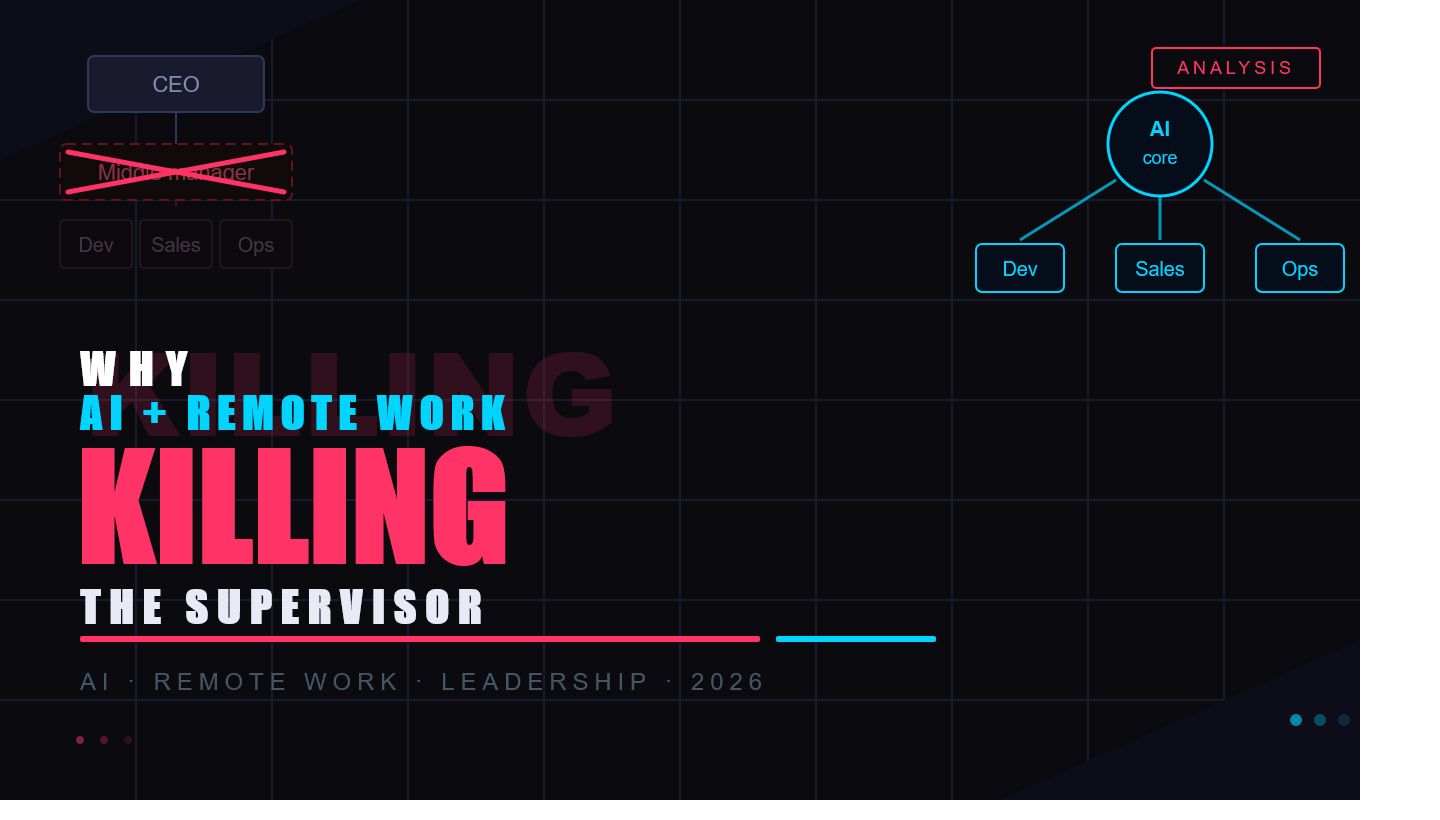
    Now in 2026 the “middle layer” is in big trouble. From Ulaanbaatar to London the traditional supervisor. The one who just watches over a team or asks for reports. Is struggling to survive. The reasons for this are not temporary they are the two drivers of the modern economy: Artificial Intelligence and Remote Work.

    Artificial Intelligence: The End of “Management by Numbers”

    In the past a middle manager spent most of their time collecting data making spreadsheets and reporting to their bosses. Now in 2026 this job is no longer needed because of Artificial Intelligence.

    Real Time Information: New project management software, powered by Artificial Intelligence gives bosses up to date information. When a CEO can see how a project is going how sales are doing or how productive a team is, with just one click, the human manager who used to give them this information is no longer needed.

    Autonomous Decision Making: Artificial Intelligence is not a tool for reporting it is also a decision maker. Whether it is optimizing supply chains predicting market changes or allocating resources algorithms can make data driven choices faster and more accurately than a supervisor. The part of management that was about numbers. Once the main job of the middle layer. Is being automated.

    The result is that the “Middle Layer” is disappearing. Companies no longer need a layer to filter information. They need systems that give data directly to the people who do the work and the people who lead.

    Remote Work: From Watching to Trusting

    The second blow to the supervisor came with the shift to remote and hybrid work models. The supervisors power came from being able to see that an employee was at their desk from 9 to 5. This was management by watching.

    In a world watching is not possible and it is not helpful. You cannot control someone who works from a time zone or a home office without hurting their morale and productivity. This shift has forced a cultural change: from watching to trusting.

    The best workers today. The kind of talent that Lambda Global supports. Do not like being controlled. They need goals and the freedom to achieve them. If a company still uses managers who do not trust their workers it is wasting a lot of time and money. Those managers are not adding value they are just causing problems.

    The “End” of the Bureaucrat

    As companies get flatter we are seeing a divide between two types of leaders. One is becoming less important while the other is becoming more valuable.

    The Bureaucrat: These are the managers who were good at administration. They were good at attending meetings watching workers and doing paperwork. Without a physical office to control and with Artificial Intelligence doing their reports they have no job left.

    The Expert Leader: These are the leaders who have technical or domain knowledge. They do not just supervise they contribute. They are the mentors who can solve problems the strategists who can close big deals and the coaches who can improve the skills of their team.

    At Lambda Global we believe the future belongs to the Expert Leader. In a company there is no room for someone who just manages. Everyone must add value.

    Strategic Implications: How to Change

    For a boss in 2026 the question is no longer “How many people work for me?” This is a way of thinking. The modern question is: “How well can my team work without me?”

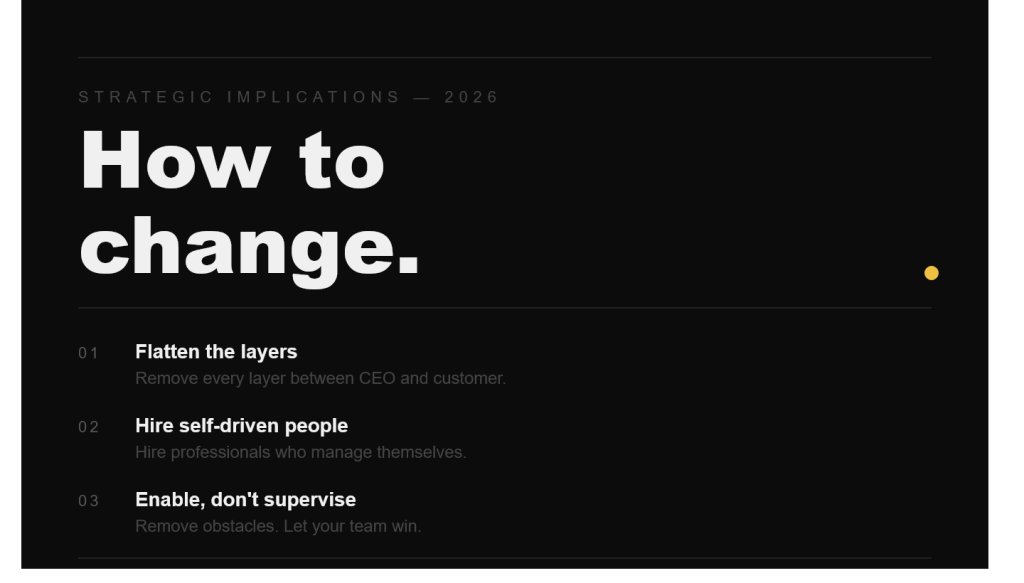
    Changing to this way of leading requires three big steps:

    1. Remove unnecessary layers of management that slow down decision-making. Every layer between the customer and the CEO is a problem.
    2. Hire workers who are self-driven. Of hiring supervisors to watch people hire professionals who can manage themselves.
    3. Change the job of managers from “supervising” to “enabling”. Their job is to remove obstacles that prevent their team from winning.

    The New Era: Leadership as System Design

    The “end” of the supervisor is not a disaster for companies it is an opportunity. It allows organizations to be leaner, faster and more human. When you remove the layer of watching and manual reporting you create a culture of high trust and high performance.

    Companies today do not need “bosses”. They need architects who can design systems and mentors who can nurture great talent. The companies that thrive in this era will be those that embrace the flat structure use Artificial Intelligence to handle logistics and empower their teams to lead themselves.

    Clarity Over Control

    The change from a hierarchy of control to a network of autonomy is the challenge for Mongolian businesses and global companies alike, in 2026. The supervisor as we knew them is gone. In their place we must build a standard of leadership based on expertise, trust and results.

    Giving your team the space to work autonomously is not a nice thing to do it is necessary. The future is flat the future is autonomous. The future is led by experts. It is time to stop watching and start making an impact.

  • 2026 онд хамгийн эрэлттэй AI чадварууд

    2026 онд хамгийн эрэлттэй AI чадварууд

    2026 он бол хиймэл оюун (AI)-ы эрин үе жинхэнэ утгаараа эхэлж буй цаг үе юм. Өмнө нь зөвхөн IT салбарын мэргэжилтнүүдийн ашигладаг байсан AI өнөөдөр маркетинг, санхүү, хүний нөөц, боловсрол, бүр жижиг бизнесүүдийн өдөр тутмын үйл ажиллагаанд хүртэл нэвтэрч байна. Монголын хөдөлмөрийн зах зээл ч үүнээс хоцрохгүй өөрчлөгдөж байгаа бөгөөд ажил хайгчид, ажил олгогчид аль аль нь AI чадварыг давуу тал биш, харин шаардлага гэж харж эхэлсэн. Энэ өөрчлөлтөд бэлтгэхгүй бол боломж алдах, харин зөв ашиглаж чадвал карьерын өсөлтөө хэд дахин хурдасгах боломжтой.

    AI чадвар гэдэг нь заавал программист болохыг хэлэхгүй. Харин AI-г ойлгож, зөв ашиглаж, ажлаа илүү бүтээмжтэй болгох чадварыг хэлнэ. Жишээлбэл, маркетингийн ажилтан AI ашиглан контент төлөвлөгөө гаргаж, HR мэргэжилтэн CV хийхдээ AI ашиглаж, бизнес эрхлэгч AI ашиглан хэрэглэгчийн дата анализ хийж байна.

    Хамгийн эхэнд эзэмших ёстой чадвар бол prompt engineering буюу AI-д зөв асуулт тавих ур чадвар юм. Ихэнх хүмүүс AI ашиглаж байна гэж боддог ч үнэндээ буруу асуулт тавьж, боломжийнх нь 30-40%-ийг л ашиглаж байдаг. Харин мэргэжлийн түвшинд prompt бичиж сурсан хүн AI-г яг л чадварлаг туслах шиг ашиглаж чаддаг. Жишээ нь “контент санаа өг” гэж бичихийн оронд зорилтот хэрэглэгч, платформ, зорилго, tone of voice-оо тодорхой бичвэл илүү чанартай, шууд ашиглах боломжтой үр дүн гардаг. Энэ чадвар Монголын маркетинг, контент, борлуулалтын салбарт хамгийн хурдан үнэ цэн нэмэх чадваруудын нэг болж байна.

    Дараагийн чухал чадвар бол AI literacy буюу хиймэл оюуны суурь ойлголт юм. AI юу чаддаг, юу чаддаггүй, ямар үед алдаа гаргадаг (жишээ нь худал мэдээлэл зохиох, bias үүсгэх гэх мэт)-ийг ойлгох нь маш чухал. Учир нь AI-г сохроор ашиглах нь эрсдэлтэй. Ялангуяа Монголд албан бичиг, маркетингийн контент, судалгааны материал зэрэгт AI ашиглахдаа мэдээллийг баталгаажуулах чадвар зайлшгүй хэрэгтэй. Энэ нь таныг AI ашигладаг хүн биш, харин AI-г зөв удирддаг хүн болгоно.

    Хэрвээ та илүү өндөр цалинтай, техник тал руу орохыг хүсвэл machine learning болон data skills сурах нь маш том давуу тал болно. Өгөгдөл (data) бол AI-ийн түлш гэж хэлж болно. Data-гүй AI ажиллахгүй. Тиймээс Excel, SQL, Python зэрэг хэрэгслүүдийг ашиглаж өгөгдөл боловсруулах, анализ хийх чадвар эзэмшсэн хүн Монголд ч, олон улсад ч эрэлттэй хэвээр байна. Ялангуяа банк санхүү, телеком, e-commerce салбарууд data-driven шийдвэр гаргалт руу шилжиж байгаа энэ үед энэ ур чадвар таныг зах зээл дээр илүү үнэ цэнтэй болгоно.

    Сүүлийн жилүүдэд хамгийн хурдтай өсөж байгаа чиглэл бол generative AI буюу контент, зураг, видео, код үүсгэдэг AI хэрэгслүүдийг ашиглах чадвар юм. ChatGPT, Midjourney, Runway зэрэг хэрэгслүүдийг зөв ашиглаж сурсан хүн ганцаараа бүтэн багийн ажлыг гүйцэтгэх боломжтой болсон. Жишээлбэл, жижиг бизнес эрхлэгч AI ашиглан зар сурталчилгааны текст, постер, видео контентоо өөрөө бүтээж, зардлаа хэмнэх боломжтой. Монголын startup болон жижиг, дунд бизнесүүдэд энэ бол асар том боломж юм.

    Гэхдээ зөвхөн техник чадвар хангалтгүй. AI хөгжих тусам хүний зөөлөн ур чадварууд илүү үнэ цэнтэй болж байна. Харилцааны чадвар, бүтээлч сэтгэлгээ, асуудал шийдэх чадвар, стратеги сэтгэлгээ зэрэг нь AI орлож чадахгүй ур чадварууд юм. Ялангуяа удирдах түвшний болон маркетинг, бизнес хөгжүүлэлтийн ажилд энэ чадварууд AI-тэй хослоход хамгийн хүчтэй комбинаци болдог.

    Монголчуудын хувьд нэг том давуу тал бол харьцангуй жижиг зах зээлтэй учраас шинэ технологийг хурдан туршиж, хэрэгжүүлэх боломжтой байдаг. Та AI чадварыг эзэмшээд зөв ашиглаж чадвал дотоодын зах зээлд маш хурдан ялгарч чадна. Мөн remote ажил хийх, гадаад зах зээлд ажиллах боломж ч нээгдэж байна. AI чадвар бол зөвхөн Монголд биш, дэлхийд өрсөлдөх чадвар юм.

    AI-г сурахдаа хамгийн чухал нь онол биш, практик юм. Өдөр бүр AI ашиглаж хэвших хэрэгтэй. Жишээлбэл, ажлын имэйл бичих, тайлан боловсруулах, контент санаа гаргах, судалгаа хийхдээ AI ашигла. Эхэндээ удаан санагдаж магадгүй ч тодорхой хугацааны дараа таны ажлын хурд, чанар мэдэгдэхүйц сайжирна. Мөн нэг чиглэл сонгож гүнзгийрэх нь чухал. Бүгдийг бага багаар мэдэхээс илүү нэг чиглэлд (жишээ нь AI маркетинг, AI data analysis) сайн болох нь илүү үр дүнтэй.

    2026 онд хамгийн эрэлттэй AI чадварууд нь зөвхөн технологи биш, харин технологийг ашиглаж үнэ цэн бүтээх чадвар юм. AI таны ажлыг булаахгүй харин AI ашиглаж чаддаг хүн таны ажлыг булааж магадгүй. Тиймээс өнөөдрөөс эхэлж бага багаар суралцаж, туршиж, өөрийгөө хөгжүүлэх нь хамгийн зөв алхам юм.

    Хэрэв та өнөөдөр AI-г сурч эхэлбэл маргаашийн өрсөлдөөнд нэг алхам урагшилна.

    https://lambda.global/ai Энд дарж lambda ai хичээлүүдтэй танилцаарай. Үүнд брошур гарын авлага дизайн бүтээх, тайлан бэлдэх, анализ хийх, бүх төрлийн контент бүтээх гэх мэт маш олон төрлийн боломжууд бий.

  • AI ямар ажлуудыг орлож, ямар ажлууд үлдэх вэ?

    AI ямар ажлуудыг орлож, ямар ажлууд үлдэх вэ?

    Сүүлийн жилүүдэд хиймэл оюун (AI) зөвхөн технологийн салбарт бус, бараг бүх ажлын орчинд нэвтэрч, бидний ажиллах арга барилыг үндсээр нь өөрчилж байгааг бид өдөр тутамдаа мэдэрч байгаа билээ. Өмнө нь олон цаг зарцуулдаг байсан ажлуудыг одоо хэдхэн секундэд гүйцэтгэх боломжтой болсон нь компаниудын хувьд ашигтай ч, ажилч хайгчдын хувьд шинэ сорилтыг бий болгож байна.

    Гэхдээ энэ өөрчлөлтийг зөв ойлговол AI бол ажлыг булаагч биш, харин боломжуудыг нээдэг хэрэгсэл юм. Тиймээс эхлээд AI ямар төрлийн ажлуудыг хамгийн түрүүнд орлож байгааг харцгаая.

    AI хамгийн түрүүнд орлох магадлалтай ажлууд

    AI ихэвчлэн тодорхой дүрэм, давтамж дээр суурилсан ажлуудыг автоматжуулж байна. Өөрөөр хэлбэл, бодохоос илүү хийх ажлууд хамгийн түрүүнд өөрчлөгдөж байгаа гэсэн үг.

    Жишээлбэл, өгөгдөл оруулах болон боловсруулах ажил өмнө нь олон хүний оролцоог шаарддаг байсан бол одоо AI системүүд асар их хэмжээний мэдээллийг богино хугацаанд, алдаа багатай боловсруулж чаддаг болсон. Үүнтэй адил customer service-ийн анхан шатны ажил ч мөн адил chatbot-уудаар орлогдож эхэлж байна. Эдгээр нь стандарт асуултад шуурхай хариу өгч, 24/7 тасралтгүй ажиллах боломжтой.

    Мөн контент үйлдвэрлэл тухайлбал сошиал caption бичих, анхан түвшний орчуулга хийх зэрэг ажлууд AI-ийн тусламжтайгаар илүү хурдан, бага зардлаар хийгдэх болсон. Санхүүгийн салбарт ч ялгаагүй, invoice боловсруулах, суурь тайлан гаргах зэрэг ажлууд автоматжиж байна.

    Үйлдвэрлэлийн салбарт бол энэ өөрчлөлт бүр ч тод харагдаж байгаа. Давтагддаг гар ажиллагааг робот, автомат системүүд орлож, илүү тогтвортой, зардал багатай үйлдвэрлэл бий болгож байна.

    AI орлохгүй (эсвэл удаан орлох) ажлууд

    Гэхдээ бүх зүйл автоматжина гэсэн үг биш. AI хэдий хүчирхэг ч хүний зарим чадварыг орлох боломжгүй хэвээр байна.

    Юуны өмнө, бүтээлч сэтгэлгээ шаардсан ажлууд болох маркетингийн стратеги боловсруулах, брэндийн ялгарал бий болгох, storytelling хийх зэрэг нь хүний мэдрэмж, соёлын ойлголт дээр тулгуурладаг. AI санаа өгч чадна, харин утга, мэдрэмжийг амилуулдаг нь хүн өөрөө байдаг.

    Үүнээс гадна, харилцаа болон сэтгэл зүй дээр суурилсан ажлууд ч мөн адил өндөр үнэ цэнтэй хэвээр байна. HR, борлуулалт, менежмент зэрэг салбарт итгэлцэл, ойлголцол, negotiation маш чухал үүрэгтэй байдаг бөгөөд эдгээрийг AI бүрэн орлох боломжгүй.

    Мөн удирдлагын түвшний шийдвэр гаргалт, хариуцлага үүрэх, эрсдэл тооцоолох зэрэг нь зөвхөн дата дээр суурилдаггүй, харин туршлага, зөн совин, нөхцөл байдлын мэдрэмж шаарддаг. Энэ нь хүний давуу тал хэвээр үлдэнэ.

    Ирээдүйд хамгийн эрэлттэй ур чадварууд

    Энэ бүх өөрчлөлтөөс харахад нэг зүйл тодорхой байна: ирээдүйд ажил биш, харин ур чадвар хамгийн чухал болно.

    AI-ийг ашиглаж чаддаг хүмүүс илүү үнэ цэнтэй болж байгаа. Жишээлбэл, зөв prompt бичих, AI tools ашиглан ажлаа хурдасгах чадвар нь бараг бүх салбарт давуу тал болно. Гэхдээ зөвхөн AI ашиглах чадвар хангалтгүй critical thinking буюу мэдээллийг шүүж, зөв дүгнэлт гаргах чадвар зайлшгүй хэрэгтэй.

    Нөгөө талаас, communication болон creative thinking ур чадварууд улам үнэ цэнтэй болж байна. Хүмүүстэй ойлголцох, санаагаа ойлгомжтой илэрхийлэх, шинэ шийдэл гаргах чадвар нь AI-аас ялгарах хамгийн том давуу тал болно.

    Эцэст нь, хамгийн чухал чадвар бол тасралтгүй суралцах сэтгэлгээ юм. Технологи маш хурдтай өөрчлөгдөж байгаа энэ үед нэг сурсан зүйлээрээ удаан хугацаанд амжилт гаргана гэж найдах боломжгүй болсон.

    Хөдөлмөрийн зах зээлд гарах өөрчлөлт

    Монголын хувьд AI нэвтрэлт дэлхийн өндөр хөгжилтэй орнуудтай харьцуулахад бага зэрэг удаан ч, чиг хандлага нь адилхан байна.

    Ойрын жилүүдэд customer service болон нягтлан бодох анхан шатны ажлууд автоматжих хандлагатай байна. Харин маркетингийн салбар илүү сонирхолтой болж, AI болон бүтээлч сэтгэлгээг хослуулсан hybrid ур чадвар шаарддаг болно.

    Мөн e-commerce салбар эрчимтэй хөгжиж, хэрэглэгчийн зан төлөвт суурилсан AI шийдлүүд илүү өргөн ашиглагдана. Энэ нь data ойлгодог, хэрэглэгчийн сэтгэлзүйг мэдэрдэг хүмүүсийн эрэлтийг нэмэгдүүлнэ.

    Ажил хайж буй хүмүүст өгөх зөвлөгөө

    Энэ нөхцөлд хамгийн чухал нь зөв хандлага юм. AI-ийг айх биш, ашиглаж сурах хэрэгтэй.

    Юуны өмнө, өөрийгөө орлогдохгүй хүн болгох гэж оролдохын оронд AI-тай хамт ажиллаж чаддаг хүн болох нь илүү бодит стратеги юм. Компаниуд ч ийм хүмүүсийг илүү үнэлж байна.

    Мөн нэг чиглэлийн биш, хосолсон ур чадвартай болох нь чухал. Жишээлбэл, маркетингийн мэдлэг дээрээ AI нэмэх, эсвэл борлуулалтын туршлага дээрээ data analysis нэмэх зэрэг нь таны үнэ цэнийг хэд дахин өсгөнө.

    CV дээрээ AI ашигласан туршлагаа тодорхой бичих нь ч бас чухал. Зөвхөн “AI ашигладаг” гэж бичихээс илүү “AI ашиглан ажлын бүтээмжийг 2 дахин өсгөсөн” гэх мэт бодит үр дүн харуулах нь илүү нөлөөтэй.

    AI ажлыг устгаж байгаа биш, харин ажлын утга, үнэ цэнийг өөрчилж байна. Давтагддаг ажлууд багасч, харин сэтгэдэг, бүтээдэг, хүмүүстэй холбогддог хүмүүсийн эрэлт нэмэгдэж байна.

    Тиймээс ирээдүйд амжилттай байх хүмүүс бол технологийг ойлгодог, өөрчлөлтөнд хурдан дасан зохицдог, мөн өөрийн үнэ цэнийг байнга хөгжүүлдэг хүмүүс байх болно.

    https://lambda.global/ai Энд дарж lambda ai хичээлүүдтэй танилцаарай. Үүнд брошур гарын авлага дизайн бүтээх, тайлан бэлдэх, анализ хийх, бүх төрлийн контент бүтээх гэх мэт маш олон төрлийн цагаа хэмнэх, суралцах боломжууд өргөн бий.

    Харин байгууллагынхаа ажилтнуудыг AI-д сургах хэрэгтэй бол Lambda.Global харилцагч компаниуддаа зориулж үнэ төлбөргүй нэмэлт үйлчилгээ байдлаар санал болгодог.

    📩 Холбоо барих: hello@lambda.global