Category: Хүний Нөөц

  • Mongolian Companies Keep Skipping the One Investment That Actually Pays Back.

    Mongolian Companies Keep Skipping the One Investment That Actually Pays Back.

    Training budgets in Mongolia are treated as discretionary. They are not. In a market projecting a 240,000-worker shortfall by 2035 and competing for talent it cannot fully afford to import, the decision to skip workforce development is not a cost-saving measure. It is a debt taken out at compound interest.

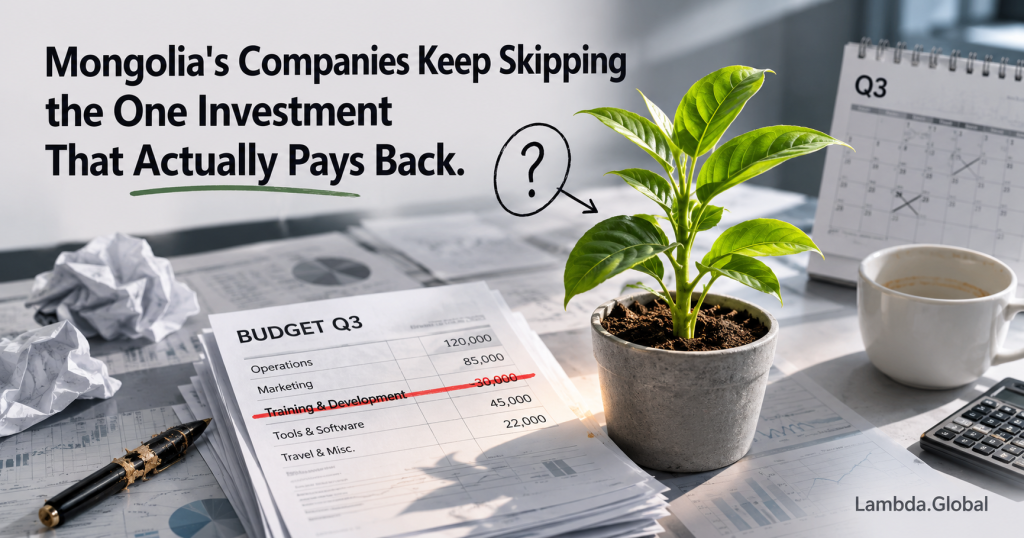
    This scene, or something very close to it, plays out in organizations across Ulaanbaatar with a regularity that has become almost unremarkable. Training budgets in Mongolian companies are treated as optional among the first items reduced when margins tighten and among the last to be restored when they recover. The logic feels pragmatic in the moment. The consequences show up later, quietly, in attrition numbers and capability gaps, and the growing inability to fill roles that the organization needs to function.

    Mongolia cannot afford this habit anymore. The evidence, both global and specifically Mongolian, is clear enough that continuing to treat workforce development as discretionary spending is not financial discipline. It is a slow, compounding organizational risk that most companies are only beginning to understand the full cost of.


    What the Data Actually Shows

    Start with the global picture, because the numbers are unambiguous. Companies that invest consistently in workforce training see a 24% increase in employee productivity and a 21% improvement in profitability. The global corporate training market is projected to reach $500 billion in 2025, a figure that reflects how seriously the world’s most competitive organizations take capability development as a strategic function, not a budget line.

    24%   productivity increase in companies with consistent training investment (Verified Market Reports, 2025)

    Now, bring it to Mongolia specifically. The country’s labor market in 2025 has around 1.2 million active workers, a number that, relative to the economic growth Mongolia is trying to sustain, is already insufficient. More than 60% of the population is under 35. That youth concentration is a genuine asset, but only if it is matched with skills development that converts raw potential into professional capability. Without it, youth dominance in the workforce just means a lot of people waiting for opportunities they cannot yet access.

    The gap between what Mongolia’s universities produce and what its labor market actually needs, particularly in digital skills, engineering, management, and cybersecurity, is both well-documented and largely unaddressed by individual organizations. The Asian Development Bank has committed investment to modernize Mongolia’s technical and vocational education system precisely because the structural gap is visible from the outside, even when it is invisible from inside the organizations experiencing it daily.


    The Specific Skills Mongolia Is Running Short On

    The shortages are not abstract. They are sector-specific, role-specific, and in many cases already creating operational friction for Mongolian companies trying to grow.

    In technology and fintech, the sector paying the highest average salaries at 3.6 million MNT per month, the critical gap is not in junior developers. Mongolia produces reasonable numbers of entry-level software professionals. The gap is in technical leadership: architects, product managers, security specialists, and senior engineers who can translate business requirements into technical strategy. These are roles that take years to develop properly, which means the shortage visible today is the result of underinvestment decisions made five years ago.

    In financial services, the gap is in compliance and risk. Mongolia’s banking sector is operating under increasing international scrutiny. The FATF grey list experience was a sharp reminder of what happens when regulatory capability does not keep pace with institutional ambition. Building genuine internal expertise in AML, KYC, IFRS, and Basel III frameworks requires sustained training investment over the years. It cannot be solved with a single workshop or an external hire who leaves after eighteen months.

    In management and leadership more broadly, the gap is generational. Mongolia has a large cohort of professionals in their late twenties and early thirties who are technically competent and organizationally ambitious. Many of them have received almost no formal management development, no structured exposure to people leadership, performance management, or the kind of decision-making frameworks that allow a good individual contributor to become a genuinely effective team leader. Organizations that invest in this cohort now will have a meaningful leadership advantage in five years. Organizations that do not will be trying to buy that advantage on the open market, at a price that will be considerably higher.


    Why It Keeps Getting Cut Anyway

    Understanding why training budgets are so consistently the first casualty of a difficult quarter requires being honest about the incentives involved. Training investment produces returns on a timeline that is almost entirely misaligned with the reporting cycles that govern most organizational decision-making. The benefit of a management development program delivered this quarter shows up in retention rates and leadership quality over the next two to four years, not in next month’s numbers.

    In a culture where organizational decisions are often made with a strong preference for visible, near-term results, this misalignment is genuinely difficult to overcome. The CFO cutting the training budget is not being irrational. They are responding rationally to a set of incentives that systematically undervalues deferred returns. The problem is structural, not individual.

    Every organization that has cut its training budget three years in a row and is now struggling to promote from within is experiencing the compounded return on that decision. The question is not whether they wish they had invested. It is whether they will make the same decision again next Q3.


    What Organizations That Get This Right Are Actually Doing

    The Mongolian companies making the most visible progress on workforce capability share a few specific practices that distinguish them from organizations still treating training as optional.

    They budget for development as a fixed cost, not a discretionary one, meaning it is protected at a structural level from quarterly renegotiation. This is not a large budget: even allocating 3 to 5% of payroll to structured development produces measurable results when it is deployed consistently. The consistency matters more than the amount. Sporadic large investments produce far less than modest, sustained ones.

    They link training directly to business strategy rather than offering a generic catalogue of courses. A logistics company scaling into new regions prioritizes supply chain management and cross-cultural communication. A bank building its digital product team invests in product management and data literacy. The training is not separate from the business. It is the business, described in learning terms.

    And critically, they measure it. Not with satisfaction surveys after a workshop, but with actual capability assessments, internal promotion rates, and time-to-productivity for new hires. Organizations that can demonstrate the return on development investment do not have to argue for the budget every year. The data argue for them.


    The Bigger Picture

    Mongolia’s government and international development partners have recognized the workforce capability gap at a macro level. The ADB’s 2025–2028 Country Partnership Strategy explicitly prioritizes upskilling and reskilling initiatives as a pillar of economic resilience. The framework is being built. The question is whether Mongolian organizations will meet it halfway or continue treating development as an expense rather than an asset, right up until the moment they find themselves unable to hire the people they need at any price.

    The 240,000-worker shortfall projection by 2035 is not inevitable. But it will become inevitable if the organizations employing Mongolia’s current workforce keep treating capability development as a luxury they can defer. The companies that will have the strongest talent position in a decade are the ones making a different decision this Q3, the ones that look at the training line item and see not a cost to cut, but an investment they cannot afford to miss.

    At Lambda. Global, we see the effect of this gap in every executive search we run. The organizations with the deepest internal development culture are the ones with the strongest candidate pipelines, the highest internal promotion rates, and not coincidentally the fewest urgent, expensive, external hires.


    SOURCES & REFERENCES

    1.  ADB — Country Partnership Strategy: Mongolia, 2025–2028 (April 2025)

    TVET modernization and upskilling as an economic resilience pillar; green and digital workforce transition investment framework.

    https://www.adb.org/sites/default/files/institutional-document/1057706/cps-mon-2025-2028.pdf

    2.  ADB News — Developing Skilled Mongolian Workforce (November 2025)

    TVET network modernization; market-relevant curriculum aligned to digital, smart, and green technology demand.

    https://www.adb.org/news/adb-mongolia-establish-framework-arrangement-support-social-sector-strengthen-disaster-resilience

    3.  Higher Careers — How Recruitment Shapes Mongolia’s Economic Future (October 2025)

    1.2M active workers; 60%+ under 35; skills mismatch in digital, engineering, and management; recruitment as national necessity framing.

    https://www.higher.careers/blog/2025/10/how-recruitment-shapes-mongolias-economic-future

    4.  Verified Market Reports — Corporate Workforce Development Training Market 2034

    24% productivity increase from consistent training; 21% profitability improvement; $500B global training market projection by 2025; 10.3% annual growth.

    https://www.verifiedmarketreports.com/product/corporate-workforce-development-training-market

    5.  NNRoad — Work Culture 2025 in Mongolia

    Skills mismatch in tech and management; upskilling as a retention tool; hybrid work and competency framework adoption in Mongolian organizations.

    https://nnroad.com/blog/work-culture-2025-in-mongolia-7-practical-steps

  • How to Hire a C-Suite Leader in Mongolia: The 2026 Playbook

    How to Hire a C-Suite Leader in Mongolia: The 2026 Playbook

    Mongolia’s executive talent market is exceptionally small compared to most Asian economies. In 2026, hiring proven C-suite leadership has become even more difficult as competition for experienced executives intensifies across mining, finance, technology, and infrastructure sectors.

    At the same time, Mongolia’s new Minerals Law overhaul and the introduction of a 20% tax bracket for high earners are reshaping how executives evaluate career opportunities, compensation, and long-term stability. The gap between a “good” executive and a truly strategic, compliant, and internationally capable leader has never been wider.

    If your company is still hiring executives based on resumes alone, you are already behind the market.

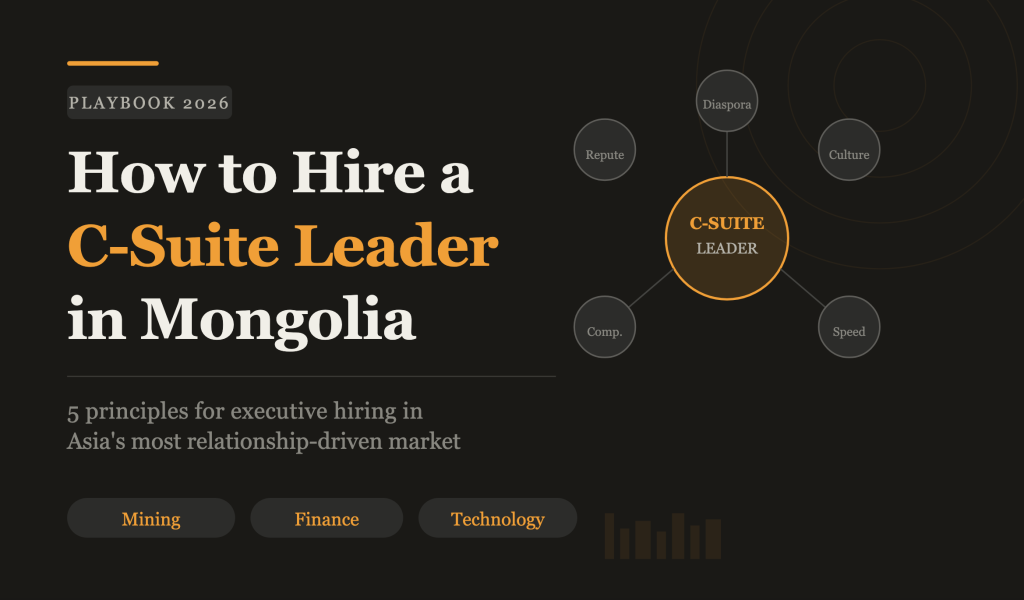
    In this playbook, we break down the five most important hiring principles for identifying, attracting, evaluating, and retaining top-tier executive talent in one of Asia’s most relationship-driven and competitive hiring markets.


    1. Returning Diaspora Talent

    In 2026, the most valuable C-Suite candidates are often those returning from abroad. The government’s “Year of Employment Support” has accelerated the return of high-skilled Mongolians from hubs like London, Seattle, and Seoul. It makes them the top participants because these candidates offer a rare “dual-fluency”—they understand global corporate governance yet possess the local cultural intuition needed to navigate Ulaanbaatar’s business circles.

    When hiring them, don’t just search locally. Use search filters to map the Mongolian diaspora. Currently, you can find them on lambda.global diaspora page.

    2. Leadership Reputation Matters More Than the Resume

    In Mongolia’s executive market, reputation travels faster than CVs. A candidate may have impressive titles on paper, but their actual leadership style, industry relationships, and decision-making history matter far more. 

    When evaluating executive talent, companies need to look far beyond a polished resume. A candidate’s reputation within the industry, ability to retain and lead teams, crisis management experience, and relationships with regulators, investors, and key stakeholders all play a critical role in long-term success. It is equally important to assess their ethical standards and compliance history to minimize potential operational or reputational risks. At the executive level, a single poor hiring decision can negatively impact company culture, weaken investor trust, and slow business growth for years.

    3. Cultural and Political Intelligence Is Critical

    Being technically skilled is not enough for someone to succeed as a senior executive in a country like Mongolia. Strong leaders also need to understand how Mongolia’s business environment works in real life. This includes understanding local business culture, government regulations, and how relationships influence important decisions. Executives must know how to communicate with employees, investors, regulators, and other stakeholders while managing different personalities and expectations inside the company. 

    Cross-cultural communication is also becoming more important as more international companies enter the Mongolian market. A leader who performed successfully in cities like Singapore, Seoul, or London may still struggle in Mongolia if they cannot adapt to the country’s unique business culture, leadership expectations, and fast-changing economic environment.

    4. Compensation Is No Longer Just About Salary

    Executive candidates in 2026 are evaluating opportunities more strategically than before. While compensation remains important, many leaders now prioritize decision-making authority, organizational stability, governance quality, international exposure, and long-term career growth. Mongolia’s introduction of higher tax brackets for high earners, combined with rising competition for leadership talent, has also changed how executives evaluate total compensation packages. 

    Global workforce studies show that executives increasingly care about flexibility, organizational trust, and long-term value creation rather than salary alone. Companies offering equity, performance incentives, strong governance structures, and meaningful leadership opportunities are becoming more competitive in attracting high-level talent.

    5. Speed and Clarity Win Executive Talent

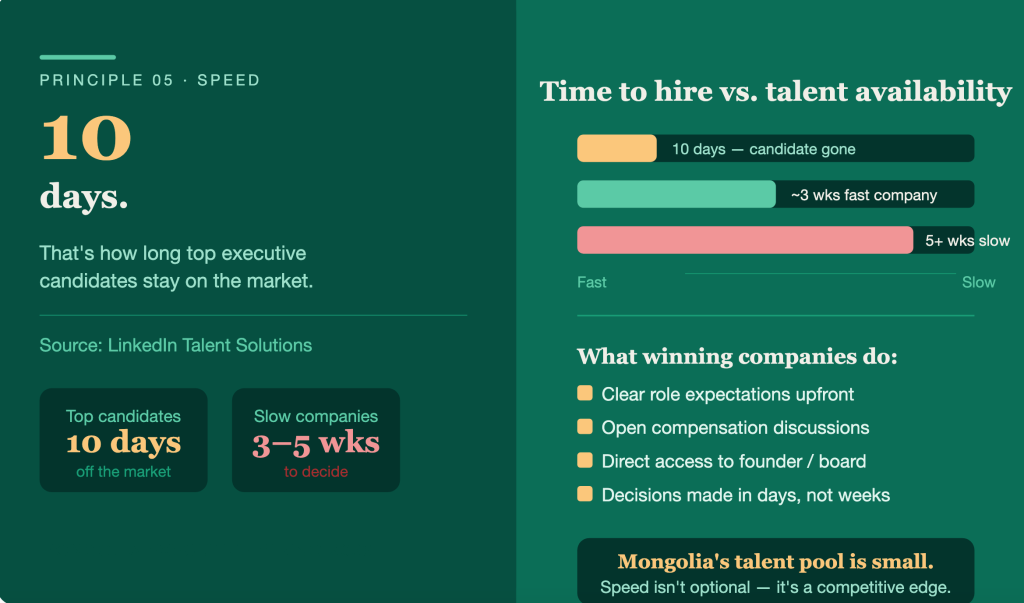
    Research from global recruitment firms shows that long hiring processes are one of the biggest reasons companies lose high-level talent. According to executive hiring studies by LinkedIn Talent Solutions, top candidates are often off the market within 10 days, while many companies still take several weeks to make decisions. In Mongolia’s smaller executive ecosystem, this challenge becomes even more severe because the pool of experienced leadership talent is already limited.

    Senior executives are usually involved in multiple confidential discussions at the same time, especially in industries such as mining, banking, technology, and infrastructure. Delayed interview scheduling, unclear reporting structures, or inconsistent communication can quickly damage a company’s credibility during the hiring process.

    Successful companies usually stand out by maintaining a professional and transparent hiring process. This includes providing clear role expectations, having open compensation discussions, making decisions quickly, and ensuring direct communication with founders or board members. Strong onboarding and leadership support also help companies build trust with executive candidates and improve long-term retention.


    Key Takeaways

    • Mongolia’s executive talent market is small, competitive, and relationship-driven.
    • Strong executive hiring requires more than reviewing resumes alone.
    • Returning diaspora professionals are becoming valuable leadership candidates in 2026.
    • Cultural intelligence and stakeholder management are critical for executive success in Mongolia.
    • Today’s executives prioritize stability, influence, and governance alongside compensation.
    • Fast, transparent hiring processes help companies secure top-tier talent before competitors do.

    REFERENCES

    Linkedin: Mongolia’s Labor Market: Key Insights from our “HR 2026” Report

    Mercer: Global Talent Trends 2026. Solving the human–machine equation

  • Mongolian Most Overlooked Leadership Resource Is Half the Population.

    Mongolian Most Overlooked Leadership Resource Is Half the Population.

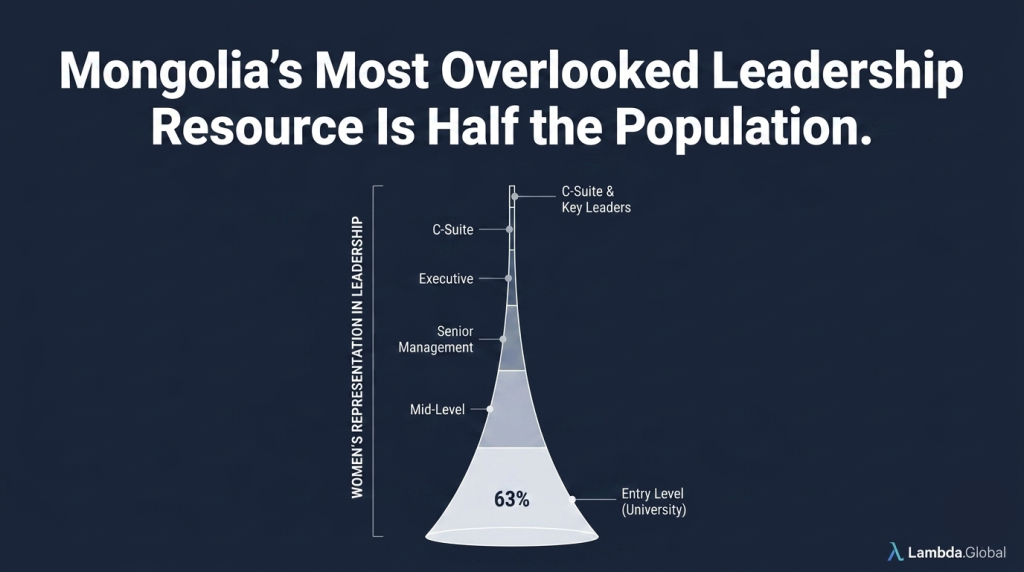
    Mongolian women outperform men in education, dominate the professional workforce, and consistently demonstrate the qualities organizations say they want in leaders. Then they get passed over. Something is not adding up, and it is costing this country more than most executives want to admit.

    Start with the numbers, because they are genuinely striking. According to the World Economic Forum’s 2024 Global Gender Gap Report, women make up 63% of Mongolia’s professional and technical workforce, the highest share in the entire Eastern Asia and Pacific region. Mongolian women consistently outperform men in tertiary education. They are present, qualified, and working. In any rational account of how talent pipelines are supposed to function, this should mean Mongolian women are well-represented at the senior leadership level.

    They are not. Female executives earn between 10 and 18% less than men in equivalent roles. Overall, women’s average salary in Mongolia sits at 1.7 million MNT per month against men’s 2.3 million, a gap that widens, not narrows, as seniority increases. The boardrooms and C-suites of Ulaanbaatar’s largest organizations remain predominantly male, even though the professional class feeding into them is majority female. Mongolia has, in short, built an impressive system for developing female talent and a stubborn system for not deploying it.


    63%   of Mongolia’s professional & technical workers are women highest in the region (WEF 2024)

    This is not a problem unique to Mongolia. Globally, women represent 43.4% of the total workforce but only 30.6% of leadership positions. Research consistently identifies what is now called the ‘broken rung,’ the first promotion to management, where for every 100 men elevated, only 81 women make the same move. That initial gap compounds at every subsequent level, which is why the drop from entry-level near-parity to C-suite underrepresentation is so dramatic worldwide.

    But Mongolia’s version of this problem has a particular shape. It is not that Mongolian women lack professional presence or educational attainment; they have both in abundance. The gap is almost entirely concentrated in the transition from competent professional to recognized leader. And understanding why that transition stalls requires looking honestly at the mechanisms that govern it.


    The Visibility Problem

    Leadership in Mongolia’s corporate sector is still substantially assigned through relationship networks through connections, through visibility in the right rooms, through the informal credibility that accumulates when senior people notice you and remember you. This system, as we have explored in previous pieces, creates problems for everyone outside the dominant network. But it creates a specific and compounding problem for women.

    Women in Mongolia’s professional class are, statistically, everywhere in banking operations, in finance departments, and in mid-level management across nearly every sector. What they are less present in are the informal spaces where senior visibility is built: the post-meeting conversations, the industry dinners, the golf rounds, and evening gatherings where professional credibility is traded alongside social currency. This is not a Mongolian idiosyncrasy. It is a universal dynamic. But in a market as small and relationship-dependent as Ulaanbaatar’s, its effects are amplified.

    A senior woman at a major Mongolian bank described it this way in a recent interview: she had spent eight years being the most prepared person in every meeting she attended, and four years wondering why colleagues who were less prepared kept being asked to lead things she was not. The answer, when she eventually understood it, was not about preparation. It was about presence in spaces she had not prioritized and had not been explicitly invited into.


    The ‘Not Yet Ready’ Deferral

    One of the most consistent patterns in how Mongolian organizations discuss female leadership is the language of timing. Women are often described genuinely, not maliciously, as ‘almost ready,’ as ‘strong candidates for the next cycle,’ as professionals who would benefit from ‘a bit more experience before taking on that scope.’ This framing is so common that it has become almost invisible.

    What makes it insidious is that it is often applied asymmetrically. Research from WEF’s 2025 Gender Gap Report confirms what many women in professional settings already know from experience: globally, women are hired and promoted on demonstrated performance, while men are more frequently elevated on perceived potential. The result is a structural double standard embedded in ordinary language, women have to prove readiness while men are assumed to have it.

    In Mongolia’s executive hiring market, this plays out in a specific and measurable way. When Lambda. Global and other executive search firms map the available candidate pool for senior roles, and the qualified female candidates are consistently there. The gap is not in the pipeline. It is in which candidates’ organizations approach first, which ones they describe as ‘obvious fits,’ and which ones they require to clear additional informal bars before being considered seriously.

    18%   executive pay gap between equivalent male and female roles in Mongolia (Higher Careers 2025)


    What Is Actually Changing

    The picture is not static, and it would be misleading to present it as though nothing is moving. Mongolia’s 2024 parliamentary elections were a genuine milestone: women now hold 25.4% of parliamentary seats, an 8-percentage-point increase in a single election cycle, pushing Mongolia above the Asian average for female political representation for the first time. Gender quotas for Parliament are legislated to rise to 30% and then 40% by 2028. These are structural interventions, and they are producing structural results.

    Mongolia also narrowed its overall gender gap by more than 2 percentage points between 2024 and 2025, according to WEF, one of the larger improvements globally in that period. The direction is right. The pace is the question.

    In the private sector, movement is slower but present. Mongolia’s most internationally integrated companies, particularly those with foreign joint venture partners, international board representation, or direct exposure to global governance standards, are measurably further ahead on female leadership representation than domestically focused organizations. This pattern mirrors what research shows globally: external accountability pressure is one of the most reliable accelerators of internal gender equity progress.


    The Business Case That Should Not Need Making

    There is a version of this conversation that appeals entirely to economic logic, and it is worth stating plainly even if it should not be the primary argument. Companies with greater gender diversity in leadership demonstrate higher profitability, stronger governance outcomes, and better talent retention. WEF’s research is explicit that organizations with women in top management are more likely to hire women into those roles going forward, meaning the compounding effect works in both directions. Mongolia’s economy is growing at 6.5% and faces a projected shortage of 240,000 workers by 2035. In that context, systematically underutilizing half the talent pool is not just an equity failure. It is a strategic one.

    But the economic case, compelling as it is, should not be the only lens. The women being passed over for leadership roles they have earned are not primarily a resource being wasted. They are professionals whose contributions are being undervalued in a market that loudly claims to be desperate for talent. The contradiction sits in plain sight.


    What Needs to Happen

    Three things, specifically, would make a measurable difference in Mongolia’s corporate sector within a hiring cycle or two.

    First: structured succession planning that explicitly maps female candidates into future leadership roles, not as a quota exercise but as an acknowledgment that the existing network-based system consistently produces a skewed result. If your senior leadership pipeline contains few women, the problem is not the pipeline. It is the process of generating it.

    Second: deliberate sponsorship, not just mentorship. Mongolia’s professional women have mentors. What they frequently lack is sponsors, senior leaders who actively advocate for them in rooms they are not yet in, who attach their own credibility to a junior woman’s readiness for the next level. Mentorship helps people develop. Sponsorship is what actually moves careers.

    Third, and most directly: organizations need to examine the language they use when evaluating female candidates for senior roles. ‘Almost ready’ applied to a woman who would be considered ready if she were a man is not neutral language. It is a decision. And in a country running out of time to develop its leadership bench, it is a decision with consequences that compound.

    Mongolia has spent decades building a professional class that is majority female at the technical and mid-level tiers. The question now is whether it is willing to let that investment pay off or whether it will keep the returns on the wrong side of the ledger.


    SOURCES & REFERENCES

    1.  WEF — Global Gender Gap Report 2024

    Women = 63% of Mongolia’s professional/technical workforce (highest in Eastern Asia & Pacific); regional leadership share comparisons.

    https://www.weforum.org/publications/global-gender-gap-report-2024

    2.  WEF — Global Gender Gap Report 2025

    Mongolia narrowed gender gap 2+ percentage points 2024–2025; women hired on performance vs men on potential; broken rung data.

    https://www.weforum.org/publications/global-gender-gap-report-2025

    3.  UNDP Mongolia — Breaking Barriers of Women’s Leadership (April 2025)

    Women hold 25.4% of parliamentary seats post-2024 elections (+8%); gender quota legislation rising to 30% then 40% by 2028.

    https://www.undp.org/mongolia/stories/advancing-human-rights-breaking-barriers-womens-leadership-decision-making-mongolia

    4.  Higher Careers Mongolia — Executive Compensation Trends 2025

    10–18% executive pay gap between male and female equivalents; women avg 1.7M MNT vs men’s 2.3M MNT.

    https://www.higher.careers/blog/2025/10/executive-compensation-trends-mongolia-2025

    5.  High5Test — Women in Leadership Statistics 2024/2025

    Global broken rung data: 81 women promoted per 100 men; 48% entry-level to 29% C-suite attrition pipeline; 11% Fortune 500 female CEOs.

  • They Left. They Succeeded. So Why Wont They Come Back to Mongolia?

    They Left. They Succeeded. So Why Wont They Come Back to Mongolia?

    One in eleven Mongolians lives abroad. Most are educated, ambitious, and doing well. Mongolia’s economy is growing faster than almost anywhere in Asia. And yet the people the country most needs are still not coming home, and the reasons are not what most employers think.

    Picture someone you probably know, or could know. A Mongolian in their early thirties, living in Seoul, Sydney, or Singapore. They left eight, maybe ten years ago, a scholarship, a job offer, a decision that felt temporary at the time. They have since built something real, a career with actual progression, a professional network with international reach, a salary that covers rent and savings, and the occasional flight home for Tsagaan Sar. They are good at what they do. They think about Mongolia more than outsiders might expect.

    They also have a spreadsheet. Not a literal one, but the mental version that every Mongolian professional abroad maintains. On one side, what going home would give them. Family proximity, familiarity, the sense of building something that matters in a place that is actually theirs. On the other side, what going home would cost them. The salary cut. The governance frustrations. The sense, shared quietly among friends in similar positions, that the system at home is not quite ready for what they have become.

    Most of them are still running that calculation. And for now, most of them are staying put.


    The Scale of What Mongolia Is Missing

    The numbers are worth stating plainly. According to the International Organization for Migration, an estimated one in eleven Mongolians lives abroad, a striking figure for a country of just 3.5 million people. The UN’s international migrant stock counted 82,098 Mongolian emigrants as of 2020, the majority of them female. The primary destinations are South Korea, Japan, China, Russia, and a cluster of European countries, including Germany, Belgium, and the Netherlands.

    Crucially, these are not low-skilled migrants in the conventional sense. Mongolians migrating abroad are disproportionately educated and young people who left precisely because their qualifications created options. More than 15,000 Mongolians were studying abroad in 2017 alone, an extraordinarily high number relative to the country’s population. Many of those students stayed. Others followed them.

    This is Mongolia’s core talent paradox: the country has invested through family sacrifice, through state education, through sheer aspiration in producing exactly the kind of professionals its economy now urgently needs. And then it watched them leave. The projected shortage of 240,000 workers by 2035 is not happening despite Mongolia’s educated diaspora. It is happening partly because of how that diaspora was created and why it has not returned.


    What Returnees Actually Need And What They Get

    Speak to Mongolians abroad who are considering a return, and a pattern emerges quickly. The conversation rarely starts with salary, though salary matters. It starts with something harder to quantify: whether the environment they return to will actually let them use what they have built.

    A finance professional who spent six years at a mid-tier bank in Seoul has internalized a standard of process, compliance, and institutional governance that many Mongolian organizations have not yet reached. She is not being arrogant about this. She is being accurate. If she returns to a role where her international experience is treated as decorative rather than operational, where her suggestions about risk frameworks are met with polite indifference, where the salary premium offered for her background disappears in the second contract cycle, she will leave again. And she will tell her peers.

    “Mongolia offers me the chance to be a big fish in a small pond. What it doesn’t yet offer is a pond that values the kind of fish I’ve become.”

    This sentiment, expressed in different words by Mongolian returnees across sectors, captures something important. The returnee opportunity is real. Mongolia’s fastest-growing companies, particularly in fintech, financial services, and the growing renewable energy sector, have begun structuring expatriate-style packages precisely to compete for this talent. Housing allowances, international schooling provisions, and travel budgets are appearing in offers that would have been unthinkable five years ago.

    But a competitive package is a necessary condition, not a sufficient one. The organizations that have successfully brought back experienced Mongolian professionals share something beyond salary: they offer genuine organizational autonomy, clear succession paths, and a visible connection between what the returnee will do and what the company is trying to become. The ones that have struggled to retain returnees are those that hired the credentials and then ignored the experience.


    The South Korea Complication

    No conversation about Mongolian labor migration is complete without addressing South Korea directly. Korea is not just the largest destination for Mongolian workers; it is a structural fixture of how Mongolia’s economy actually functions. Remittances from Korean-based Mongolians represent a significant and stable income stream flowing back into Mongolian households, and the Korean labor market’s appetite for Mongolian workers has remained robust across economic cycles.

    For working-age Mongolians without strong professional credentials, the Korea option is economically rational in a way that is difficult to argue against. A basic manufacturing or service role in Korea often pays more, in absolute terms, than a mid-level white-collar position in Ulaanbaatar. That gap has been narrowing as Mongolian wages grow. Average wages hit 2,877,800 MNT in Q4 2025, up meaningfully from prior years, but it has not closed.

    For credentialed professionals, the calculation is more nuanced. Korea, Japan, Australia, and Singapore offer not just higher salaries but faster career escalators, deeper professional networks, and exposure to institutional complexity that Mongolia’s market simply cannot yet replicate. The professionals Mongolia most needs, the CFOs, the technology directors, the operations leaders with international joint-venture experience, are precisely the people for whom the abroad option remains most compelling.


    What Would Actually Change the Equation

    Three things, specifically, would meaningfully accelerate the return of Mongolia’s professional diaspora, and none of them require a government program to implement.

    The first is organizational honesty about what a returnee role actually involves. Companies that advertise senior positions to diaspora candidates and then present a role that is more advisory than operational lose credibility fast in a small professional community. Returnees talk to each other. A bad experience at one company ripples quickly through networks in Seoul and Sydney. The reverse is equally true: a company that delivers on what it promises becomes a magnet.

    The second is structured integration, not just onboarding. Returning professionals face a specific challenge that employers rarely plan for: the gap between international working norms and domestic ones. A Mongolian who has spent a decade in Singapore has absorbed assumptions about meeting culture, decision-making speed, and feedback directness that can create friction in a Ulaanbaatar office. Companies that create deliberate space for that integration, peer mentorship, leadership coaching, and explicit conversations about organizational culture retain returnees at significantly higher rates than those that simply hire them and hope for the best.

    The third is the most uncomfortable: genuine governance improvement. The Mongolians abroad who cite political instability, corruption, and inconsistent regulatory enforcement as reasons for not returning are not being precise. They are describing a real constraint on how effectively they can operate. This is a longer arc to change, but it is worth naming honestly, because it means that the returnee strategy cannot be solved by HR policy alone.


    Mongolia’s Window

    The global context is shifting in ways that create a real, time-limited opportunity for Mongolia to accelerate returnee migration. Immigration policy in the United States, the UK, and parts of Europe has become materially less welcoming for foreign professionals. The anti-immigration political turn across several traditional destination countries has made the calculus of staying abroad less automatic than it once was. Several Mongolians who had parked the question of returning are revisiting it now, not because Mongolia has changed, but because the alternative has.

    Mongolia does not need to be perfect to win its diaspora back. It needs to be good enough and visibly improving. The companies and institutions that move now to build the organizational culture, the compensation architecture, and the professional infrastructure that returnees are looking for will be the ones with the most capable leadership teams in five years.

    The spreadsheet that every Mongolian professional abroad is running never fully closes. It just gets updated. The question is whether Mongolia’s employers are putting numbers on the right side of it and whether they are doing it fast enough to matter.

    At Lambda. Global, connecting experienced Mongolian professionals in the diaspora with organizations ready to receive them is one of the most consequential and underserved parts of what executive and mid-senior search can do for this market. The talent is there. It always has been. The gap is between where it currently sits and where it could be deployed.

    SOURCES & REFERENCES

    1.  Vatican Migrants & Refugees — Mongolia Country Profile

    82,098 emigrants (UN 2020); 1 in 11 Mongolians living abroad (IOM); 15,000+ studying abroad in 2017; destination countries breakdown.

    https://migrants-refugees.va/country-profile/mongolia

    2.  Trading Economics — Mongolia Wages, Q4 2025

    Average wages 2,877,800 MNT/month in Q4 2025; quarter-on-quarter wage trajectory.

    https://tradingeconomics.com/mongolia/wages

    3.  Migration Policy Institute — Brain Drain & Brain Gain

    Global frameworks on skilled worker migration, return migration policy, and talent circulation in emerging markets.

    https://www.migrationpolicy.org/topics/brain-drain-brain-gain

  • Rent the Brain, Not the Body: Why the Future of High-Impact Hiring in Mongolia is Fractional

    Rent the Brain, Not the Body: Why the Future of High-Impact Hiring in Mongolia is Fractional

    By 2026 the way we think about success in business will be different. We used to believe that having a lot of employees and a big office meant a company was successful. Now we know that is not true. Having many employees can actually hurt a companys chances of succeeding.

    Successful companies today are the ones that are flexible and have few employees. They make decisions because they have executives who are in charge of making important choices. Many of these companies have reduced the number of employees they have because they can hire Fractional Executives.

    The Ownership Paradox:

    Are we too focused on hiring people time? Many business leaders think that if they do not hire someone time that person will not be loyal and will not do a good job. This is not true. Lets look at what executives do every day. They only spend 15-20% of their time making important decisions and solving problems. They spend the rest of their time 80%, reading emails attending meetings and doing administrative tasks that other people can do.

    When companies pay a lot of money for full-time executives like Chief Technology Officers or Chief Marketing Officers they are basically paying for them to be in the office not for the work they actually do. Fractional Leadership is an approach. Companies hire an expert to work for them for a hours a week. These Fractional Executives can still make decisions and solve complex problems but companies do not have to pay as much for them.

    Seventy percent of technology companies are now using Fractional Leadership. This helps them save money and be more efficient. A report by Deloitte in 2025 said that seventy percent of successful technology companies hire experts for important roles. This helps them save forty to fifty-five percent on costs.

    Research Insight: According to Deloitte’s 2025 “Global Human Capital Trends” report, 70% of high-growth technology firms now utilize fractional experts for critical roles. This shift has resulted in an average operational cost reduction of 40% to 55%. 

    What is Fractional Leadership?

    Fractional Leadership is when a company hires an expert to work for them for a hours a week. This expert is not an employee. Helps the company make good decisions and solve problems.

    According to Deloittes 2025 report seventy percent of technology companies now hire outside experts for important roles. This helps them save forty to fifty-five percent on costs.

    Fractional Leadership is also good for managing costs and risks. Here is a comparison:

    FeatureFull-time Executive (Legacy)Fractional Executive (Lambda Global)
    Financial CostHigh Salary + Benefits + Equity + TaxRetainer Fee (Pay for specific value/results)
    Time to Impact3-6 Months (Onboarding & Integration)1-2 Weeks (Immediate Strategic Action)
    ExpertiseLinear (One industry at a time)Cross-functional (Diverse global insights)
    FlexibilityHigh Exit Cost (Severance & Bureaucracy)On-demand (Scalable based on project needs)
    Primary FocusAdministration + Internal Politics100% Problem-Solving & Strategy

    Why You Should “Rent the Brain”

    There are three good reasons to hire someone for a short period:

    1. You can get an expert with a lot of experience. For example a company in Mongolia that wants to expand can hire an expert to help them for a short time.

    2. You can get a perspective. Sometimes people who work for a company can be too close to a problem. Not see the solution. An outside expert can look at the problem in a way and make good decisions quickly.

    3. You can scale your leadership team as needed. Companies needs change over time. With Fractional Leadership you can hire an expert for a time to help with a specific project or challenge.

    The traditional way of hiring people using resumes is not working anymore. What matters is what a person can do not what they have done in the past. At Lambda Global we look for people who can adapt and work well with others.

    The Lambda Global Manifesto

    We are not a recruitment company. We help companies find the talent to solve their problems. We do this in three steps:

    1. We find the gaps in the company.

    2. We find the expert to fill those gaps.

    3. We help the expert work well with the company.

    Which Type of Leader Are You?

    The old way of hiring full-time executives is not the way to succeed in business anymore. Fractional Leadership is the future. It allows companies to get the experts to help them with their biggest challenges without spending a lot of money. A company, in Ulaanbaatar can learn from an expert in a few hours a day. This is what Lambda Global offers. Are you ready to try this way of hiring or will you stick with the old way?

    Sources & References

    • Deloitte (2025): Global Human Capital Trends – “The Open Talent Economy”
    • Gartner Research (2025): The Strategic Shift to Fractional Roles in Tech
    • Lambda Global (2026): Internal Workforce Analysis & Global Mobility Data
  • Mongolia’s Untapped Talent Edge: A Practical Guide for HR Leaders

    Mongolia’s Untapped Talent Edge: A Practical Guide for HR Leaders

    10 Ways to Understand Mongolia’s Talent Market Opportunity

    Mongolia is still one of Asia’s most overlooked talent markets, but that is changing rapidly. For HR managers and executives who want to hire smarter, reduce costs, and build stable teams, this market offers a strong mix of young workers, growing digital skills, and significant room for growth.

    1. Mongolia’s young workforce creates long-term value

    The real question is not whether Mongolia has talent. It is whether companies are ready to recognize it. In this post, you will learn what makes Mongolia stand out, why its workforce matters, and how employers can approach the market with a practical hiring plan.

    Mongolia’s demographics give employers a clear advantage. A large share of workers is young and already active in the labor market, which means companies can hire people who will grow with the business over time. For HR leaders, this is not just about filling roles today. It is also about building a team for the next five to ten years.

    Younger workers tend to adapt quickly, which helps in roles where tools, systems, and tasks change often. This makes them well suited for support, administration, operations, and junior professional positions. A young workforce becomes even more valuable when employers invest in training, feedback, and clear paths for advancement, which also helps reduce turnover.

    2. Education and English skills are improving

    Mongolia continues to produce graduates in business, IT, finance, and related fields, including strong alumni from universities around the world. English proficiency is also improving among younger professionals, particularly in Ulaanbaatar. This makes the market more accessible for international teams and cross-border collaboration.

    Strong language skills and solid academic backgrounds make onboarding easier for employers. Teams can work across borders with less friction, adopt global tools more readily, and demonstrate broader business standards. This is especially useful in accounting support, customer success, digital marketing, and junior tech roles. Companies can strengthen these capabilities further through structured interviews, skills assessments, and role-specific training.

    3. Remote work expands access to Mongolian talent

    Remote and hybrid work have changed how companies think about location. Mongolia no longer needs to be seen as geographically distant from major business centers, it can now be viewed as a source of talent that works seamlessly with teams in many places.

    This model works especially well for tasks that follow clear processes and rely on digital tools. Back-office support, coordination, data work, and certain tech roles fit this approach well. For HR teams, remote hiring also provides greater flexibility in workforce planning. The key is to keep work clearly defined, document processes thoroughly, and establish straightforward communication habits. Without structure, remote work becomes difficult to manage. With structure, it can work very well.

    4. Salary efficiency supports steady growth

    One of Mongolia’s most compelling advantages is salary efficiency. Compared to more established Asian talent hubs, companies may be able to hire strong candidates at a lower cost — without sacrificing quality. This means businesses can grow faster, add more staff, and preserve budget for training and retention.

    For executives, that can be a genuine strategic advantage. It allows companies to scale thoughtfully rather than overspending in crowded markets. However, lower salary costs only deliver value when the rest of the offer is fair. Companies still need clearly defined roles, competitive local compensation, and benefits that matter to workers. Paying less on its own is not a sustainable strategy.

    5. Retention depends on workplace quality

    Hiring talent is only half the job — keeping it is just as important. Employers that expect long hours, apply rigid pay structures, or offer no clear path for advancement often lose younger workers quickly. HR teams must therefore focus on fairness, communication, and growth.

    This is where local knowledge matters most. Some global companies apply hiring practices from larger markets without adapting them to local expectations, and in Mongolia, that gap shows. Better retention comes from salary transparency, manageable workloads, well-trained managers, and regular feedback. When people feel respected and can see a future with the company, they are far more likely to stay.

    Lambda Global notes that by 2035, working-age people could make up 64.7% of Mongolia’s population, with younger generations still entering the labor market. That gives companies a genuine opportunity to build teams now, before demand rises further. Lambda also points out that many employers are already struggling to retain young workers, which makes fair pay, clear growth paths, and stronger hiring systems even more critical.

    6. Mongolia can support key business functions

    Mongolia is not only suited to basic outsourcing. It can also support finance, accounting, software development, digital marketing, customer support, and operations making it a viable option for companies building regional teams or shared service centers.

    The best fit is typically work with defined processes, measurable outcomes, and digital systems. A finance support team, for example, may find strong analytical professionals in Mongolia. A startup may find junior developers or product support staff who are eager to learn and grow. The opportunity strengthens further when companies invest in local employer branding and build relationships with universities, recruiters, and professional communities.

    7. Early movers gain a hiring edge

    The market is still developing, which means top talent is not yet as competitive to attract as it is in well-known Asian hubs. That creates an opening for early movers. Companies that build a presence now can earn trust, attract stronger candidates, and develop better referral networks before the market becomes crowded.

    This matters because talent markets reward visibility. If people know your company as a good employer, they are more likely to apply when opportunities arise. HR leaders should think beyond one-off hires and focus on sustained market presence. Building local trust, refining hiring processes, and developing strong ties with people who understand the local landscape. The sooner a company gets involved, the better its long-term access to talent.

    8. Bonus tip: localize your hiring process

    A simple way to improve hiring outcomes in Mongolia is to localize the process. This means adapting job postings, interview formats, salary ranges, and communication styles to fit the local market. This small adjustment can meaningfully improve applicant quality and reduce drop-off rates.

    Transparent salary ranges and clearly defined roles help build trust quickly, as do practical interview formats that assess real skills rather than relying on vague corporate signals. Localizing the hiring process is often the difference between generating interest and finding the right person.

    9. Build local employer trust

    Mongolia’s talent market is still maturing, so trust carries significant weight. Many strong candidates want to know that a company will pay fairly, communicate openly, and offer genuine growth. Employer branding, therefore, is not a secondary concern. It is a core part of the hiring strategy.

    HR teams should focus on the basics that build trust quickly: clear job postings, honest salary ranges, and prompt feedback. When candidates see a company that respects their time, they are more likely to apply and remain engaged throughout the process.

    10. Use local partners and market insight

    Global hiring models do not always translate well in Mongolia. Local hiring partners, recruiters, and market specialists can help companies avoid common mistakes and provide better guidance on compensation, job titles, candidate expectations, and interview practices. Useful resources include lambda.global, zangia.mn, and worki.mn

    The local market has its own pace and norms. Companies that learn from people who already know the space can hire faster and make better decisions. For HR leaders, this is one of the most reliable ways to reduce risk and improve results.

    Conclusion

    Mongolia’s talent market is frequently overlooked because many companies focus only on familiar hiring hubs. But for HR managers and executives who think ahead, the country offers a compelling combination of youth, adaptability, improving skills, and cost efficiency.

    The real opportunity lies in building access to talent before the market becomes crowded. Companies that move early, hire thoughtfully, and adapt to local conditions can build a meaningful competitive edge. In a crowded region, the smartest talent strategy often starts where others are not yet looking.

  • Hired in a Heartbeat: the Future of Rapid Recruitment in Mongolia

    Hired in a Heartbeat: the Future of Rapid Recruitment in Mongolia

    What’s your recruitment experience in Mongolia? After how long have you been hired by an organization? As a millennial, I have quite few experiences of being hired into an organization. But the recent experience was the fastest one in my entire career history. 

    Two weeks ago, I have seen an advertisement of an English Writer on Lambda Global. As a full time mother, I was interested in remote writing job, which will allow me to spend more time with my children. Consequently, I have applied for the job the next day. Two days later I have received an email from the CEO and founder of the Lambda Global, congratulating me for passing the first screening. The final stage was to send a 800-1200 word article by Sunday strictly written by myself, without any AI assistance. I have sent my article within the given deadline. I was assuming that the CEO or the other team members of Lambda Global will read my article on Monday, and I will hear back from them by Tuesday at the earliest. To my big surprise I have received the results after two hours on the same day. It was not only the results, but it contained all the necessary information to start my work immediately. By Friday the same week I have already received my first payment. For someone, who was expecting the response at least two days after the test article submission, it felt super quick. This whole experience of gig work is new to me and certainly it gave me an idea of a future work. Lambda Global is a start-up business, hence everything is swift and different from the traditional organizations that I have worked.

    In the future, I think not only start-ups, but with the further development of an AI and the new generation’s demand the most organizations will be similar to today’s start-ups. 

    Hiring trend

    I have experience of being recruited in a big and small organizations with international and national management. Depending on the urgency of the position, the entire process usually took at least 2-3 weeks. That will not be the case in the near future. It will not be surprising, if someone applies for a job and starts the work next day. AI involvement in the recruitment process will speed up the process significantly. Lengthy processes of an interview, exam, negotiation and signing of a contract will be much shorter. After I was selected as an English writer, the Lambda Global’s CEO shared a spreadsheet with me. The spreadsheet contained all the other writer’s payment and deliveries. At first, I thought he had sent it mistakenly. It turned out it was not. Everything is transparent at Lambda Global. I could see, who has what payment scale, based on what delivery. It made everything clear, no guessing and confusion. Lambda Global is promoting exactly this to other organizations – to be transparent on the salary. I could see how much time it saves for both the company and the contractor. You have a clear task, this is what we pay for the task, this is what others get, if you agree come and join. 

    Automated emails and the system 

    I have received an email from the CEO and founder of the Lambda Global, Bayarsaikhan Volodya. Somehow, it felt like an AI email. I presume the CEO does not intend to hide AI assistance, on contrary he is embracing the AI. Lambda Global is developing an AI driven system to enhance the human resources efficiency and to shape fair labor ecosystem in Mongolia. Consequently, from the recruitment process I could sense some involvement of an AI. In the future, the new generation might receive clear and concise emails from an AI. Email exchanges might look and feel very different from the traditional ones. That made me to question, whether the communication skill will be crucial as it is today. Computer to computer interaction seemed to require minimal communication skill, especially the oral communications. Today, I am performing my task not interacting with anyone. I have received one email with clear instruction and expectation. That was it. I do not have to deal with an accountant or any other personnel. 

    Full time office work 

    Current gig work is perfect for me. I can spend my time with my children and manage my time. Plus, I get paid every week. How convenient is that! I could completely understand why Gen Z reluctant to have full time office work, where you get paid twice a month. In the future, it will not be surprising, if all the full time office works replaced by an output based remote jobs. Most organizations will likely to hire highly skilled contractors, who will perform tasks with a clear goal. There will be no so-called “pointless” jobs that fills an office desk. 

    My current work as an English Writer at Lambda Global could be an expectational case today, but this is what attracting the new generation. Start-ups such as the Lambda Global is already defining new practices of future work. The “future work” ,widely discussed as something faraway, is already unfolding around us.

  • The State of the Male Workforce in Mongolia

    The State of the Male Workforce in Mongolia

    I remember there were a podcast called “Where are the Mongolian men?” hosted by three men. Three hosts worked in a corporate sector. They have claimed that everywhere they go, in the office, restaurants, networking events, different clubs and training, there were always women outnumbering the men. Hence, they have started a podcast to discuss this issue. 

    According to the study the state is one of the major employers in Mongolia, especially in the rural provinces. One out of five people in Mongolia are employed by the state. Head of the government agencies are dominated by men. 
    There are around 120 state owned enterprises, if the subsidiary and local government owned enterprises will be added this number will rocket to 450. Men are dominantly working in these state-owned enterprises. It is not a secret that recruiting process of ministries, government agencies and state-owned enterprises are very different than the private enterprises. Private enterprises have largely merit based recruiting system. Candidates have to pass the interview and exam to get into the big company, whereas in the state-owned enterprise connection is more important than the candidates’ education and skills. This connection-based system allows a number of incompetent workforces to easily get a job.
    Majority of Mongolian men are heavily interested in politics. Therefore, most of them see state enterprises as a ladder to the political leadership role. It is public knowledge that the heads of the state-owned enterprises are appointed by a political party. 
    The rest, who are not aspiring to the political leadership role, stays in the organization even if they dislike the job. The main reason is they are aware that, if they lose this job, they will face hard time to get another one as they have poor skills and qualifications. 

    For both government agencies and corporate sector, in the office environment men are either at the top or the bottom. Middle positions are dominated by women. That’s why women seem to be everywhere in the corporate world. 
    Educated and skilled Mongolian men are predominantly working in construction, mining and energy sectors in the home country. Rest is the business owners. If we look into the number of medical professionals of Mongolia, men comprise only around 20%, which is a huge gap. 

    Men, who have no connection to government agencies and state-owned enterprises among others, choose to go abroad and work there. Working abroad allows men to earn a decent salary to build their life. Today approximately 55,000 Mongolians are residing in South Korea, from which 37,000 are contracted workers. It is the number one destination for Mongolians. Consequently, South Korea is the largest country with bilateral social security agreement with Mongolia, where Mongolians are granted an option to be covered by Mongolian social insurance. It is not clear when will the outflow to South Korea cease, as the system sending the contractor workers is well established that even the legal regulations are in favor of it. 

    Another group of men are the men who are continuing the Mongolian heritage, undertaking a herding work. They regarded as a workforce in the agricultural sector. Herding is a hard work. Consequently, most herder families keep the boys to help with herding, while sending the girls to go to the university. It created a so-called reverse gender gap in education. 

    This is the overall picture of male workforce of Mongolia. They are either directors or a contract worker, they are a business owner or a herder. There are small number of doctors, software engineers and other specialists. Thus, there is need to support the male professionals and increase the number of highly skilled workforce.

    Tips to support existing male professionals:

    – Involve in professional training to upgrade their qualifications
    – Involve in other self-development training 
    – Provide clear career path
    – Provide incentives aside the salary, such as transportation and communication allowances
    – Provide attractive packages such as a health insurance.

    References:

    1. Agreement between Mongolia and the Republic of Korea on Social Security, the Ministry of Family, Labour and Social Protection, 2006
    2. Employment of Mongolians in South Korea and Changes of Foreign Labor Policy of South Korea,2024
    3. Gender bias in medicine: which countries have the most female doctors, the World Health Organization, 2023
    4. Mongolia’s Workforce in the Public Sector is 18.4%, Inside Mongolia, 2026
    5. Reports of State-owned enterprises, Agency for State Property Policy and Coordination,2023. 

  • Яагаад сайн талентууд буруу ажил дээр гацдаг вэ?

    Яагаад сайн талентууд буруу ажил дээр гацдаг вэ?

    Сонголт хийх заримдаа хэцүү байдаг. Юу зөв юу буруу байх нь тухайн цаг үе, сэтгэл санааны байдал, мэдээлэл бүрэн бус байх, орчин болоод нийгмийн үзэл бодол төдийгүй эргэн тойрны хүмүүс гээд олон хүчин зүйл сонголтод нөлөөлөх боломжтой билээ. Ажлаас уйдах мэдрэмж та авч байсан уу? Өдөр бүр нэгэн хэвийн өнгөрөөд, яг нэг байрандаа гацсан юм шиг санагдах үе амьдралд цөөнгүй тохиодог билээ. Чадвартай хэдий ч та өөрт тохирохгүй, тухгүй газраа хэт удаан байх нь тийм ч таатай байдал биш юм.

    Юуны түрүүнд хувь хүн өөрийгөө таньж мэднэ гэдэг их чухал. Юунд дуртай, юуг хүсэж мөрөөддөг болоод өөрийн амьдралаас хүлээх хүлээлт, баримталдаг зарчим, үнэ цэн, давуу болон сул талууд гээд сайн мэддэг байх нь хаана байхаа сонгохын үндэс болох юм. Олон хүн өөрийн чадварыг бүрэн ойлгоогүй, эсвэл зах зээл дээр хэрхэн зөв байршуулж байгаагаа мэдэхгүйгээс болж өөрт тохироогүй ажлыг сонгох нь олонтаа.

    Бодит байдал дээр олон чадварлаг, потенциал өндөр хүмүүс өөрт тохироогүй ажил дээр удаан хугацаанд гацсан хэвээр байдаг. Зарим нь тогтвортой байдал, цалин, эсвэл айдсаас шалтгаалан тухайн орчноос гарахгүй уддаг. Харин зарим тохиолдолд компани өөрөө тухайн хүний потенциалыг бүрэн ашиглаж чаддаггүй, эсвэл өсөлтийн боломж нь хязгаарлагдмал байдаг байна.

    Үр дүнд нь чадвартай хүмүүс хийж чадах зүйлээсээ доогуур түвшинд гацаж, сэтгэл ханамжгүй ажиллах нь элбэг. Өөрийн ур чадвар, сонирхол, үнэ цэнтэйгээ нийцсэн орчинд байх нь илүү сэтгэл ханамжтай, тогтвортой ажиллах үндэс юм.

    Өөрийн туршлагаасаа хуваалцахад, ажил дээрээ аль болох асуудлыг зөв бөгөөд хурдан шийдээд, бусадтай зохицох гэж хичээж, заримдаа илүү цагаар ажиллаж гэр бүлдээ болон өөртөө зарцуулах цагаасаа ч ажилдаа зарцуулж удаан хугацаанд ажилласан. Мөн хариуцлагаа хамгийн түрүүнд ухамсарлаж, тухайн зорилгод хүрч, таскаа биелүүлэхийг урьтал болгож ажиллана. Удирдлага нь хэрвээ ажилчдаа анзаардаггүй, ажлын үр дүнг шударга үнэлж чаддаггүй, хэт их шахаж улмаар тэр байдал нь дарамт болдог тохиолдолд ажилчлдын сэтгэл зүй хамгийн түрүүнд гэмтдэг. Бүтэнсайны орой сэтгэлийн түгшүүрийг мэдэрч, ажилдаа өглөө дуртай явах эрч хүч яваандаа суларсаар л байдаг.

    Зөв газраа байгаа үед илүү суралцах хүслээр дүүрэн, хамт олондоо сэтгэл хангалуун, work buddy-тай буюу ажлын сайн найзтай, хийж буй зүйлсээсээ урам авч, хааяа ч болов өөрөөрөө бахархан, нээлттэй мэдээлэл солилцоо бүхий орчинд бүтээмж өндөртэй ажиллах нөхцөл бүрдэх байх гэж боддог. Тушаал дэвших, урамшуулал авах, цалин орлогоо нэмэгдүүлэх боломжууд байвал хэн ч байсан илүү урт хугацаанд ажиллахыг эрмэзэнэ гэдэгт эргэлзэхгүй байна. Харин сөрөг буюу хортой уур амьсгалтай газар хүн ачаалал багатай ажилласан ч маш их туйлдаж, идэвхгүй болсон байх магадлалтай.

    Заримдаа чадвартай хүмүүс ч гэсэн тогтвортой байдалд дасах үедээ аюулгүй бүсээс гарахаас эмээх нь бий. Тогтмол цалин, танил орчин, дассан хамт олон нь гаднаасаа тайван, найдвартай мэт санагдавч энэ нь илүү том боломж руу дөхөх алхмыг нь саатуулдаг. Ийм үед хүн өөрт илүү тохирох, өсөлт авчрах боломжийг олж харсан ч эрсдэлээс зайлсхийж, одоогийн байдалдаа үлдэхийг сонгодог нь урт хугацаандаа хөгжлөөс нь холдуулдаг байх талтай юм.

    Гэхдээ амьдралд гаргах шийдвэрүүд бүгд л биднээс хамааралтай байдаг билээ. Өнөөдрийн сонголт маргаашийн ирээдүйг тодорхойлно гэдэг үг шиг хэрвээ танд өөрчлөлт хиймээр санагдаж байвал эрсдлээс айлгүй оролдоод үзээрэй. Нэг хаалга хаахад нөгөө хаалга нээгддэг учраас чадварыг тань услах зөв газарт хувь нэмрээ оруулаарай. Өөрийгөө дэмждэг, үнэлдэг, санал санаачлагыг сонсдог орчинд байх нь амьдралаас авах аз жаргалыг тань нэмэгдүүлэх ч юм билүү.

  • Компаниуд чадварлаг талентын төлөө өрсөлдөж байна уу

    Компаниуд чадварлаг талентын төлөө өрсөлдөж байна уу

    Өөрт тохиромжтой ажлын байраа хайж олох, эсвэл тухайн ажлын байранд хамгийн сайн зохицох тогтвортой ажиллах талентыг олж авна гэдэг хамгийн чухал билээ. Хэдэн жилийн өмнө компанийг гуйж, өөрийгөө баталж маш их хичээж ажилд ордог байсан бол одоо эсрэгээрээ компаниуд тухайн шилдэг талентыг шударга өрсөлдөхүйц цалин, бусад давуу талуудаараа өрсөлдөн авдаг болсон байна гэж хүмүүс хоорондоо ярихыг олон сонссон юм.

    Бодит байдал үнэхээр яг ийм байгаа эсэхийг баттай мэдэхгүй ч үүнтэй холбоотой компаниудад анхаарах хэрэгтэй чухал бодлогын асуудлууд байсаар байна. Мэдлэг чадвартай хүмүүсийг ажилд аваад, ажиллах нөхцлийг нь бүрдүүлж, тогтвортой ажиллуулах, үнэ цэнтэй хөрөнгө оруулалт бий болгох нь байгууллага бүрийн чухал зорилгын нэг байх ёстой.

    Дижитал шилжилт, хиймэл оюун ухаан, автоматжуулалт хурдацтай хөгжсөн энэ үед технологи өөрөө давуу тал байхаа больсон. Хэн ч ижил төрлийн программ, ижил хэрэгсэл ашиглаж чадна. Харин тэр боломжийг ашиглаж бодит үр дүн гаргах чадварлаг мэргэшсэн ажилтан бол маш ховор нөөц билээ. Тиймээс компаниудын жинхэнэ ялгарал нь бүтээгдэхүүнээсээ илүү түүний ард байгаа хүмүүсээр хэмжигдэх болсон гэхэд хилсдэхгүй.

    Боловсролын зэрэг, мэдлэгээс ч илүү чухал зүйл бол түүнийг зөв ашиглах чадвар гэдгийг ажил олгогчид дүгнэж байна. Нэг асуудлыг өөр өнцгөөс харах, шийдэл олох, хурдан суралцах чадвар гэх мэт нь үнэ цэнтэй болсоор байна.

    Өчигдөр ажиллаж байсан арга маргааш хуучирч болдог болсон технологийн эрин үед суралцах, хөгжих, дасан зохицох чадварууд эзэмшсэн талентууд хамгийн их хэрэгтэй. Иймээс компаниудад өөрчлөлтөд дасан зохицож, шинэ боломж олж хардаг хүмүүсийг илүү үнэлж байна. Бүтээмжтэй ажиллах нь ажлын дийлэнх үр дүнг илэрхийлдэг билээ.

    Нөгөө талаас, компаниудын ажилтнуудаа татах арга барил ч өөрчлөгдөх хэрэгтэй юм. Зөвхөн өндөр цалин санал болгох нь хангалтгүй байдаг. Хүмүүс утга учиртай ажил, өсөх боломж, өөрийгөө хөгжүүлэх орчин, уян хатан нөхцөлийг илүү чухалчилж эхэлсэн. Ажлын орчин, багийн уур амьсгал, удирдлагын хандлага хүртэл шийдвэр гаргахад нөлөөлдөг гол хүчин зүйлсийн нэг болсоор байна.

    Туршилтын хугацаанд ажиллах болон жинхлэх тухайд хэт нэг талыг барьсан ойлголт заримдаа байдаг. Ажил олгогч нь ажлын ярилцлага дээр манай байгууллагад таны ур чадвар, туршлага, ажиллах арга барил тэнцвэл, та өөрийгөө баталж харуулвал бид энэ ажлын байранд таныг жинхлэнэ гэж ярилцлагадаа хэлдэг байдлыг олон сонсож байлаа. Нэг талаас ийм нөхцөл байж болох ч нөгөө талд талентын хувьд ч тухайн байгууллагын соёл, орчин уур амьсгал, хүний үйл ажиллагааны бодлого, цалин хангамж зэрэг олон хүчин зүйлийг анзаарч өөрийн зүгээс үргэлжлүүлэн ажиллах шийдвэрээ баттай гаргах нөхцлийг нээлттэй бас шударга байлгах нь нэн чухал юм. Энэ нь хэн хэнээ хоёр талд сонгох шийдвэр гаргаж байнаа л гэсэн үг билээ.

    Энэ сэдэвт хөндсөн нөхцөл байдал нь ажил хайж буй хүмүүст ч бас зарим давуу талыг авчирч байна. Өмнө нь хүмүүс өөрийгөө ажил горилогч гэж хардаг байсан бол одоо өөрийн ур чадвар, туршлагаа үнэлж, хаана илүү үнэ цэн бүтээж чадах вэ гэдгээ бодох цаг иржээ. Өөрөөр хэлбэл, компани таныг сонгохоос гадна та ч компанийг сонгодог болсон байна.